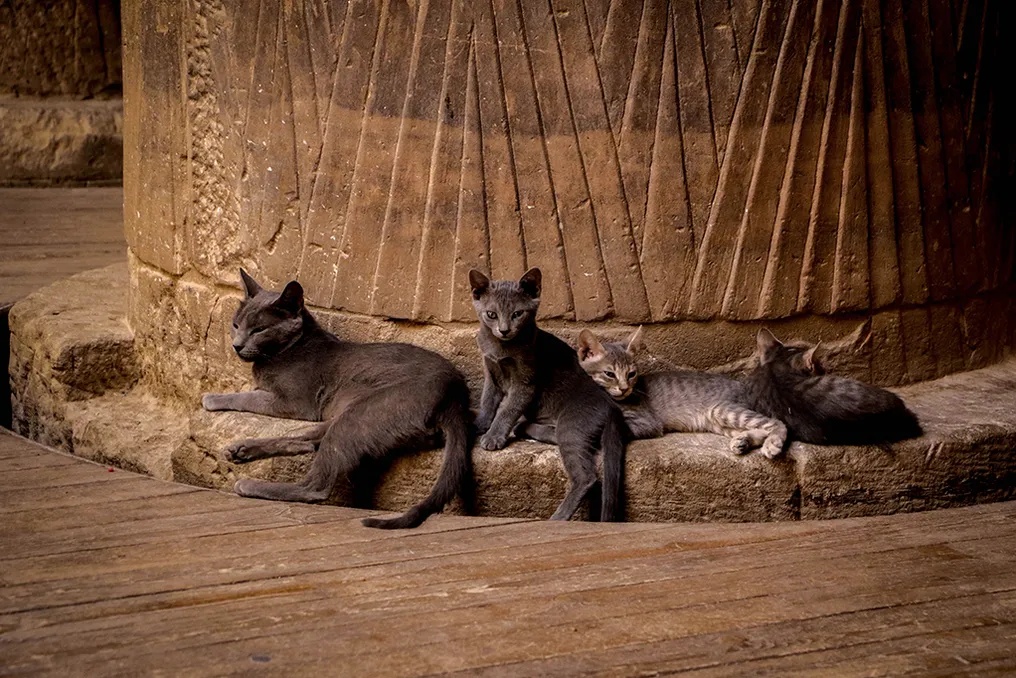
Ancient Egyptians dedicated worship to various animals, each with a distinct sacred meaning: dogs were revered for their hunting and protection roles, falcons symbolized royal power and the sky, and bulls represented fertility. However, cats achieved a unique recognition in Egyptian civilization.
To the Egyptians, felines possessed magical characteristics, appreciated for hunting rodents, birds, and venomous snakes that threatened crops. Their importance was so great that they appeared in funerary texts, such as the Book of the Dead, where the sun god Ra takes the form of a cat to combat the serpent Apep, a symbol of chaos. Since approximately 2000 BC, cats were present in religious and social contexts in Egypt.
Various Egyptian deities were depicted with feline heads, such as Mafdet, Bastet, and Sekhmet, associated with justice, home, and power, respectively. The offering of cats to the gods evolved into a prominent tradition, with many being bred specifically for mummification and donation to temples as an act of devotion.
Given this reverence, it was natural to assume that these animals lived in royal conditions. Greek historians who wrote about Ancient Egypt, including Herodotus, supported this idea, noting that the connection of cats with the goddess Bastet conferred great social prestige upon them; according to him, when a cat died naturally, household members would pluck their eyebrows in mourning.
However, a recent study published in the Journal of Archaeological Science questions the idea that cats destined for the gods enjoyed luxurious lives. Researchers examined 131 mummified cat skulls from the Beni Hassan cemetery in Egypt. More than half of these skulls (81) showed evidence of illnesses, and 14 exhibited signs of injuries.
Animals with missing teeth, signs of gum problems, and deformed bones were identified, which the authors attribute to metabolic or infectious disorders. Some presented healed fractures, while others showed perforations, likely resulting from fights. The dental problems found were comparable to or even less common than those observed currently in wild cat populations.
Bea De Cupere, a zooarchaeologist from the Royal Belgian Institute of Natural Sciences and co-author of the study, told Phys.org that what struck her most was the high incidence of injuries and diseases, indicating that these cats lived in adverse circumstances, something unexpected for animals intended to become votive mummies.
This collection of skulls offers an unusual glimpse into the existence of cats offered to the gods. The study suggests that they probably resided in overcrowded areas, facilitating the spread of diseases and the occurrence of conflicts.
Wim Van Neer, the first author of the study and a researcher at the Royal Belgian Institute of Natural Sciences, explains that the large number of animals would inevitably generate stress and aggression, leading to injuries, while also accelerating the spread of pathologies.
In addition to fights between felines, the findings reveal another facet: marks of blows from sharp objects, such as metal blades, or blunt objects, such as clubs, suggesting injuries inflicted by humans. Van Neer observes that the capture and slaughter of the cats for mummy making did not always follow the plan, which could justify such aggressions. However, the authors do not rule out other possibilities, such as punishments administered to the animals.
Some of these injuries were fatal, while others show signs of healing, indicating that the animals may have survived the attacks. A chemical analysis of the bones of 16 cats provided more information: seven skulls belonged to wildcats (Felis chaus), a larger native species than the domestic cat. These animals had a distinct chemical signature, typical of individuals who lived near rivers or in flooded areas. For the researchers, they were probably captured in the wild and spent little time in captivity before dying.
Of the nine skulls dated by radiocarbon, eight date from a period between 380 and 40 BC. An older skull, from the Third Intermediate Period (c. 1077 to 664 BC), represents an exception, suggesting that the Beni Hassan cemetery may have been used for cat mummification much earlier than written records indicate. It is also possible that this specimen is not from Beni Hassan, but rather from Bubastis, the oldest known cat cemetery in Egypt.
These skulls were located in the Vienna Natural History Museum, where they remained almost forgotten since the 19th century. Based on old correspondence kept in the museum's archives, it is likely they were rescued from Beni Hassan, a cemetery located in the Nile Valley, Egypt.
With 131 skulls, this constitutes one of the largest documented museum collections of Ancient Egyptian cat skulls. However, there is a limitation: 86% of the skulls are from adults, whereas other sets of cat mummies predominantly feature kittens. Researchers speculate that 19th-century collectors may have preferred larger and complete skulls, which might cause the collection not to reflect the entire cemetery population.
Regarding the remaining skeletons, there is no clarity about their fate, with researchers believing they were discarded. Van Neer explains that at that time, the scientific focus was primarily on skulls. This led to the dismantling of animal mummies for skeletal analysis, and what remained often had less noble fates. In 1890, about 180,000 mummified cats from Beni Hassan were auctioned in Liverpool, England, to be used as fertilizer. Currently, the practice of dismantling mummies has been replaced by technologies such as tomography, which allows investigation of what is hidden under ancient wrappings.