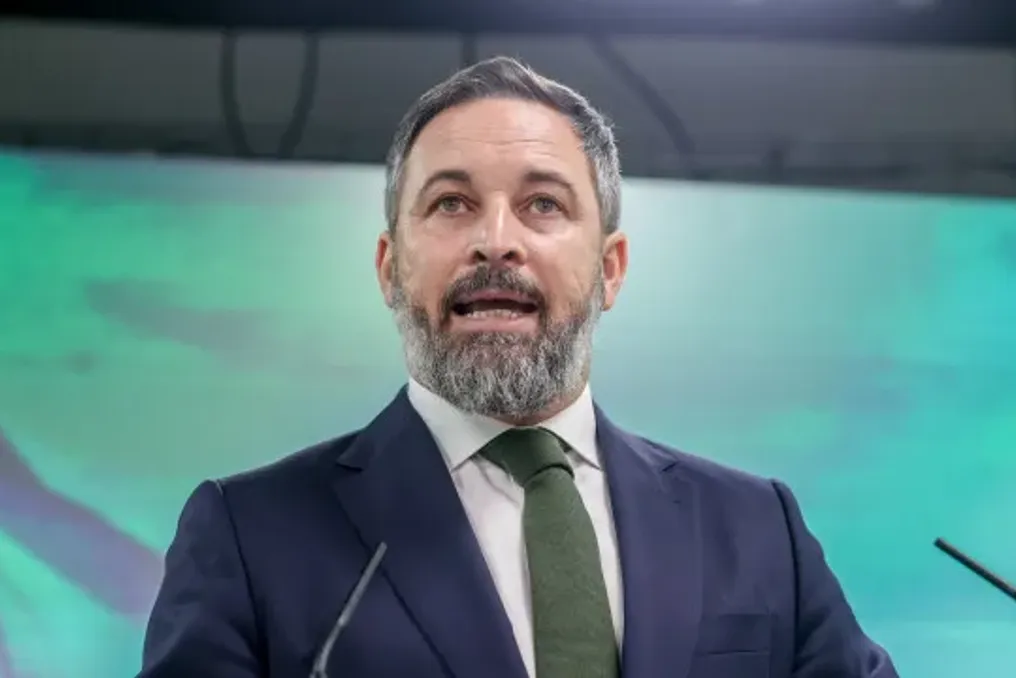
Journalists from the Spanish public broadcaster TVE have accused 'serious errors' being made during an interview with Vox party leader Santiago Abascal. This occurred within a program typically characterized by humor and aimed at an audience selected by the far-right party itself.
On Monday evening, TVE broadcast the interview with Santiago Abascal on the show 'La Revuelta,' hosted by comedian David Broncano. As Spain prepares for the November 29 elections, other political leaders, including a representative from the Socialist Party (PSOE) and Prime Minister Pedro Sánchez, have already participated in the program in recent weeks.
The program is recorded at the Madrid Theatre. At the start of the broadcast on Monday, Broncano himself stated that Abascal's team, 'fearing the constant audience,' had requested that Vox take responsibility for the viewers. Broncano noted: 'They organized it through an agency. We thought it was fine.' Over the hour and a half of the show, according to all analysts, Broncano appeared 'uncomfortable and nervous.'
Abascal was met with applause and shouts of 'president,' and he continued to systematically applaud all of Vox leader's statements. At the end of the program, which devolved into an interview lacking its usual humor or other elements, the comedian admitted to having 'doubts and concerns.'
Broncano told Abascal: 'This decision causes me doubt, worries me, and raises objections because your opinions received unanimous support, and it seems they will be confirmed. If there were a random audience, there would be opinions that wouldn't applaud you. And this is not a real audience.'
The comedian also admitted at the beginning that he felt uncomfortable 'doing a joke program' with the leader of the Spanish far-right party, so he intended to 'do less.' Ultimately, the program turned into a serious interview (or almost a debate between the host and guest, as Abascal qualified it), while journalists and analysts noted that Broncano was unprepared for such a format.
The comedian stated that several years ago he hadn't even considered inviting the far-right party leader, but now believes he has 'more responsibilities while being on public television.'
The TVE Program Information Council (similar to an editorial council representing media journalists) condemned the 'serious errors' made on Monday in 'La Revuelta' and demanded that those responsible be held accountable. The President of the Board of Directors of Spanish public radio and television (RTVE), José Pablo López, acknowledged that 'it was not an ideal platform,' and that the result 'calls for reflection.'
In its statement, the TVE Program Information Council labeled the change in the program's usual audience and the abandonment of humor and entertainment content, which characterize 'La Revuelta,' as 'serious errors.' For the journalists, the program transformed into an 'information space without required journalistic rigor' and 'someone at RTVE allowed the interview to present itself as 'serious',' which caused 'strong discomfort' among editorial staff.
The Council insists that such incidents demonstrate the need for journalists at RTVE to conduct interviews with politicians, especially during election periods, and for public television to produce them fully. 'These conditions were not met. Therefore, we ask those who made these decisions to take responsibility,' the body stressed in the same message titled 'The Importance of Journalism and News Programs for Ensuring Public Service of RTVE.'
The RTVE President acknowledged that 'undoubtedly, it was not an ideal platform' and 'calls for reflection,' but felt that it is easy to comment and make decisions 'post-factum.' He added in a post on the social network X: 'Many will say that saying 'no' is enough. But at RTVE, we do not offer excuses to anyone to shout censorship, nor do we create martyrs in the theatre.'
José Pablo López also expressed support for the host and his team, regretting the 'sharpness' of what Abascal said to Broncano at the end of the interview: 'I wish you luck, because you will need it.' This phrase is interpreted as a threat to the host at a time when polls show an absolute majority for the Popular Party and Vox in the elections, which would allow the far-right party to enter the Spanish government.
Many political figures and other voices also criticized the format of the interview with Abascal on public television. The interview on 'La Revuelta' on Monday achieved a record average rating of 4.8 million viewers.