Brazil and India plan to develop commercial rocket for satellite launches
Read more
Olhar Digital
olhardigital.com.br

Brazil and India plan to develop commercial rocket for satellite launches

Brazil is advancing in an international collaboration aimed at developing a commercial rocket capable of sending satellites into space. This endeavor involves the Brazilian company Concert Space and the Indian company Skyroot Aerospace, with plans to conduct launches from the Alcântara Launch Center, located in the state of Maranhão.

The project's objective is to create a launch vehicle with the capacity to transport payloads exceeding 100 kg. The strategy consists of combining the technologies and knowledge of both corporations to meet the global demand for small and medium-sized satellite launch services.

Discussions between the parties began in 2024 and gained momentum after the Indian company conducted an orbital launch with its Vikram-I rocket in July 2026. The companies formalized this cooperation through the signing of a memorandum of understanding, although no date has yet been set for the first flight.

Rafael Mordente, CEO of Concert Space, stated that the project timeline is contingent upon the completion of the vehicle's qualification and safety phases. The choice of the Alcântara Launch Center has important geographical reasons, as its proximity to the Equator in Maranhão offers operational advantages for certain space missions.

Earth's rotation generates an extra boost for rockets launched in that area, which reduces the need for energy and fuel to reach specific orbits. This characteristic positions Alcântara as a strategic location to serve international clients interested in placing small satellites into equatorial trajectories.

The partnership also aims to explore the global launch market, which already has major players such as SpaceX, Rocket Lab, and Blue Origin. Instead of competing in all niches of this market, Concert Space and Skyroot intend to focus on the specific needs of entities seeking alternatives for putting satellites into orbit.

This initiative represents an additional effort by Brazil to increase its participation in the space industry, particularly regarding the development of launch technologies and the provision of commercial services. In addition to providing infrastructure for space activities, the country seeks to build its own capabilities and participate in higher value-added technological processes.

Currently, the agreement with India awaits the conclusion of technical and commercial studies. The final configuration of the rocket, the required investments, and the operational conditions will be determined as the partnership evolves. Meanwhile, Concert Space's immediate priority remains the completion of the Brazilian Micro-launcher, and the collaboration with Skyroot allows for the expansion of satellite launch capacity from national territory.
Similar stories

Brazil joins international agreement to mitigate space debris and ensure satellite protection
Read more
olhardigital.com.br

Brazil joins international agreement to mitigate space debris and ensure satellite protection

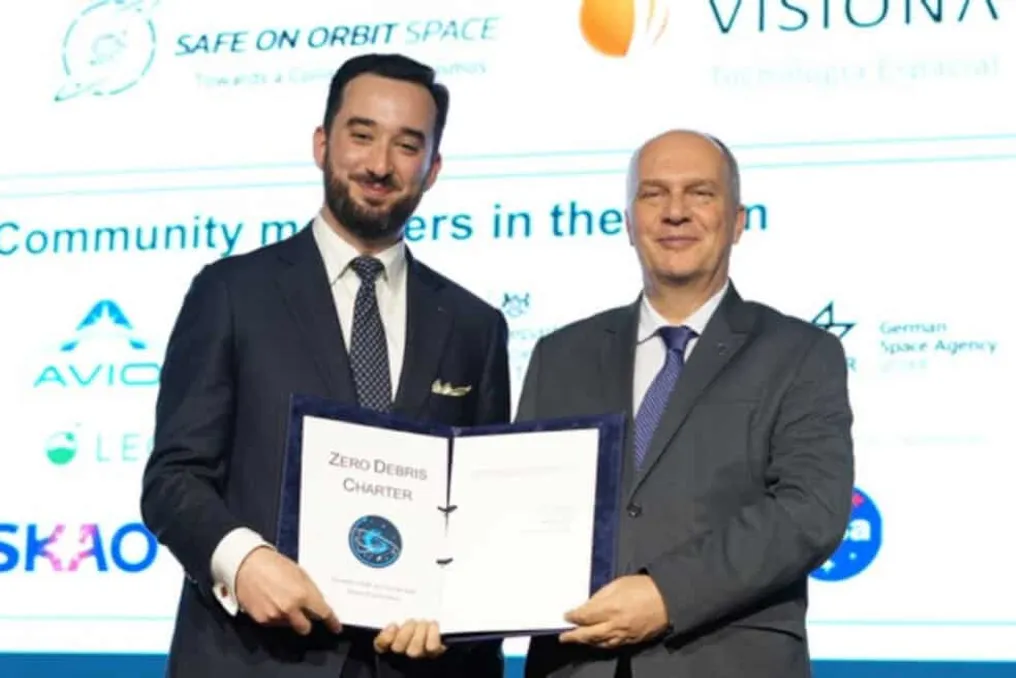
Brazil formalized its adherence to an international pact aimed at reducing the amount of space debris and enhancing the safety of satellites in orbit. This acceptance of the so-called Zero Debris Charter occurred on November 4th during the 8th Space Sustainability Summit, officially ratified by the Brazilian Space Agency (AEB). Brazilian companies Visiona Espacial and Safe on Orbit also signed this document.

This initiative, led by the European Space Agency (ESA), brings together governments, companies, higher education institutions, and other entities in the space sector. The central purpose is to define procedures to reduce debris creation and maintain operational conditions in space until the year 2030.

The agreement stipulates several actions, such as preventing orbital collisions and explosions, improving the monitoring of space objects, and planning appropriately for the disposal of satellites and other equipment after the completion of their functions.

The AEB, an agency linked to the Ministry of Science, Technology, and Innovation (MCTI), announced Brazil's entry into this commitment. According to the Agency's president, Marco Antonio Chamon, sustainability must be a factor considered from the initial phase of space project development.

The Zero Debris Charter constitutes a global agreement designed to encourage more sustainable methods in space activities. Its development began in 2023 through a collaborative process coordinated by the ESA, involving various representatives from industry, academia, and space agencies.

The document establishes collective goals and principles valid until 2030. One objective is to increase the availability of data on space objects measuring up to five centimeters in low Earth orbit and 20 centimeters in geostationary orbit. This would facilitate better risk assessment and maneuver planning to avoid impacts.

Additionally, the Charter mandates that the probability of generating debris from fragmentation or collisions should be less than one event in a thousand objects during their time in orbit.

Space debris comprises artificial artifacts that remain in orbit without performing any operational function. This category includes deactivated satellites, rocket parts, equipment remnants, and waste generated by explosions or collisions.

Even small particles can pose a danger to active satellites, as these fragments move at extremely high speeds, making potential impacts with small objects quite risky. The scenario could worsen, as a collision can generate new fragments, which then pose extra threats to other missions.

The concern extends beyond scientific activities, as satellites are vital for navigation, communication, environmental monitoring, and weather forecasting services. Damage to these devices can impact terrestrial services and infrastructure.

One of the pillars of the Zero Debris Charter is considering the fate of equipment even before its launch. When a satellite completes its useful life, it should not remain indefinitely in an orbital area used by other equipment. Depending on the altitude and mission characteristics, tactics can be implemented to remove it from the operational zone or induce its reentry into the Earth's atmosphere.

The initiative also sets goals for removing objects from low and geostationary orbits, aiming for a minimum success rate of 99% in vacating these regions after missions conclude.

Another aspect addressed is the reduction of risks to people on the surface. Certain components of space equipment may survive atmospheric passage and reach the ground.

It is important to note that the Zero Debris Charter does not have mandatory legal force. According to the ESA itself, it constitutes a collaborative commitment, dependent on the contribution of participants according to their capabilities and restrictions.

In the Brazilian context, the adherence did not come with new regulatory rules for those operating satellites, nor were specific national deadlines defined for the application of the measures. Thus, the country's participation signals an engagement with international space sustainability practices, during a period of growth in orbital activities and increasing attention to operational safety.

China details plan to send astronauts to the Moon with crewed mission by 2030
Read more
olhardigital.com.br

China details plan to send astronauts to the Moon with crewed mission by 2030

China has disclosed new details regarding its scheme to execute a crewed mission to the Moon before 2030. This plan involves launching two rockets, meeting two spacecraft in lunar orbit, and sending a team of three astronauts. Of this group, two individuals will descend to the surface of the natural satellite to conduct scientific investigations.

The planning details were presented by Wang Xiang, who serves as the deputy chief designer of the Chinese crewed space program and is responsible for the lunar exploration project. This presentation took place during the 7th Symposium on Crewed Spaceflights, held in Beijing, China, from October 31 to November 1, 2026.

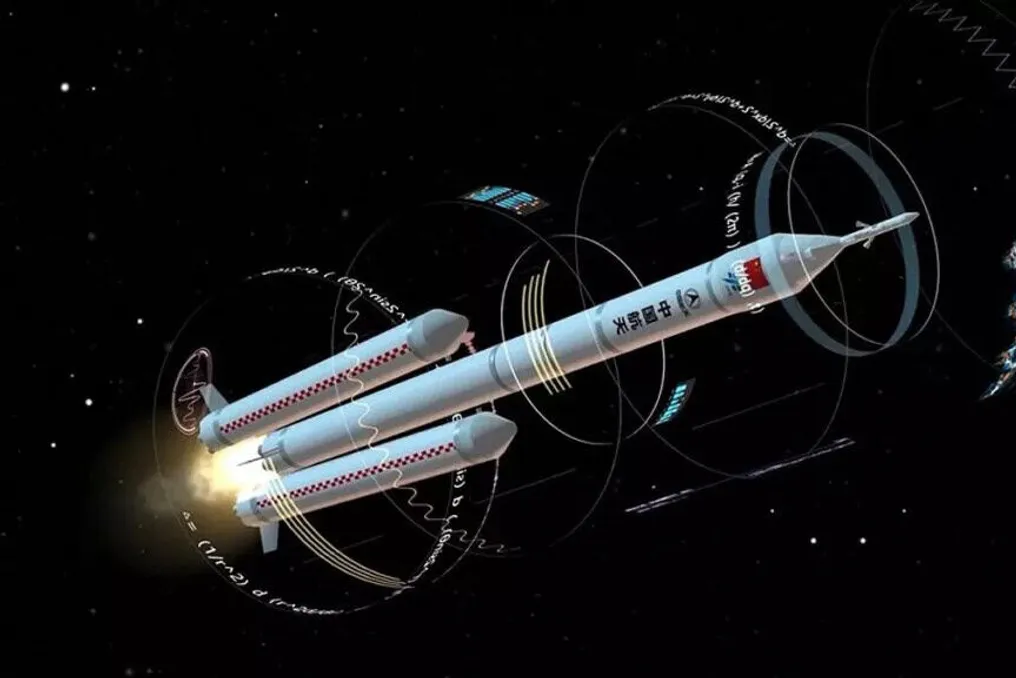
The mission structure calls for the use of two Long March 10 rockets. One of these rockets will be responsible for transporting the crewed spacecraft Mengzhou, while the second will carry the lunar landing module named Lanyue. After both reach lunar orbit, the vehicles must meet and dock. Subsequently, the astronauts will transfer from Mengzhou to Lanyue, which will perform the landing on the lunar surface.

The decision to use two separate launches is linked to the capabilities of Chinese rockets. Instead of concentrating all mission elements into a single vehicle, the country opted to send the crewed spacecraft and the landing module separately. This approach is called lunar orbit rendezvous, requiring an approach and docking maneuver after the equipment arrives around the Moon.

Once the docking operation is complete, two of the three crew members will enter the Lanyue module to begin the descent. The third astronaut will remain in Mengzhou, which will serve as the support vehicle and for the return to Earth. This configuration resembles the architecture used by NASA's Apollo program in the 1960s and 1970s, when the lunar module also separated from the main spacecraft to go to the surface and return to orbit for rendezvous.

Three pieces of equipment are crucial for China's attempt to reach the Moon. The name Lanyue means something close to 'embracing the Moon,' and the design of this module was introduced in 2023, officially receiving this name the following year.

Wang Xiang clarified that the crewed mission will not occur without a series of prior checks, following a gradual progression: first, validating the equipment in near-Earth flights, and only then proceeding to operations in the lunar environment. The established timeline covers several phases, although these dates are merely a disclosed plan and not guarantees of execution.

Some preparations have already been made by China, including emergency escape tests of the Mengzhou spacecraft, simulations of the Lanyue module's landing and takeoff, and a low-altitude test of the Long March 10 rocket. Furthermore, the strategy includes using the Tiangong space station, located in low Earth orbit, to test procedures and technologies before they are sent to the Moon.

This plan positions China in a technological and strategic competition with the United States, which is also seeking to return astronauts to the lunar surface. While the Chinese goal is to reach the satellite before 2030, NASA uses a distinct architecture based on the Orion spacecraft and landing modules developed by private companies.

The rivalry goes beyond merely replicating the Apollo missions; both countries have plans to establish a more sustainable human presence in the lunar region. Within the Chinese scope, the long-term project includes building the Lunar International Research Station, an initiative that envisions collaboration with international partners. The construction of this station is planned to begin in 2031, utilizing the heavy-lift Long March 9 rocket in the future.

Currently, the priority is proving the integrated functionality of all components of the crewed mission. Among the most complex stages of the project are the spacecraft rendezvous, the lunar module descent, and the astronauts' return to orbit.

Brazil prepares transportation of new Inpe Amazônia 1B satellite
Read more
olhardigital.com.br

Brazil prepares transportation of new Inpe Amazônia 1B satellite

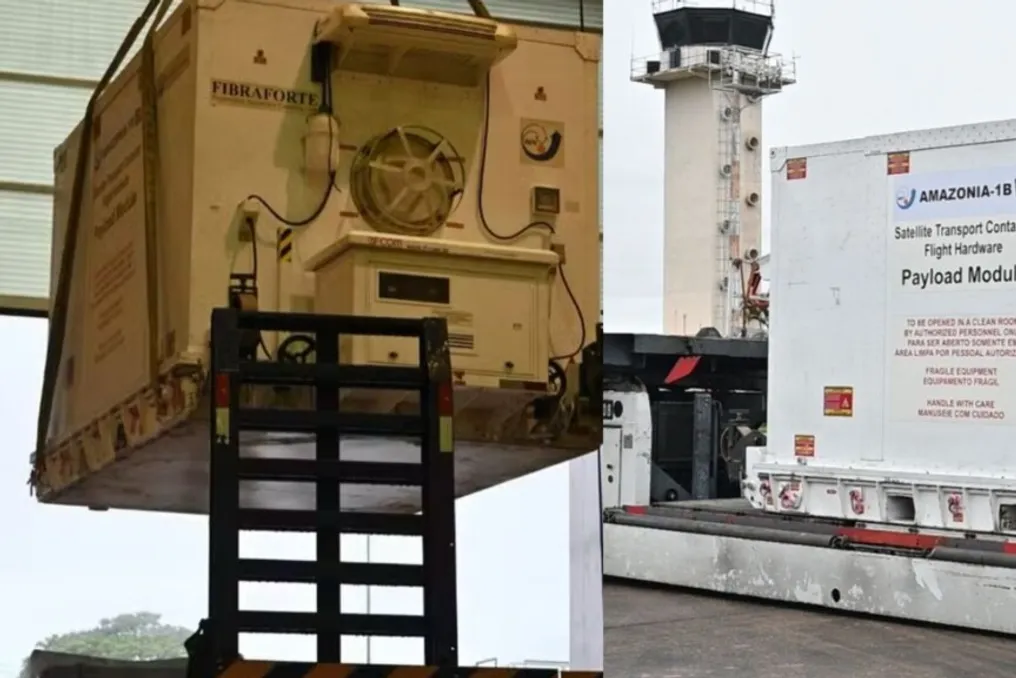
Preparations for the launch of the Amazônia 1B satellite are continuing. Simulations conducted at San José dos Campos Airport (São Paulo state) confirmed that the KC-390 aircraft is capable of transporting the container in which the satellite will be placed.

The next step is to deliver the satellite and equipment for testing into the container. Then, this entire cargo shipment, which is expected to weigh 13 tons, will be sent from the city in São Paulo state to French Guiana, where the launch is scheduled for September 2027.

The Amazônia 1B satellite, developed by the National Institute for Space Research (Inpe), is intended for Earth monitoring. It is the second spacecraft in the Amazônia series created by this institute; the first spacecraft was launched from India in February 2021.

In addition to obtaining Earth images, this new model is equipped with Global Navigation Satellite System (GNSS) Reflectometry technology. This technology uses signals from navigation systems reflected by the Earth's surface to collect environmental information.

The satellite itself weighs approximately 638 kilograms, and the container it will be placed in exceeds seven tons. The KC-390 aircraft was also developed in Brazil by Embraer. According to the company, this aircraft, operated by the Brazilian Air Force (FAB), can carry up to 26 tons of cargo.

This aircraft is used for missions involving troop transport, in-flight refueling, and humanitarian operations. The equipment must be delivered to the launch base in French Guiana in 2027.

Popular