During interactions with voters, Cape Verdean women argued that the time has come for a woman to assume the Presidency of Cape Verde, arguing that female unity could strengthen the fight against issues such as violence against women.
Margarida Fernandes, 61, a resident of Picos on the island of Santiago, expressed the belief that a woman would be beneficial for improving the country, specifically mentioning the need for changes in violence against women. She made this comment while at a hair salon and Joana Rosa, a presidential candidate supported by the Movement for Democracy (MpD), was passing by.
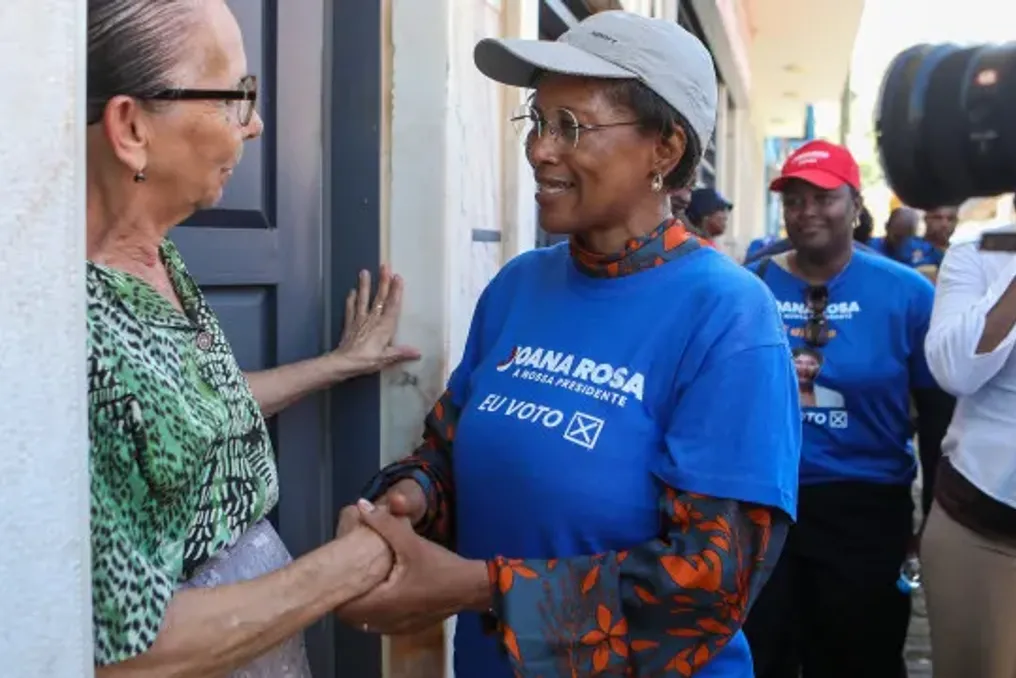
After greeting the candidate, Margarida reinforced the importance of female unity in facing social challenges. Candidate Joana Rosa walked through the streets of Picos, accompanied by approximately twenty supporters wearing blue t-shirts with the inscription 'Joana Rosa, our President.'
Along the way, Joana Rosa interacted with female vendors, children, and curious residents. She reiterated the message that 'I count on your vote of confidence; it is fundamental to have balance' while talking to passersby. The entourage also met supporters of the current President of the Republic, José Maria Neves, who is seeking a second term, one of whom commented that they were present daily, unlike the candidate's recent visit.
Lídia Lopes, 48, saw the possibility of a woman in state leadership as a chance for transformation, especially in increasing job creation. She stated that she hopes Joana Rosa will continue her work, as she believes it is a woman's turn, given women's rights, and that there is much to change, especially in the employment sector.
Dulcineia Semedo, 47, also expressed hope for change, focusing on violence, health, and education as areas needing solutions. She expressed the desire for Cape Verde to change and for Joana Rosa to win to demonstrate female capability, emphasizing that there are many problems to be solved.
Kátia Freire, 40, emphasized that the arrival of a woman in the Presidency must result in dedication and work for the population, declaring: 'We want a woman in power; enough of men. If she wins, she has to work to help the people. It's not just about sitting in power.'
Dina Furtado, 50, encouraged female participation in elections, asking for support for Joana Rosa's candidacy. She expressed hope to celebrate the victory and the need to put a woman in the highest office.
The young Deivany Gonçalves, 26, although seeing a change with the female election, underlined the urgency of creating more job opportunities for young people. He agreed that a change with a woman would be positive but stressed that there are many problems to solve, especially those related to youth employment, stating it is time to have a woman in charge.
In statements to Lusa, Joana Rosa proposed greater investment in North Santiago, covering tourism, agriculture, and other economic sectors. Furthermore, she advocated for public policies aimed at job creation, better salaries, and curbing youth emigration, stating that investing in youth is fundamental and she will demand these investments as President.
Regarding the campaign reception, Joana Rosa reported feeling 'a lot of enthusiasm' and believes that women feel represented by her candidacy. She declared: 'We have to show that we are capable; we have competence, we have strength, we are humble, and we can be where we want to be.'
Candidate Joana Rosa is the first woman to appear on the presidential ballot in Cape Verde, after being a pioneer in seeking a municipal council seat. Previously, she served as a deputy for the MpD and Minister of Justice between 2021 and June 2026, a period when the party lost power to the African Party for the Independence of Cape Verde (PAICV).
The presidential elections on November 15 feature five other candidates: José Maria Neves, supported by the PAICV and currently in power; Gilson Alves; Casimiro de Pina; Antero Tavares, and Loisito Sousa. José Maria Neves seeks a second term, having won the 2021 elections in the first round with 51.8% of the votes, surpassing Carlos Veiga's 42.4%. The abstention rate was 52%. Historically, all presidents elected by universal suffrage in Cape Verde who sought a second term have been re-elected, such as António Mascarenhas Monteiro, Pedro Pires, and Jorge Carlos Fonseca. The most recent data from September indicates there are 426,531 registered voters, of which 76,898 are in the diaspora, representing about 18% of the total.