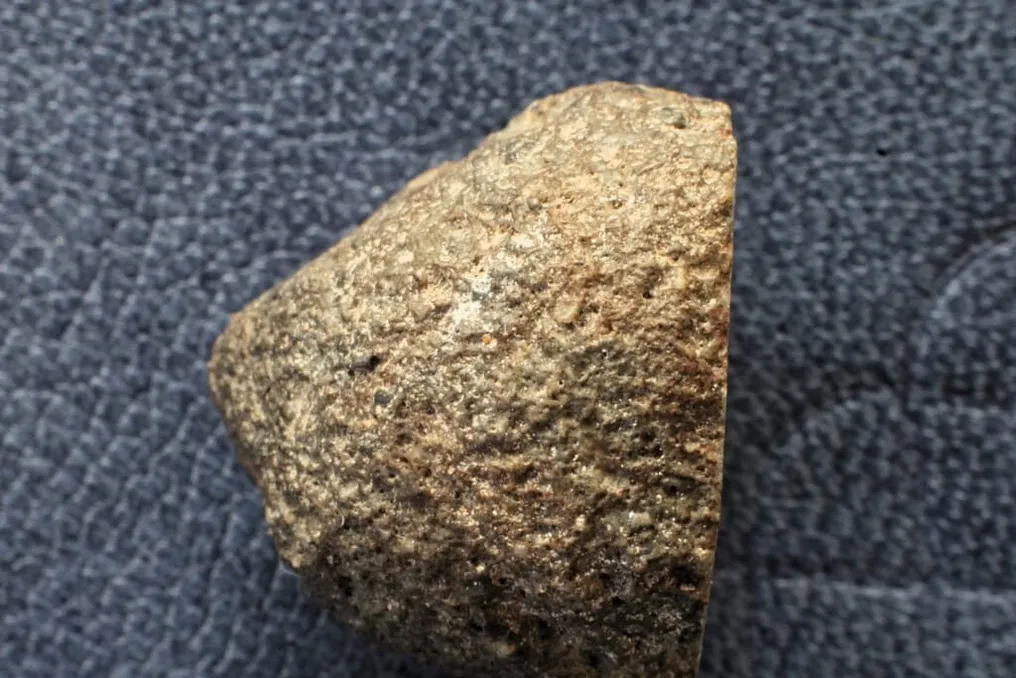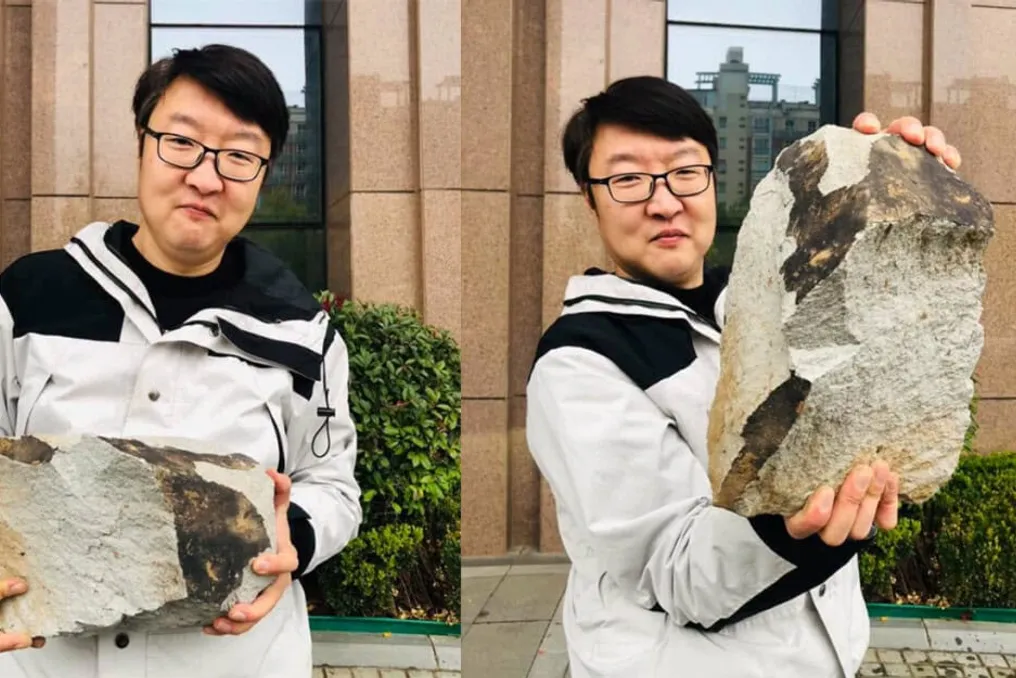
A meteorite weighing approximately 20 kg was located on a farm in Shijiazhuang, Hebei province, in northern China. This discovery occurred two days after the observation of a fireball over Beijing and other cities in the region last Friday, the 6th.
Fireball is the technical term used to describe an extremely luminous meteor that culminates in an explosion. Such events are caused by a space rock passing through the Earth's atmosphere. Due to their high speeds, these bodies generate a plasma bubble that radiates intense light while simultaneously heating and vaporizing much of their material. In cases of larger objects, like the one seen in China, it is likely that some of this material can resist atmospheric passage and reach the ground as meteorites.
The first reports of the phenomenon began circulating on social media early on the evening of Friday, November 3rd. Videos showing a vast sphere of fire crossing the sky were recorded by surveillance cameras, cell phones, and vehicle cameras, with most captured in Beijing, but also in various locations in Hebei province, northern China.
The images revealed the object fragmenting into multiple pieces, leading many researchers to suspect that the event had left meteorites on the ground. Thus, searches were initiated. The next day, meteorite hunter Yu Bin traveled to Shijiazhuang to begin searching for the fragments. Local residents also participated in the search, finding some smaller pieces.
On Sunday, the 9th, Yu Bin located a large fragment, weighing about 20 kg, near a local farmer's residence. According to him, this is the largest piece of the original rock responsible for the luminous phenomenon that occurred last Friday.
Based on preliminary analyses, the meteorite was classified as an L6 chondrite. It is a primitive meteorite whose parent body did not undergo internal differentiation. The letter 'L' suggests a low iron concentration, while the '6' indicates that its chondrules are very fine, almost imperceptible. Chondrules are small spheres of molten material that condensed when temperatures near the Sun decreased after its initial ignition. Their presence confirms that the material is primitive, having never been part of a larger body since the formation of the Solar System.
Although hundreds of meteorites are found globally every year, what drew attention in this case, besides the size of the largest fragment, was the careless manner in which the pieces were collected. Meteorite experts would never use a shovel in the manner shown in videos due to the risk of damaging the fragments.
In another circulating video, a fragment appears to have passed through the roof of a shed and shattered on the floor. People, without due care, are sweeping up the pieces with straw brooms, gathering fragments of a 4.5 billion-year-old rock in the center of the area, which has immense scientific and commercial value. Many viewers fear that these pieces may have been collected improperly and discarded.
Many people are unaware that much of the history of the Solar System's formation can be told thanks to meteorites. The study of these space rocks allows us to know when and how the Sun and planets formed, as well as obtain information about impact events and the chemical composition of the beginning of cosmic history.
Due to this scientific relevance, meteorites are of great value. They help reconstruct the dynamics and history of the Solar System, and some may even help explain the origin of life on Earth. Furthermore, due to their scientific importance and the unique narratives of each piece and fall, they attract collectors and museums, giving them considerable commercial value. Newly fallen chondrites, like the one from Shijiazhuang, can be worth tens of dollars per gram, but some rarer types can exceed the value of gold.
If a space rock is discovered on your property, it is recommended to treat it as if it were gold: collect each fragment with extreme care and store it in a place protected from moisture and brooms. It is essential to seek out an expert to evaluate the material.