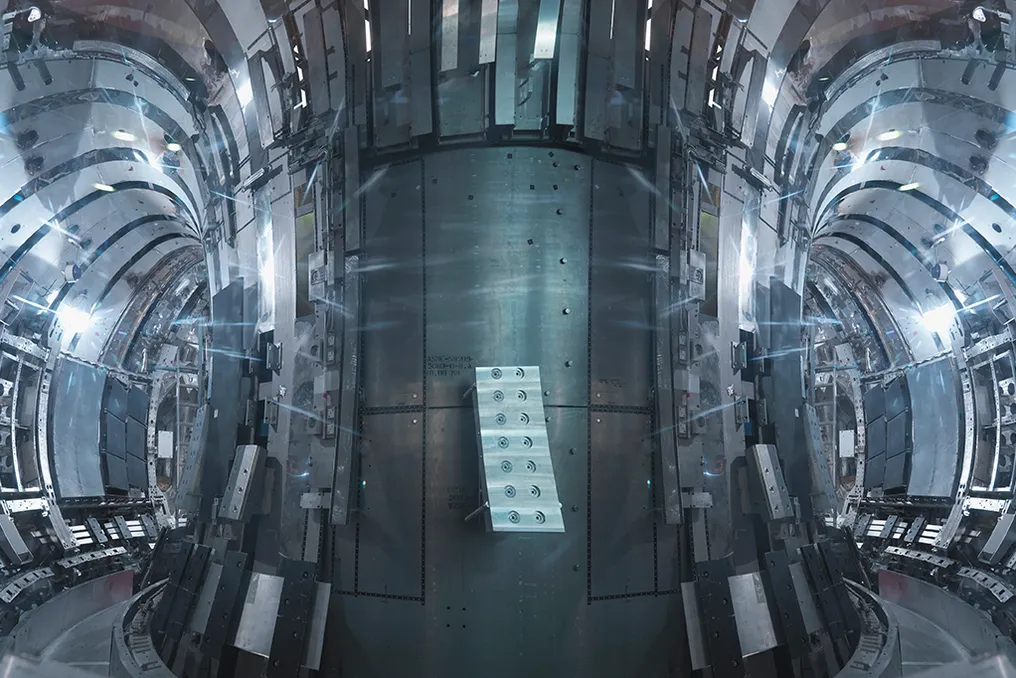
Current nuclear power plants operate based on nuclear fission, a process that involves splitting uranium atoms or other radioactive material to generate heat. This heat turns water into steam, which drives turbines and produces electricity. However, scientists globally are seeking to develop power plants based on nuclear fusion, a mechanism similar to those used in nuclear weapons and the Sun, aiming to reduce the amount of radioactive waste generated by the industrial sector.
Gustavo Canal, a professor at the Institute of Physics (IF) of USP and responsible for the National Nuclear Fusion Program (PNFN), details the distinctions between the two types of plants. He explains that commercial plants use fission, where a heavy nucleus, such as uranium, is struck by a neutron, causing it to destabilize and fragment, releasing energy. The challenge lies in containing the resulting fragments, as they are radioactive and can cause future environmental damage.
In contrast, in fusion, instead of breaking apart a nucleus, a light nucleus, such as deuterium and tritium, is fused. This process generates a helium nucleus, which does not present radiation problems, along with a neutron. Canal points out that most of the energy (about 80%) is released by the neutron, and the total energy from fusion is ten times greater than that obtained from fission.
Deuterium and tritium, frequently used in nuclear fusion tests, are classified as 'hydrogenoids,' which are atoms composed of a nucleus, a single electron, and light nuclei.
According to the professor, nuclear fusion research requires a very high energy consumption, which currently prevents its large-scale commercial application. To initiate the fusion reaction, a gas must be heated to an impressive 150 million degrees Celsius, causing it to reach a plasma state. In this condition, the gas must be kept hot, consuming energy, until the extremely high temperature—ten times hotter than the center of the Sun—allows the fusion reactions to begin.
At the JET tokamak in England, the most significant advance achieved was 70% efficiency in energy production compared to the energy spent keeping the plasma hot. Another approach to inducing fusion reactions is through the creation of high-temperature plasma using high-power lasers. A reactor is under construction in France, under the international consortium ITER, designed to generate ten times more energy than is consumed. This equipment requires the injection of 50MW (megawatts) of power to heat the plasma, which is considered an essential investment to achieve yield.
Thiago Mastrangelo, a professor at the Center for Nuclear Energy in Agriculture (CENA) of USP Piracicaba, states that nuclear fusion energy is reliable and potentially safer than the fission used in conventional plants. Theoretically, fusion plants would be safer; in a conventional fission plant, cooling failures can lead to the melting and fusion of nuclear fuel, potentially resulting in explosions like those seen in Chernobyl, releasing various radionuclides into the water, air, and vapor, as happened in Fukushima.
Mastrangelo clarifies that although the fusion reactor presents risks related to high temperatures and magnetic fields, these are not of the catastrophic type found in conventional reactors. The main byproduct of fusion is helium, an inert gas. However, due to neutron circulation, other materials may become activated, generating some radioactive elements, but on a much smaller scale than observed in a traditional fission reactor.
Besides electricity generation, Mastrangelo indicates that nuclear fusion technology can be applied in other social spheres, such as industry and healthcare. Although the primary focus is electricity, the generated heat can be utilized to produce hydrogen or to desalinate water. Additionally, the neutrons from the fusion reactor can be used to manufacture radionuclides intended for medicine or to create superconducting magnets applicable in MRI equipment.