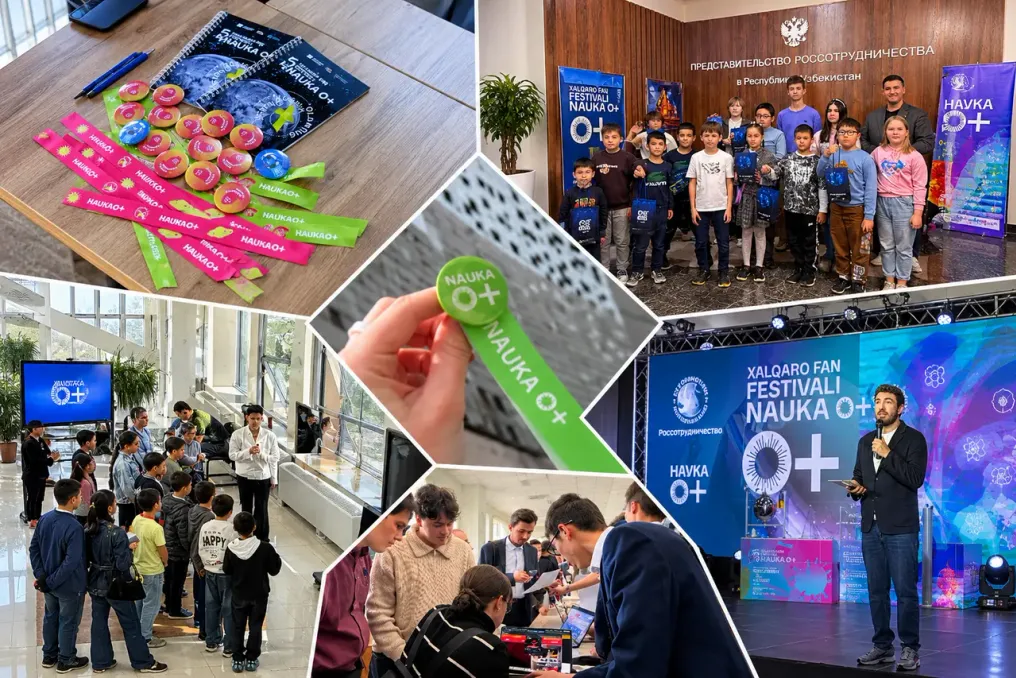
Uzbekistan is hosting the weekly BRICS+ science week from November 2 to 8, during which the fifth international NAUKA 0+ festival will take place in Tashkent on November 7–8. For the first time, the events covered all regions of the country.
The festival program includes 70 popular science lectures, interactive exhibitions spanning over 2000 square meters across 20 different venues, as well as master classes, quizzes, and science shows. The Polytechnic Museum remains the main venue in Tashkent.
The main theme for the festival in 2026 has been declared as 'Your Cosmic Universe,' marking the 65th anniversary of the first human space flight.
The festival is organized by the Ministry of Science and Higher Education of Russia and Moscow State University with the support of the Russian Academy of Sciences and the Academy of Sciences of Uzbekistan. The main partner was the Alisher Usmanov Charitable Foundation in the field of art, science, and sports, and the organizing partner is the Center for Subject Olympiads at the Agency of Specialized Educational Institutions of Uzbekistan.
Rector and Academician of Moscow State University, Viktor Sadovnichy, noted that Uzbekistan is once again becoming one of the key venues for the NAUKA 0+ festival, uniting science popularizers, students, and schoolchildren through a common interest in science and technology. He expressed confidence that the festival's events will strengthen scientific and educational ties between Russia and Uzbekistan, contribute to the development of international scientific dialogue, and inspire a new generation towards research and discovery.
For the first time in Uzbekistan, the 'Future Scientists' competition was held, covering all regions of the country. Semi-finals took place in specialized schools, where participants presented their projects in poster session format. They were evaluated by a jury consisting of researchers from regional universities and industry representatives.
The final of the competition, held at the branch of Moscow State University in Tashkent, gathered over 100 schoolchildren who reached the final stage from STEM centers in Russia, Uzbekistan, and other countries. They presented their work to a jury composed of university and business representatives.
Participants in the festival included Lomonosov Moscow State University, Mirzo Ulugbek National University of Uzbekistan, the branch of MEI National Research Nuclear University in Tashkent, the branch of Dmitrievsky University of Chemical Technology of Russia, Gubkin Russian State University of Oil and Gas, Shenzhen MSU-BIT University, Zaryadye Park, Uzavtosanoat JSC, as well as the companies VOLTBRO and MUR Edu.
Lectures were given by Russian researchers and representatives of scientific and technological companies. Nikolai Nikitin from the Faculty of Biology at MSU spoke about viruses in space and conducted a quiz on the topic. Ivan Panchenko from the Sternberg Institute of Astronomy at MSU discussed gamma-ray bursts—the most powerful explosions in the universe, while Maxim Mironenko from the University's VR Center explained how virtual reality helps in astronaut training.
Ivan Samylovsky and Anastasia Samylovskaya from the Laboratory of Astrodynamics of the MSU Space Research Faculty talked about satellite docking and space solar panels. Yuri Moiseev from the Sternberg Institute of Astronomy and the Space Research Institute of the Russian Academy of Sciences discussed the early history of the universe. Natalia Makarova and Elvira Dorofeeva from Zaryadye Park explored the influence of space on the human body and methods of growing plants in orbit.
Sergey Sergeev, organizer of the 'Future Scientists' competition, gave a lecture for parents and teachers titled 'How to Raise Geniuses.' A Roscosmos cosmonaut spoke about how to become a space researcher and what experiments are conducted in orbit.
Visitors had the opportunity to control a rover at the Martian Polygon organized by the Research Institute of Mechanics of MSU, view rockets, satellites, and unmanned aerial vehicles that have undergone flight tests, and practice drone control using a VR simulator. The MUR Edu team demonstrated underwater vehicles that participated in the Underwater Navigation Grand Prix.
Quizzes on the history of science, astronomy, and virology were also held. At the National University of Uzbekistan and the MEI branch, visitors assembled an atomic power plant model and used virtual reality technology for a virtual tour of the research reactor.
Other events included master classes in Chinese painting and calligraphy, mineral and oil sample exhibitions, CubeSat models, and a mission control center. Uzavtosanoat presented an exhibition titled 'The Evolution of the Wheel.' A forum for science popularizers was held at the MSU branch in Tashkent, bringing together researchers and journalists.
The NAUKA 0+ festival has been held since 2006 at the initiative of Rector and Academician of Moscow State University Viktor Sadovnichy. Over the years, the total audience of the festival has exceeded 100 million people.