Gurnoor Barar discusses best performance in ODI career after victory over New Zealand
Read more
Aaj Tak
www.aajtak.in

Gurnoor Barar discusses best performance in ODI career after victory over New Zealand

In the second match of the series between India and New Zealand, held in Wellington, a thrilling game unfolded. Although the Indian team faced an extremely difficult situation while chasing a small target score, rain ultimately provided salvation, and thanks to the Duckworth-Lewis (DLS) rules, India secured a tense 4-run victory, giving them a comfortable 2-0 lead in the five-match series.

Initially, the New Zealand team was preparing to celebrate a victory, but the intervention of nature completely changed the course of events. The Indian team started its chase of a modest target of 135 runs very poorly.

Jacob Df destroyed the top order of the Indian lineup in the first overs. Captain Shubman Gill was dismissed for zero, and Virat Kohli, who was in excellent form, scored only 7 runs after a magnificent cross-batted shot. Rohit Sharma also struggled but fell victim to Kyle Jamieson. Axar Patel, coming in at number five, also quickly lost his wicket, and India's score rapidly reached 47 runs for the loss of 4 wickets.

Subsequently, Shreyas Iyer (30 runs) and KL Rahul tried to stabilize the innings, but Iyer also lost his wicket due to a dangerous short ball from Jamieson. Naman Dheer and Anshul Kamboj were also dismissed for a small number of runs. When India reached 113 runs, having lost 7 wickets in 26 overs, and needed 22 runs to win, heavy rain stopped the game, making further continuation impossible.

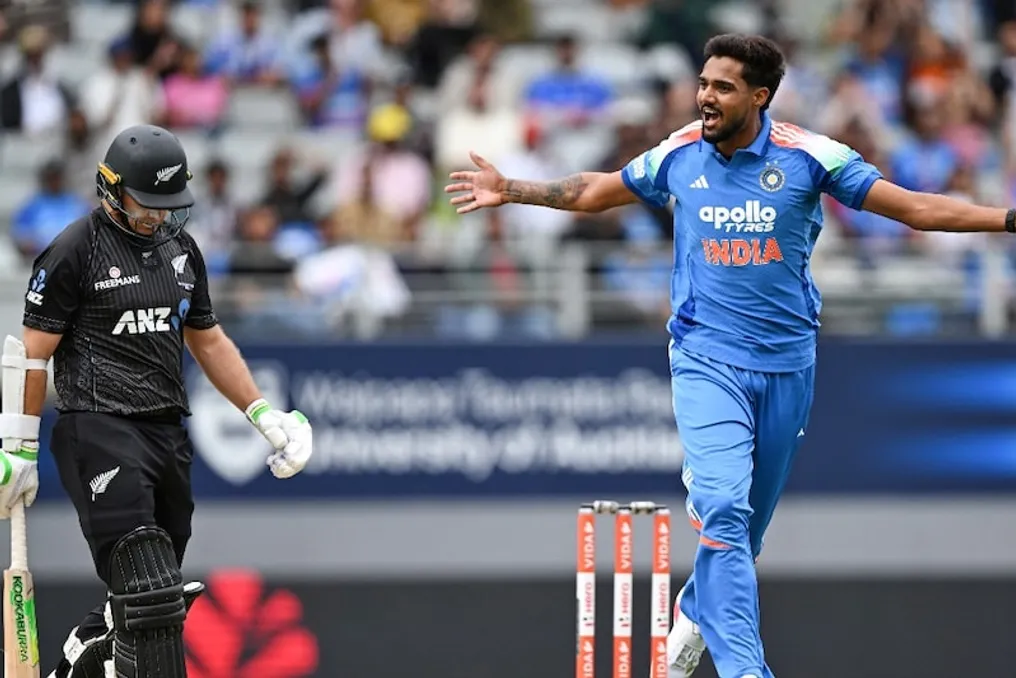
After the match, the young fast bowler, named Player of the Match, Gurnoor Barar, elaborated on his impressive performance and tactics. Barar, who enjoyed playing on the lively pitches of New Zealand, mentioned that he really liked playing there. He emphasized that the extra bounce and pace in New Zealand greatly helped him, as pitches in India are usually flatter, requiring hard-length bowling, whereas here there is a different bounce.

Speaking about planning his bowling, Barar added that for fast bowlers bowling at an average speed of 140 or 142 km/h, aggression is crucial. However, he also noted the necessity of knowing one's limits. He stated that he simply enjoys the game and bowls according to his capabilities. It is worth noting that in this match, Barar took four wickets, forcing New Zealand to retreat.

Similar stories

Anshul Kamboj demonstrated outstanding bowling performance in New Zealand
Read more
www.aajtak.in

Anshul Kamboj demonstrated outstanding bowling performance in New Zealand

Amidst the rapid development of T20 cricket, where batsmen often score heavily, Anshul Kamboj made a strong impression with his bowling performance in New Zealand. During the first ODI match at Eden Park in Auckland, Kamboj took 2 wickets, conceding only 22 runs in 10 overs, resulting in an economy rate of 2.20.

The entire New Zealand team was eventually brought to a score of 185 runs after 40.2 overs. This match marked Kamboj's best performance in international competition at the age of 25, as he prevented the New Zealand batsmen from playing freely. His strength lay in his ability to move the ball in both directions: sometimes it went in, and sometimes it went out. He consistently bowled with good length, slightly shorter, and surprised the batsmen by varying his length, sometimes bowling full and sometimes short, which caused difficulties for the New Zealand players in scoring runs.

Kamboj secured the first wicket against Santner, dismissing the captain. This happened on the first ball of the 27th over when Kamboj's delivery touched the inside edge of Santner's bat and went into the wicket. Santner tried to stop the ball, but it came in and led to the loss of a wicket. After this, Kamboj celebrated very energetically.

The impact of Kamboj's play was also evident in the 28.3 over, when Nathan Smith fell victim to him. Kamboj bowled a good-length ball outside off-stump, which became straight after hitting the pitch. Smith tried to defend by moving forward, but the ball touched the outside edge of the bat and flew towards the second slip. Virat Kohli executed a magnificent one-handed catch there, diving to the right. The third umpire confirmed the catch, showing in replay that the ball was in Virat's hands before it hit the ground. After this, Virat celebrated the moment in his signature style, pointing towards the dressing room.

Indian captain Shubman Gill decided to start the game with bowling after the toss. In this match, India fielded four specialized fast bowlers: Anshul Kamboj, Akib Nabi, Guruon Barar, and Arshad Singh. These four combined had experience in 29 ODI matches. Mohammad Siraj was not included in the starting XI, and instead of all-rounder Nitish Kumar Reddy, spin all-rounder Naman Diar was selected. Facing this young attacking bowling attack, the task was to prove their worth in New Zealand conditions. However, the Indian bowlers did not allow the hosts to play freely.

The entire New Zealand team was brought to a score of 185 runs in 40.2 overs. The most outstanding performance, however, was demonstrated by Kamboj through his restrained bowling. He showed that even in modern aggressive cricket, control of the ball, correct length, and movement in both directions can create serious problems for batsmen. In New Zealand, Kamboj strengthened the trust in the Indian team.

Guruon Barar took 3 wickets, conceding 44 runs in 9.2 overs. Arshad Singh took 4 wickets, conceding 70 runs in 10 overs, while Akshar Patel conceded only 12 runs in 5 overs. Akib Nabi failed to take any wickets, conceding 33 runs in 6 overs.

Although Arshad Singh conceded 70 runs in 10 overs, his performance was not bad throughout the day. His last over proved quite expensive, which affected his statistics, despite him taking 4 wickets. After New Zealand reached a score of 185 runs, a good opportunity opened up for the Indian batsmen to chase the target at Eden Park. Considering how the bowlers restricted the home team's score, achieving this target looks relatively easy for India.

Team management's decision to exclude Vaibha called into question Gautam Gambhir's aggressive strategy
Read more
www.aajtak.in

Team management's decision to exclude Vaibha called into question Gautam Gambhir's aggressive strategy

The Indian team under the leadership of Gautam Gambhir is supposed to play aggressively, dominate opponents, and leave no chance for the rival. However, the team management's decision in the fourth T20 match in Auckland called this philosophy into question. Former player Vaibha Suryawanshi, who created history with Abhishek Sharma by scoring 118 runs in the powerplay in the previous match, was excluded from the starting lineup.

Captain Shreyas Iyer stated the need to remain 'ruthless,' but facing a mountain of 260 runs, the Indian team's game turned chaotic: two wickets fell in the very first over, undermining hopes of victory. The question arises: what kind of aggressive strategy excludes the most explosive player?

When the fielding team New Zealand set a target of 260 runs, the Indian batsmen found themselves in a difficult position. The hosts secured a convincing victory by 87 runs, and India could not get close to the target score. The team, which hoped for a 4-0 win, was forced to accept a bitter defeat.

Gautam Gambhir prefers aggressive cricket, and his team is not afraid to pursue big goals. Batsmen are given the freedom to play openly, and players are expected to take wickets from bowlers. Nevertheless, there is a fine line between aggression and blind experimentation, which the team management may have forgotten to observe in Auckland.

India already had an undisputed advantage of 3-0 in the series. The fourth match provided an opportunity to solidify the success and take the lead at 4-0. However, Gambhir and his colleagues made a decision that caused the most surprise.

In the previous match, Abhishek Sharma and Vaibha Suryawanshi demonstrated excellent performance against the New Zealand bowlers, scoring 118 runs in 6 overs during the powerplay. This was the highest score in the powerplay for any team in T20 international matches. This figure was not just a record; it testified to the strength of the batsman combination that took the opponent out of the game in the first overs. Vaibha and Abhishek understood each other's game and attacked the bowlers.

However, in the next match, this pair was separated: Vaibha was excluded, and Ishan Kishan came in his place. The question is not about Ishan's ability, as he is also capable of winning a match. The question is why Vaibha had to be excluded? Does the record of the previous match hold so little value for the team management? Should a player have to prove their worth in every match, yet historical performance is insufficient to maintain a spot in the team?

Gambhir should ask himself: what was the basis for breaking up the batting pair that set the record?

During the toss, captain Shreyas Iyer stated: 'We don't want to leave any chances. We have already won the series, but I think our half of the job is done. It is important to remain ruthless.' The captain's words sounded impressive, but ruthless play is not achieved through statements alone; it requires clarity in decisions. If the team's goal is not to give the opponent any chances, then why was the opening pair that destroyed the opponent in the previous match broken up?

Iyer is the captain, and the responsibility for team selection decisions lies jointly with the coach and the captain. Therefore, the captain cannot avoid questions about this change. Did he support the decision to exclude Vaibha? Did he not feel that the pair that scored 118 runs should have been retained?

The captain's task is not only to choose between bowling or batting after the toss. He is also responsible for the team's on-field strategy and for trusting the players. When you talk about ruthless play, you must show the same clarity regarding your successful players.

New Zealand, batting first, scored 259 runs in 20 overs, losing 7 wickets. Glenn Phillips scored 107 runs off 49 balls, and Michael Bresshaw complicated matters for the Indian bowlers, scoring 65 runs off 25 balls.

India faced a target of 260 runs. It was a serious challenge, but not insurmountable. Based on how the Indian batsmen behaved when chasing big targets in previous matches, it was expected that the team would start aggressively again. However, Sanju Samson was dismissed after scoring 4 runs in the second ball. Ishan Kishan also returned to the dressing room without scoring a single run on the fifth ball. Abhishek Sharma (27) was dismissed in the fifth over.

The team that habitually scored 118 runs in the powerplay lost three major wickets already in the fifth over. Here arises the biggest question regarding Gambhir's strategy: if the team relied on aggressive play, why was the batsman who best executed this strategy excluded?

India's defeat was not only caused by the decision to exclude Vaibha. The Indian bowlers also failed to cope...

_
Virendra Sehwalag recounted an incident where Shoaib Akhtar insulted him, and Sehwalag responded with 309 runs
Read more
www.aajtak.in

Virendra Sehwalag recounted an incident where Shoaib Akhtar insulted him, and Sehwalag responded with 309 runs

A tense atmosphere is observed among television stars in the reality show 'Rise and Fall,' as they cross boundaries by exchanging mutual insults. Due to the lack of upbringing among the participants, Virendra Sehwalag felt intense irritation and began criticizing everyone present.

Sehwalag shared a personal story from his life that impressed everyone gathered. He recounted how during a match against Pakistan, Pakistani cricketer Shoaib Akhtar insulted him on the field. However, instead of responding with an insult, Sehwalag decided to answer with his powerful bat shot.

Sharing his experience, Virendra Sehwalag told that in 1999, when he was a twenty-year-old man, he went onto the field where Shoaib Akhtar approached him, insulting him, and left him at the crease. Sehwalag then asked if he could play, after which Akhtar left.

Sehwalag further explained that at that moment, he played only two shots and scored one run. He noted that he could have either entered into a conflict, responded with an insult, or hit Akhtar. But he decided that if he had to play against Pakistan again, he would show them such a game that he wouldn't have to use curses, and his bat would speak for itself.

'I scored 309 runs then and answered with my bat. After that, the Pakistani players decided not to insult Sehwalag. They thought that if they insulted him, he would score even more runs against them,' he said.

After Virendra Sehwalag shared this story, all the celebrities expressed their admiration. The clip featuring Sehwalag is actively spreading on social media, and people highly appreciate his action.

Popular