Annie from Thinkerbell Labs helps visually impaired students master Braille script
Read more
The Better India
thebetterindia.com

Annie from Thinkerbell Labs helps visually impaired students master Braille script

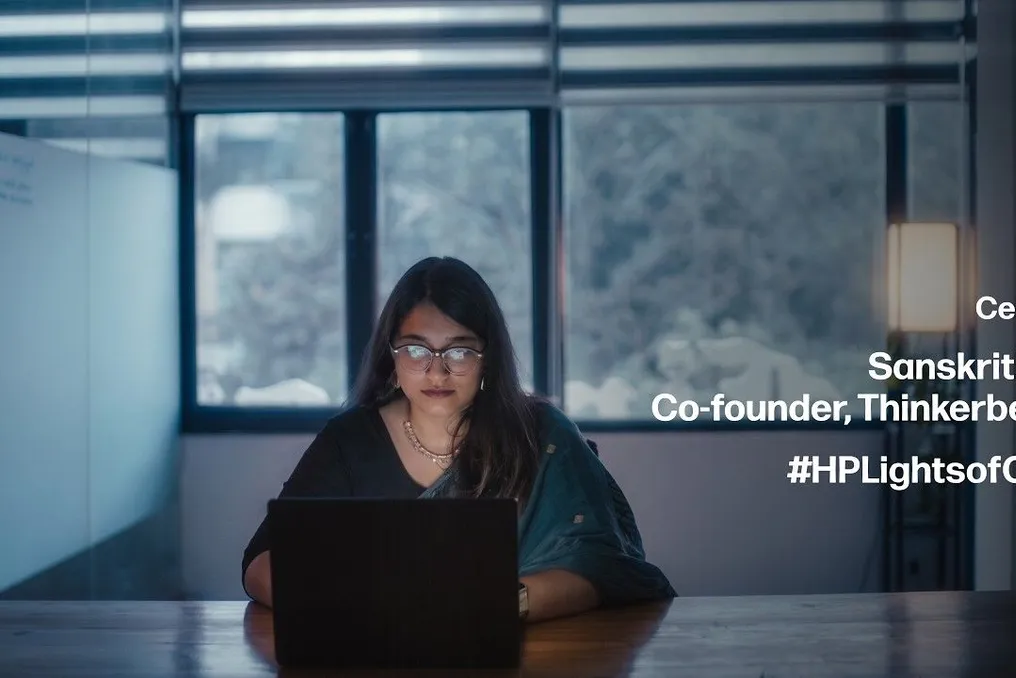
The development of Annie from Thinkerbell Labs aims to ensure that learning to read and write does not depend on the availability of teachers. This innovative system allows visually impaired students to independently learn reading, writing, and typing in Braille.

Annie was created by Thinkerbell Labs and is the result of the collaboration between Sanskriti Doule and Saif Shaikh. Thanks to this development, over 11,000 students have had the opportunity to study in more than 490 educational centers.

Special thanks are extended to the Helen Keller Institute for the deaf and blind for their exceptional support of students, helping them develop and gain greater independence.

In celebration of Diwali, HP is highlighting the theme 'Lights of Change' across India. Users are invited to visit the website https://www.hpcreatorsgarage.com to explore other 'Lights of Change' projects and share the innovations that inspire them. This initiative is implemented in collaboration with @HPIndiaVideos.

Similar stories

Stories from Ilahabad: The City's Intellectual Atmosphere and Cultural Peculiarities
Read more
www.aajtak.in

Stories from Ilahabad: The City's Intellectual Atmosphere and Cultural Peculiarities

In the city of Ilahabad, formerly known as Illahabad, there exists a distinct intellectual atmosphere that manifests even in daily interactions. One day at Ilahabad University, two professors from Delhi, after finishing their business, left the university and asked an auto-rickshaw driver to take them to a hotel. During the ride, they began discussing literature.

The first professor stated that Kafka's sense of Alienation is not merely a social division but an existential state, as his characters are detached from their own existence. The second professor countered, arguing that Kafka's absurdity is not a literary device but an existential reality, citing Gregor's metamorphosis as a metaphor for dehumanization.

The first professor continued the debate, noting that the theme of dehumanization is more characteristic of Dostoevsky, whose worldview does not place human reason on any moral foundation. He emphasized that this forms Dostoevsky's psychological and philosophical universe. He then mentioned the story 'The Stranger,' where the protagonist, whose mother is dying, does not cry, and the world condemns him for it.

At that moment, the second professor tried to recall the author's name of this story but could not, feeling confused. Suddenly, from the next row of the auto-rickshaw, a voice rang out: 'Ah, Albert Camus wrote it!' Both professors were stunned, looking at each other, amazed by the knowledge of the Ilahabad auto-rickshaw driver. They asked him if he read literature.

The author notes that this is the 'Ilahabadi flavor'—the intellect inherent in the water of this city, where even a panas seller can share knowledge unavailable in books because this city is populated by educated people such as Akbar Ilahabadi and Jawaharlal Nehru.

Another story from Ilahabad is recounted: a delegate from Delhi, who was both a poet and a civil servant, approached Firak Gorakhpuri asking him to write a preface to his collection of poems. Firak agreed, writing a brief description of the author. However, the delegate requested the addition of a phrase stating that this poet had given a new direction to Urdu ghazal. Firak replied: 'Son, do not change the direction, or the ghazal will break. What is written is enough.'

This 'Ilahabadi spirit,' passing through Firak, Harivansh Rai Bachchan, and Shamsur Rahman Faruqi, reflects the mentality of a city where people dream of becoming bureaucrats (IPS, PCS). In Ilahabad, there are no unemployed people, only those awaiting results. At the same time, the city is full of people possessing street smarts.

The narrator recalls the times when the city was called Ilahabad and recounts moving to the city to work in a private company's sales department. The first visit was marked by the feeling that it was a small city lagging behind Mumbai, and that people could be easily deceived here because sellers tend to consider themselves smarter than those around them.

One evening, while walking in the park near his home, the narrator noticed a man sitting on a bench at the entrance, next to whom sat a little girl. The girl was reading a book, making notes with a pen. They looked like hundreds of other park visitors, but there was a noticeable sadness on their faces. The narrator ignored them and started running along the park paths.

After several laps, when he started to get breathless, his gaze fell again on the same pair. The girl continued to look at the book, and the man watched her with longing, seemingly wanting to start a conversation but stopping himself. When the narrator finished his run, the man looked at him. As the narrator crossed his path, the man stood up and began to follow him at a quick pace. The narrator became wary, but the man gestured for him to stop, showing despair. They approached a bench located a little further from the girl, and the narrator stopped.

Technology companies use religion as a resource to aid in teaching Artificial Intelligence ethics
Read more
g1.globo.com

Technology companies use religion as a resource to aid in teaching Artificial Intelligence ethics

While technology companies compete intensely to create the most advanced artificial intelligence, the question arises of how to instruct a chatbot to discern right from wrong. One of the answers pointed to is religion.

Chris Olah, co-founder of Anthropic, mentioned that such questions transcend the capacity of a laboratory to answer, stating that religious traditions have dealt with these themes for millennia. This growing proximity between faith and technology has generated little public coverage regarding what these companies understand by religion or what they hope to achieve with this approach.

Executives warn about the destructive potential of AI and debate the need to develop models that follow specific moral principles, increasingly turning to religious leaders and philosophers. The premise is that religion can guide AI development in a scenario where technological fears are spreading throughout society.

Since these corporations are not tied to a single faith, the purpose is generally broader: to establish a set of moral guidelines to steer their models. Sam Altman, CEO of OpenAI, expressed the opinion that ChatGPT should reflect a weighted average of humanity's moral view.

However, experts and practitioners of various beliefs warn that this simplified view ignores the fact that traditions and worldviews often contradict each other, arguing that religion does not operate in this manner.

Religion transcends a mere set of rules

Anthropologist Webb Keane, from the University of Michigan, has criticized for decades the popular notion that religion can be reduced to a mere code of rules, separable from the 'complex, practical, and improvised' ways believers experience their faith. The idea of dissociating religion from spheres such as culture and politics persists, although in reality it is intrinsically linked to both.

There are concerns that by seeking ethical advice from religious leaders, AI companies might reinforce an image of religion that neglects the importance of doctrine, rituals, and the connections among its followers. Keane questions: if we assume that religion offers an isolable set of moral principles, using it to train AIs may end up favoring certain traditions and distorting others, particularly those that are not primarily defined as ethical systems.

He observes that there is a very common way of conceiving of religion as a rulebook, which ultimately is strongly associated with biblical religion and, consequently, Abrahamic religions.

Companies seek to expand dialogue with religious leaders

This search does not imply a lack of variety in discussions, nor carelessness on the part of the companies. Meghan Sullivan, a philosopher of religion and leader of an initiative on ethics and AI at Notre Dame University, assesses the process. Although she does not detail all the consulted traditions, Anthropic reported in a May blog post that it met with 'academics, clergy, philosophers, and ethicists from over 15 religious and intercultural groups,' a number that is expected to grow.

Earlier this year, Sullivan participated in an Anthropic meeting that included Christians from various denominations. Comparing it to previous conversations with other technology companies, she was impressed by the depth with which Anthropic addressed religious matters. The company is known for dedicating great attention to AI safety and ethics.

Sullivan described the company's internal culture as being similar to that of a good university campus, characterized by a group of intellectually curious individuals. She classified the meetings as 'very nerdy—I don't know if that's the best way to describe it—in a good way.' The meeting was structured in two phases: first, the company presented its models in a simplified manner; then, the religious leaders commented and debated the topics presented.

'We discussed all kinds of moral issues that this technology raises—from 'Do humans possess a soul?' to 'Should third-year students have access to a chatbot to aid in literacy?'', Sullivan reported. Representatives from Meta, Google, and Amazon also met with Vatican delegates, while Microsoft has intensified its collaboration with religious communities.

Religion is ancient, but its study is not

Religion is generally perceived as something ancient and universal. However, even influential scholars like the late Jonathan Z. Smith recognize this truth in certain aspects, but argue that this perspective does not encompass all complexity. Smith wrote in 1982 that 'man has had all his history to imagine deities and modes of interaction with them. But man, more precisely Western man, has only had the last few centuries to imagine religion.'

Many contemporary academics share Smith's view, questioning the idea that religions constitute distinct and comparable systems, alleging that this is a modern construction dating back to the 19th century. Tomoko Masuzawa, a researcher of religion and author of 'The Invention of World Religions,' points out that Buddhism and Hinduism, for example, were not seen as clearly demarcated traditions by practicing populations before the arrival of European scholars, adding that 'all these categories were not native.'

These categorizations were consolidated by Western academics over time and only underwent a more systematic reexamination in the second half of the 20th century. These established conceptions of religion—including the ease of comparison between different cultural traditions—help explain why Silicon Valley may not feel the need to define what it means by religion.

In trying to represent multiple viewpoints, resorting to religion becomes a seemingly simple method to integrate diverse thought. Masuzawa comments that 'in some way, religion becomes a way of mapping the world,' as if the entire planet had adopted this map.

By aggregating different views, AI risks erasing particularities. Some experts argue that companies should better specify their terms and goals so that the public understands exactly what is expected of this religious dialogue. Anthropic stated in its release that 'this work is not aimed at aligning our models with the worldview of a specific tradition. We want Claude to be inspired by a wide range of perspectives—religious, secular, and political—with equal depth and rigor.' The goal of these conversations, according to the company, is to promote 'careful and accumulated reflection on how good character is truly formed.'

Large language models function by sequentially predicting which elements are most likely to follow, based on patterns detected during training with vast amounts of human content, including religious texts. Paolo Carozza, a member of Meta's independent oversight board and a legal expert in Catholic social thought and technology, fears that by mixing perspectives, the distinctive characteristics of a tradition may end up being lost. He argues that, in practice, they can be homogenized, resulting in a more generic view or one that favors Western traditions. Carozza concludes that while any living and sophisticated tradition evolves organically by interacting with others, AI tends to simply mix and disorganize everything without conferring meaning.

Grandmother from Kerala teaches children to write in the sand using a traditional method
Read more
www.aajtak.in

Grandmother from Kerala teaches children to write in the sand using a traditional method

In an era where formal education heavily utilizes modern digital tools such as smart classrooms and computers, an elderly woman from Kerala demonstrated a simple and effective teaching method. She does not have expensive blackboards, nor do the children have notebooks and pens; instead, she teaches them to write letters in scattered sand. This charming approach has attracted public attention on social media.

The video, which went viral on social networks, shows how an elderly woman from Kerala, affectionately called Ashatti Ammumma, teaches young children. She brings a bucket of sand and spreads it on the ground. Then, she levels the sand with a small wooden stick to facilitate writing.

After a layer of sand is formed on the ground, she begins writing letters on it using the stick. The children sit in front of her and watch the process of writing letters attentively. Afterward, they try to reproduce these letters themselves with their fingers in the sand.

A distinctive feature of this video is that the children are not just watching but actively practicing creating letters independently. The woman first demonstrates the letters in the sand, and then the children repeat these letters with their fingers. Thus, they receive the necessary writing practice, and their interest in learning is maintained. Another advantage of writing in the sand is the ability to easily erase a wrongly written letter and write it again, eliminating the need for new notebooks or torn pages.

Despite the abundance of modern resources for primary education, this sand-writing method reminds people of older teaching methods. Previously, in many places, children were taught to write letters on the ground, clay, or sand. Ashatti Ammumma's approach proves that expensive materials are not always required to impart knowledge. It is important to explain the material correctly, allow children to practice independently, and teach them patiently.

After watching this video, people on social media praise this woman's teaching style. Some recall their own childhood experiences, while others note that expensive equipment is not necessary for learning. A good idea and the right way of presenting it can be very beneficial for children. Such videos also show that although teaching methods may change, explaining the material with love and giving children the opportunity to learn independently always remains paramount.

This grandmother's little school in Kerala wins hearts precisely because of this.

Popular