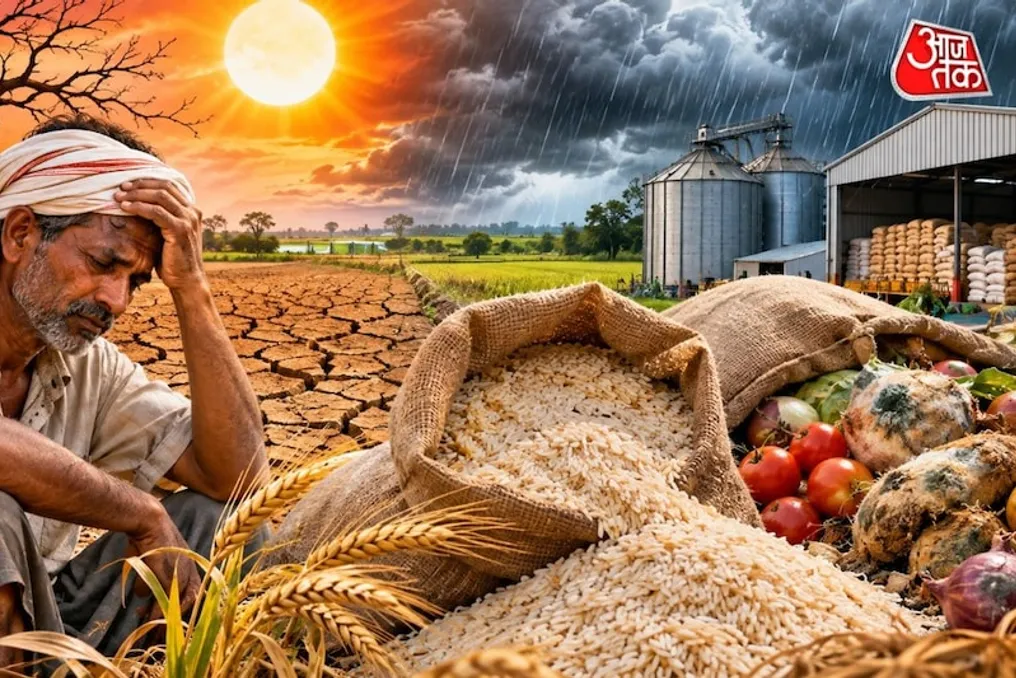
India's agricultural system is suffering from the consequences of climate change, including rising temperatures, irregular rainfall, droughts, and floods, which damage crops. According to a new report on climate trends, the country incurs annual losses of about 13 billion US dollars due to food losses. These losses are mainly linked to inadequate storage, transportation, and cold chain systems.
A drought has been declared in six states, negatively affecting farmers' incomes, food availability, and market prices. The impact of climate change is now extending beyond fields, affecting the entire food supply chain and increasing the financial burden on ordinary consumers.
The report 'From Risk to Resilience: Climate Change, Ecology and the Future of Indian Agriculture' notes that abnormal heat and extreme weather events exacerbate post-harvest losses. The crisis is vividly illustrated by the example of the Azadpur market in Delhi. 2024 was the hottest year in India's history, during which one fruit vendor incurred losses of more than one lakh rupees in a single day because mangoes spoiled quickly due to intense heat. Fruits that usually last two days were destroyed in one day.
Dr. Palak Bhyalan, a leading researcher on climate trends, points out that one-third of all fruits and vegetables spoil before reaching consumers. Furthermore, heat affects milk production, and soil quality deteriorates.
Despite the drought declaration in six states, the situation in other regions also remains challenging. Dr. G.V. Ramanenyulu from the Centre for Sustainable Agriculture notes that the intensity of drought can vary across different areas within the same state. Decades of experience show that this crisis can persist for a long time.
Due to intense heat, there is an annual loss of milk production worth about 2661 crore rupees, equivalent to approximately 18 million tons of milk. 40 percent of the country's livestock population is sensitive to extreme weather conditions. A weak cold chain leads to the spoilage of 40 percent of fruits and vegetables, as well as 5-6 percent of grains. Only 4 percent of fresh produce has access to refrigerated storage.
More than 20 million hectares of agricultural land have been affected by floods, droughts, and other natural disasters. Over the last three decades, the consumption of chemical fertilizers has more than doubled: from 73.5 kg per hectare in 1990 to 199 kg in 2023. Air pollution could feed about 9.4 crore people with products lost because of it. Agriculture accounts for 13.7 percent of India's total greenhouse gas emissions.
Arti Hosla, Director of Climate Trends, asserts that El Niño puts additional pressure on weakened soil and falling groundwater levels, affecting not only fields but also markets, food prices, and inflation.
Experts agree that weather forecasting alone is insufficient. Investment is needed in improving storage systems, expanding agricultural services, market access, and sustainable agriculture. There is a need to strengthen organic farming, crop diversification, weather-based insurance, and early warning systems.
Former Secretary of Agriculture T. Nandakumar called for attention to political risks and decision-making at the local level. Meteorologists emphasized the importance of drought-resistant crops and irrigation systems. The report concludes that instead of compensation after increased risks, investment should be made in proactive risk reduction policies. To ensure India's food security, methods for soil and water conservation, use of modern technologies, and timely assistance to farmers must be implemented.