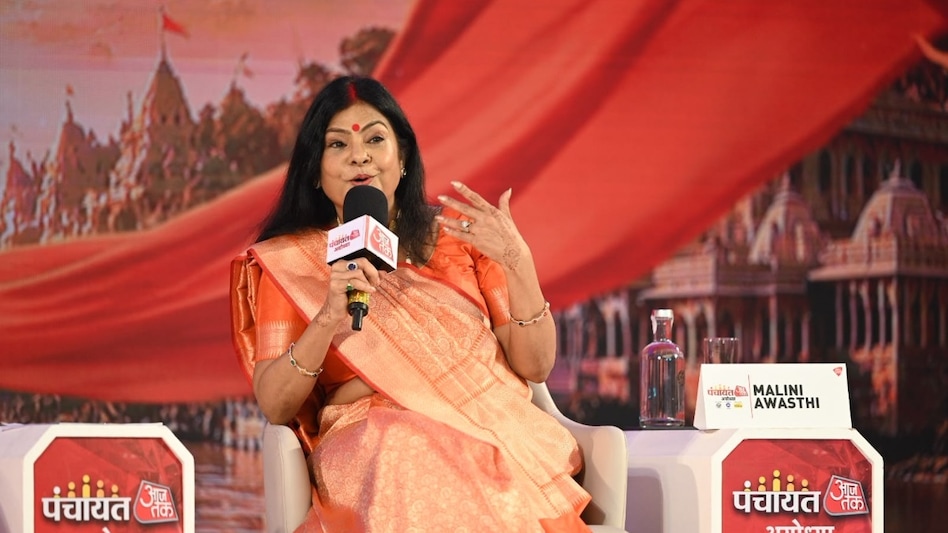
Popular folk singer Malini Awasthi visited Ayodhya as part of the Aaj Tak Panchayat event. During her visit, she discussed in detail the changing face of Ayodhya, the traditions of Dipotsava, Ram Mandir, Indian culture, and folk customs. She noted that Ayodhya, which was once a quiet and dull city, has regained its vibrancy.
Malini Awasthi emphasized that Lord Rama embodies the moral principles and ideals of Indian society. She clarified that Rama goes beyond simple religious belief, being an integral part of the life and values of Indian families.
Recalling her previous days in Ayodhya, the singer shared that about 28 years ago, she had the opportunity to live in the city for about a year and a half. At that time, the atmosphere in Ayodhya was quite melancholic and calm. The viewing of Ram Lalla took place in tents, and the situation regarding state governance was different then. Nevertheless, there was immense enthusiasm among pilgrims during Ram Navami. A large number of people arrived in Ayodhya from Gond, Devipatan, Nepal, and Bihar to celebrate the birthday of Lord Rama.
She stated that the appearance of Ayodhya has changed drastically. The old sadness of the city has disappeared, and now an atmosphere of celebration prevails.
Speaking about the observance of Dipotsava, Malini Awasthi explained that the true meaning of Diwali lies in the return of Lord Rama to Ayodhya after 14 years of exile and the reunion of the family. She added that Diwali is not just a festival of lighting lamps, but also an opportunity to meet loved ones and share joy. According to her, Prime Minister Yogi Adityanath attempted to present this core idea to the world by initiating Dipotsava in Ayodhya. Currently, millions of lamps are being lit during Dipotsava in Ayodhya, and people from all over the world await this event. The goal of lighting 30 million lamps this year symbolizes this enthusiasm.
Malini Awasthi shared a particular aspect of Dipotsava: so far, no unpleasant incidents have occurred during this event. A large number of youth and students participate in lighting lamps with great enthusiasm. She also recalled an old moment on the banks of the Sarayu, when around eight or nine in the evening, people poured oil into extinguished lamps to relight them. In her opinion, this sight demonstrates that for the people, Dipotsava has become not just an event, but a festival of faith and collective participation.
The singer noted that the most beautiful feature of Dipotsava is not only the lighting of millions of lamps but also the presentation of Ramayana and Ram-katha from various countries and cultures around the world. She mentioned that in countries such as Sri Lanka, Indonesia, Russia, and Nepal, Ram-katha is presented in different forms.
Regarding the significance of Rama in Indian society, Malini Awasthi stated that Rama serves as an example for Indian families and life ideals. She said that a child hears the name of Rama from birth in their home. Mentioning Rama occurs everywhere: from greetings from older family members to songs performed during weddings. Thus, a person unconsciously assimilates Rama's ideals.
She emphasized that Rama is an example of an ideal son, ideal brother, and ideal husband in the eyes of Indian society. Lord Rama renounced royal power to fulfill his father's promise and went into exile. During his exile, he formed his own army and fought against Ravana along with the forest dwellers. In Malini Awasthi's opinion, Rama's life teaches every person to live with dignity, self-sacrifice, and adherence to ideals. This is why Mahatma Gandhi also incorporated the concept of Rajya Rama into his thoughts.
Malini Awasthi shared an old experience from her career: about 21 years ago, while recording in Dordsan Delhi, she was opposed to a performance related to the birth of Rama. She wanted to present a skit related to Ram Navami, along with Holi and Phagun songs, but the producer stopped her. He stated that one could not sing about the birth of Rama in Ayodhya because the issue was under judicial review at the time. Malini Awasthi expressed disagreement, noting that the belief in Rama's birth in Ayodhya has existed in folk traditions for generations. She decided to abandon the recording.
She added that social media did not exist back then, so such incidents did not become public knowledge. However, today everyone has a platform to express their opinion. Recalling this experience, Malini Awasthi recounted that about 19 years later, she was given the opportunity to perform in Ayodhya on the occasion of the Ram Lalla appearance festival. For her, it was a very touching and special moment after a long wait.