Argentina offers tax incentives to attract investments in artificial intelligence data centers
Read more
CGTN
cgtn.com

Argentina offers tax incentives to attract investments in artificial intelligence data centers

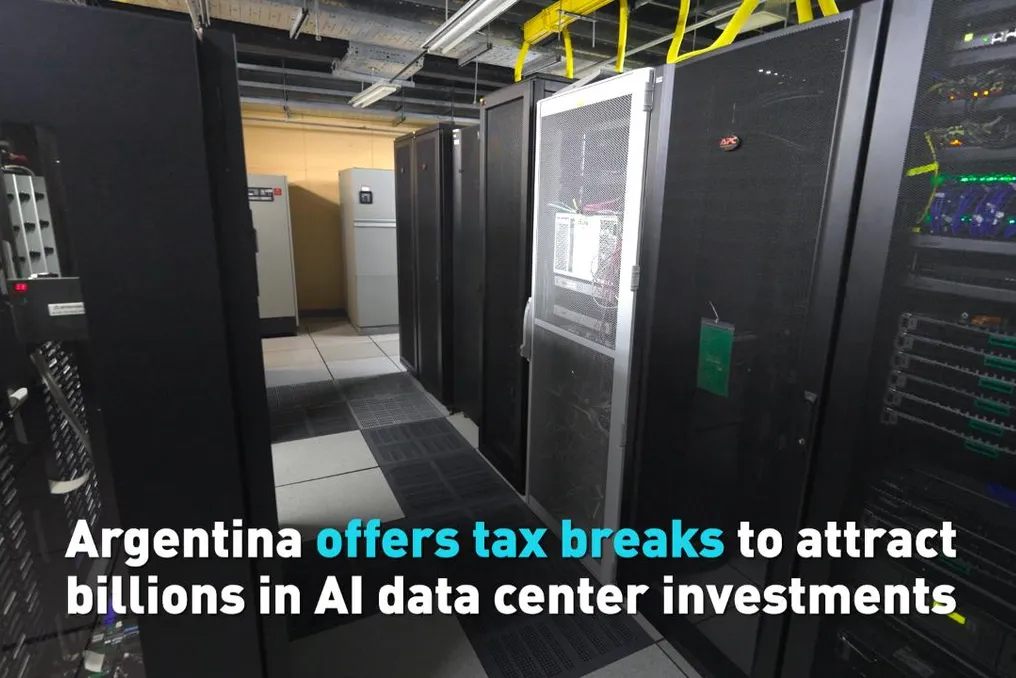
Argentina seeks to attract billions in investment into artificial intelligence infrastructure by offering tax incentives, minimal regulation, and favorable conditions in Patagonia. This move comes against the backdrop of growing opposition to data centers in the United States.

Despite numerous statements about large investments, the expected boom in data center construction has not yet materialized.

Similar stories

Argentina proposes regulatory exemption and tax reduction to attract AI and data centers in Patagonia
Read more
olhardigital.com.br

Argentina proposes regulatory exemption and tax reduction to attract AI and data centers in Patagonia

Argentina seeks to establish Patagonia as an artificial intelligence-focused data center hub. To attract large technology corporations, President Javier Milei has proposed reducing taxes and keeping AI free from regulatory restrictions.

This initiative has generated interest from companies such as Amazon, Google, and OpenAI, but it has also sparked debates about the environmental impacts and the benefits these investments will bring to the local population.

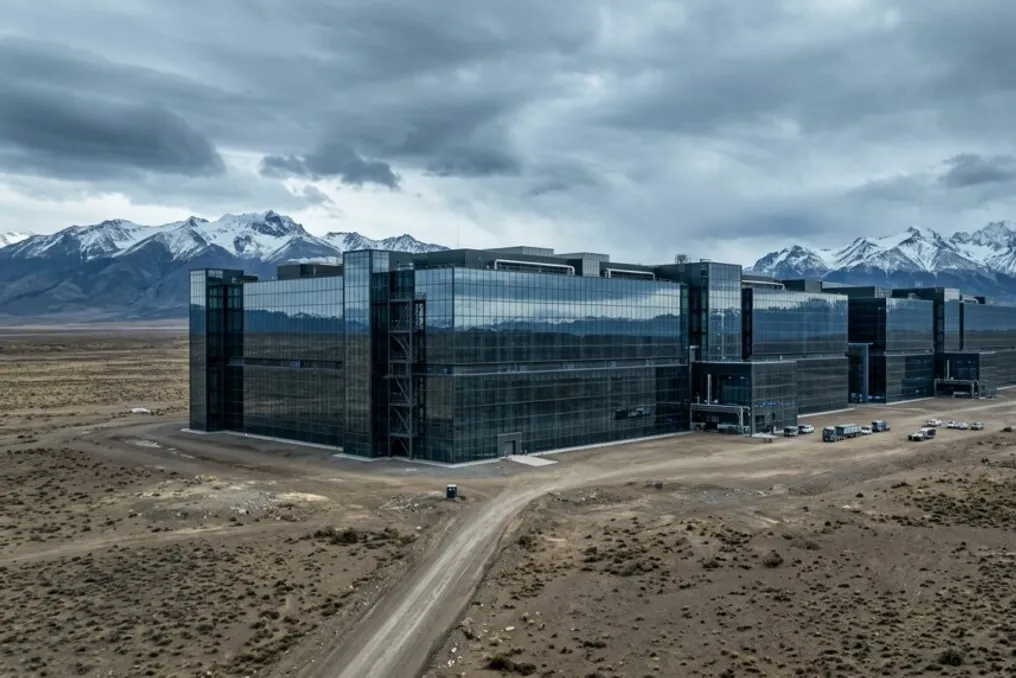
The region possesses ideal characteristics for the installation of these data centers, including vast available land areas, mild climate, strong winds, and access to gas derived from the Vaca Muerta shale formation, a resource that can be used for both energy production and facility cooling.

While communities in the United States and Europe contest new projects due to competition for electricity, the Argentine government is trying to capitalize on these advantages to entice investors. In a meeting held last month with the US Chamber of Commerce, Milei stated categorically: 'We will not regulate artificial intelligence. We will let it be free.'

Visit records provided by the Associated Press indicate that representatives of investors and industry companies met with the president and his team in recent months. Among those present were investor Peter Thiel and delegates from OpenAI, Amazon, Google, and Oracle.

The movement also involves the data center developer Crusoe, which approached Argentine authorities this year to discuss investments supported by the United States government. This company has already participated in the construction of OpenAI's main campus in Texas.

Another project under negotiation is that of Green Capital, a Polish company, which intends to invest US$3 billion (approximately R$16.05 billion) in a complex in Patagonia. This complex would be leased to large technology companies for AI processing, although it does not yet have a defined client.

To make projects of this magnitude viable, Milei advocates for a program that would reduce the corporate income tax rate from 25% to 15% for investments of at least US$1 billion (about R$5.45 billion) directed towards artificial intelligence and other emerging sectors. However, this proposal is still awaiting approval from the Senate.

It is important to note that this tax incentive imposes no reciprocal obligations regarding the use of infrastructure within the country itself. Companies are not required to reserve computational capacity for the Argentine market, nor do they need to report the volume of water and energy their ventures will consume.

The discussion about technological sovereignty concerns researchers and environmentalists. Alan Rocha Varsanyi, a member of the Argentine group Observatorio Petrolero Sur, assesses that the processing capacity will be mainly destined for the international demand of contracting companies, rather than for local technological advancement.

The lack of regulation also raises fears about risks such as cyberattacks and mass surveillance. Nicolás Wolovick, a computer science professor at the National University of Córdoba, expresses concern that the country could become a testing ground for technologies that would not be evaluated in more controlled markets.

In the province of Chubut, Green Capital plans to install its complex in an area of 130,000 hectares, leased from 14 rural landowners. Among them is the family of Francisco Sáenz, an agricultural engineer and sheep breeder, who sees in the venture a new source of income against the decline of livestock farming.

Construction is not expected to begin before 2028. When operational, the campus could demand, in a single year, about 2.7 times more electricity than was consumed by the entire city of Buenos Aires in 2025, according to an Associated Press estimate.

Green Capital assures that it will generate its own electricity through wind turbines, solar farms, and gas generators. Provincial authorities expect the project to attract billions in investment, generate specialized jobs, and create a market for excess wind energy.

However, the assurances presented have not yet convinced all residents of Trelew, a city near the proposed site. Environmental studies are underway, licenses remain pending, and the company has not specified water consumption or the participation of gas in energy generation.

The lack of information has motivated in-person and virtual protests under the slogan 'Trelew Free of Data Centers.' The resistance has also reached Congress, where the opposition managed to alter a proposal to relax rules on foreign land ownership and block Milei's plan that would allow artificial intelligence agents to control companies.
Apple exceeds sales and profit expectations, but AI costs impact holiday sales
Read more
iol.co.za

Apple exceeds sales and profit expectations, but AI costs impact holiday sales

Apple reported exceeding analysts' expectations for its latest financial results on Monday. The iPhone manufacturer stated that it achieved 'record revenue' for the third quarter, covering the period from July to September. Revenue growth was driven by iPhone sales and service income, but increased expenses related to artificial intelligence are expected to put pressure on margins.

CEO John Ternus, who took over from Tim Cook in September, stated in a statement before the analyst call on Monday afternoon: 'We are concluding the year with our most ambitious product lineup to date.' Ternus hinted at an optimistic sales forecast for recent devices, including the foldable Duo, during the holiday season.

Nevertheless, CFO Kevin Parek warned that Apple's gross margin would slow slightly at the end of the year compared to the Q3 margin of 47.9 percent. Parek specified that the expected gross margin would be in the range of 45 to 46 percent. This is mainly due to increased memory costs, as well as expenses related to the launch of Siri AI.

In June, the company updated its digital assistant Siri in partnership with Google, utilizing the Gemini model to enhance the new Siri AI. Apple attempted to dispel investor concerns regarding rising AI costs. Parek noted that, in his opinion, AI provides a compelling reason for customers to upgrade their devices and adopt new features, and also opens up opportunities in third-party applications, partnerships, and proprietary products.

In September, Apple released three new phones—the 18 Pro, 18 Pro Max, and its first foldable phone, the Duo—in addition to two new desktop computers. In October, the company introduced the new smart display HomeView, powered by Siri AI, and the first touchscreen MacBook Pro. In July, the Apple Upgrade program was launched, allowing customers in the US to pay for iPhones or other gadgets through monthly installments.

Apple, which has long been criticized for lagging in the AI race, may benefit from its competitors' significant spending on data centers while keeping its own investments moderate. Analysts predicted that the Cupertino giant would spend $11 billion over the 12 months ending in September, when its fiscal year concludes.

This amount represents only a small fraction of the annual expenditures of Microsoft, Alphabet, Amazon, and Meta, which analysts estimate plan to spend over $700 billion on capital investments this year. These funds are primarily directed towards AI infrastructure, and their volume is comparable to the economies of Argentina or Belgium. In July, Meta announced plans to spend $145 billion this year, nearly double what was spent in 2026. Last week, Amazon announced plans to spend $220 billion this year, and Microsoft expected to spend $170 billion by the end of the year. The latest forecast for Alphabet's spending is between $195 and $205 billion in 2026.

However, the iPhone manufacturer is involved in litigation with one of its close AI partners. In July, Apple filed a lawsuit against OpenAI, accusing the company of organizing a campaign to steal trade secrets from the iPhone manufacturer, as the AI lab attempts to develop its own consumer hardware device. OpenAI's flagship product, ChatGPT, has been integrated into Apple products since 2024.

Uzbekistan Tax Committee Discussed Application of Artificial Intelligence with American Company Governful
Read more
uzdaily.uz

Uzbekistan Tax Committee Discussed Application of Artificial Intelligence with American Company Governful

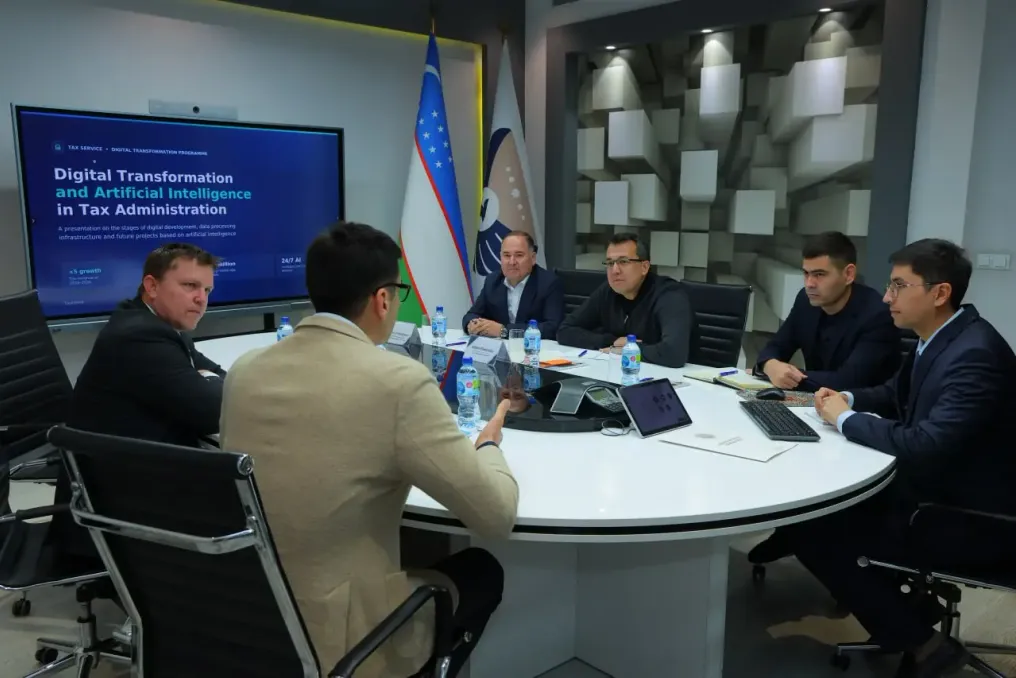
The Tax Committee of Uzbekistan held negotiations with Nate Benson, the global head of projects for the American company Governful. The discussion focused on cooperation in the field of digitalization of tax administration and the implementation of artificial intelligence technologies, according to the press service of the Tax Committee of Uzbekistan.

Governful specializes in artificial intelligence technologies. Benson was in Uzbekistan to participate in the C5+1 forum, which was held in Samarkand.

Alisher Elmuradov, advisor to the Chairman of the Tax Committee; Farrukh Akhmedjanov, Director of the Department of Information and Communication Technologies, and other ICT specialists took part in the meeting. Representatives of the committee demonstrated AI-based solutions that are already used by this agency.

Benson expressed readiness for further cooperation with the Tax Committee.

Popular