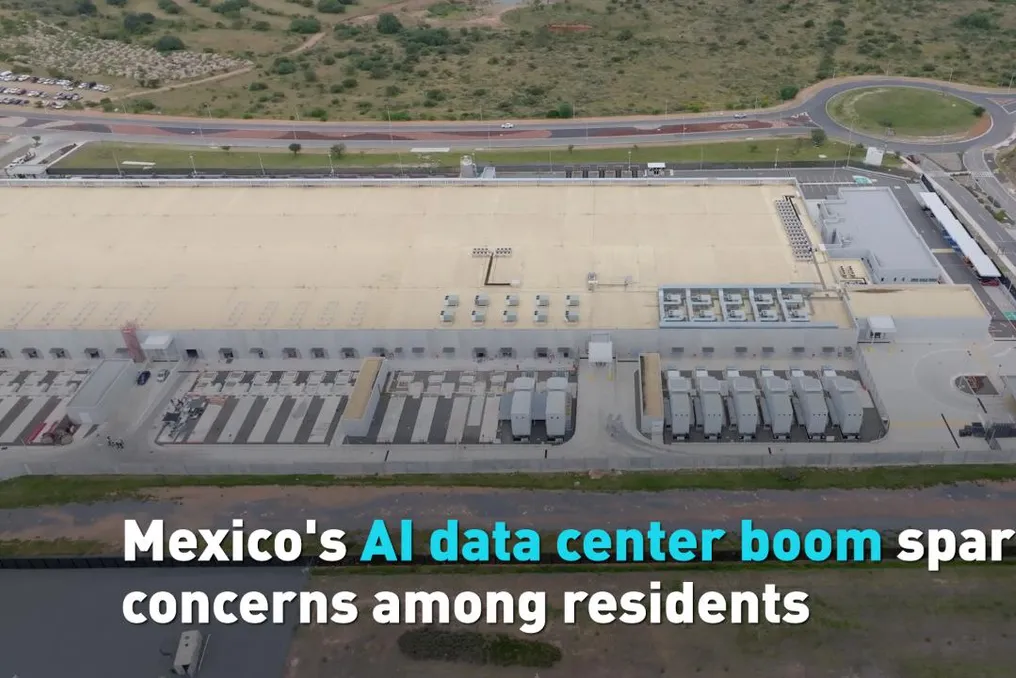
Amid the global race for artificial intelligence development, there is a sharp increase in the construction of data centers. Mexico seeks to utilize the potential of this growing industry. However, in central Mexico, where most of these facilities are concentrated, local residents express concerns about the impact of this boom on their communities.
Similar stories

The main problem with artificial intelligence lies not in the model itself, but in the data infrastructure
Despite the growing availability of artificial intelligence models, turning them into reliable commercial products remains a complex task, especially when enterprises face fragmented data infrastructure.
At the TechSparks 2026 event, Michael Cronin, Vice President of Sales for Asia Pacific, Japan and India at Couchbase, participated in a discussion with Shivani Mutanna, Senior Director of Strategic Content and Video at YourStory. They discussed the transition of AI from the experimentation stage to full production, management challenges, customer experience, and the increasing role of India in AI innovation.
For decades, large corporations have implemented various databases and highly specialized solutions to solve specific problems. While each solved an immediate issue, the result was often a fragmented data layer composed of multiple systems that interact poorly with each other.
Cronin considers this fragmentation a serious obstacle to AI adoption. He cites industry estimates suggesting that 70–80% of AI development projects never reach the production stage, and MIT research showed that 95% of such projects do not become profitable.
Couchbase's operational data platform is designed to address this problem by helping companies consolidate their data infrastructure. Instead of trying to fix everything at once, Cronin advised companies to start small, recommending that founders and enterprises struggling with data layer fragmentation first choose the most critical use cases.
He cited the example of UK retailer Tesco, which has a large Global Capability Center (GCC) in Bengaluru. Many of this retailer's systems negatively impacted the customer experience, especially during peak shopping periods like Black Friday and weekends. Tesco began consolidating its data layer, starting with one instance and one use case before expanding efforts across its entire technology stack. This consolidation allowed the retailer to process millions of transactions per second with less than a millisecond latency. In Cronin's view, this example demonstrates how companies can begin solving the fragmentation problem through one use case before scaling changes across their entire operation.
The pressure associated with developing AI products has prompted many enterprises to prioritize models and applications. However, pilot projects are often conducted on small datasets in controlled environments, which does not prepare organizations for real-world production demands. Cronin pointed to the growing scale of machine traffic. He stated: 'In eighteen months, machine traffic surpassed human traffic on the internet. That is the scale of AI. That is the scale of machine speed at which businesses must operate.'
When AI applications encounter real-world workloads, fragmented data systems can prevent them from functioning reliably at scale. The increasing use of AI agents exacerbates this issue. As agents become more autonomous and take on decision-making functions, enterprises must ensure they can access the necessary data within appropriate governance structures.
Fragmented systems can hinder communication and management, limiting agents' ability to act autonomously. Cronin also urged enterprises to reconsider their approach to allocating AI investment. While models evolve rapidly, corporate data remains a critical asset. He emphasized: 'Models can be rented. The best model today is yesterday's newspaper. The true asset for an enterprise is data.'
As enterprises began to realize that fragmented data was slowing down their AI initiatives, many responded by adding APIs and connectors to link existing systems. However, Cronin warned that this method could create additional complexity instead of solving the core problem. Every extra connection increases latency, risk, and creates another potential point of failure.
Instead, he recommended consolidating the data layer so that AI applications and agents could interact with it more directly, bringing data closer to the customers. According to Cronin, many enterprises, including large GCCs in India, are currently re-architecting to eliminate data fragmentation. Without these changes, further investments in AI development may lead to the same problems.
Data consolidation can also improve customer experience by helping systems handle growing demand, remain available, and respond quickly. As customers expect more from AI-based services, having data at the edge is becoming increasingly important.
Cronin noted that business cultures vary across the Asia Pacific region, but fragmented data infrastructure remains a common challenge for AI adoption. At the same time, India is emerging as a vital hub for AI innovation and decision-making. He noted that 80% of Couchbase's top 50 global customers have a significant presence in India, with much of their AI innovation and leadership based in the country. Couchbase is also expanding its presence in India, moving its Asia Pacific headquarters to Bengaluru. Among Couchbase's corporate clients in India are Air India, Airtel, BigBasket, and Mahindra Finance. In Cronin's opinion, India's role in global business extends beyond cost savings; innovation, leadership, and important business decisions are increasingly happening there. He mentioned Air India's next-generation entertainment platform, which is built on Couchbase. This platform aims to provide passengers with a personalized shopping and entertainment experience even without network connectivity on board the aircraft. For Cronin, this project illustrates how Indian enterprises are using technology to enhance customer experience in real-world operations.

US election results may influence infrastructure regulation and artificial intelligence development
The outcome of the mid-term elections in the United States, scheduled for this Tuesday (the 3rd), could potentially affect the advancement of a bill that proposes to change federal environmental licensing rules for energy infrastructure projects. This occurs against the backdrop of growing electricity demand needed to power data centers supporting artificial intelligence expansion.
The Bipartisan American Accessibility to Economy and Employment Act (BAAJA), developed by Republican and Democratic lawmakers, aims to alter environmental assessment and authorization procedures for large enterprises. This initiative combines changes across various legislative acts and seeks to reduce the time required for infrastructure projects to move from planning to implementation.
The text of the bill is the result of negotiations between four senators holding leadership positions in the committees on environment and public works, as well as energy and natural resources: Shelley Moore Capito and Mike Lee, who are Republicans, and Sheldon Whitehouse and Martin Heinrich, representing Democrats.
One of the key goals of BAAJA is to establish deadlines for federal environmental reviews. According to the text, the analysis of major projects should generally be completed within one to two years. The proposal also provides for closer coordination between government agencies, limits certain avenues for judicial challenge, and sets conditions for increasing the reliability of issued licenses.
The bill amends provisions in three federal environmental laws: the National Environmental Policy Act (NEPA), which regulates the assessment of impacts from work and projects; the Clean Water Act, which protects water resources; and the Endangered Species Act, aimed at conserving endangered animals and plants.
According to analysis, this reform could change the approach to analyzing projects affecting natural areas, waterways, and animal habitats. The stated goal of proponents is to prevent the endless delay in obtaining construction permits due to successive administrative stages and legal disputes. However, environmental organizations question whether reducing these stages will lead to diminished opportunities for public participation and oversight.
The proposal also concerns electricity transmission. BAAJA provides for changes to the operations of the Federal Energy Regulatory Commission (FERC), expanding its authority to authorize certain interstate lines if governmental processes stall. The initiative also adjusts criteria for such enterprises and aims to facilitate the connection between producing and consuming regions.
This aspect is particularly important because expanding electricity generation itself does not solve supply problems. Energy produced at a power plant must reach consumers through a grid capable of transporting large volumes over long distances. Without transmission lines, new generation projects may face difficulties connecting to the system, even if they have production capacity.
According to Thiago Maia, a physicist with master's and doctoral degrees in nuclear physics, an oil engineer, and an MBA holder in project management, simplifying licensing could help overcome some of these obstacles. In an interview with Olhar Digital, he explained that the construction of power plants, substations, and transmission lines could accelerate due to reduced approval times.