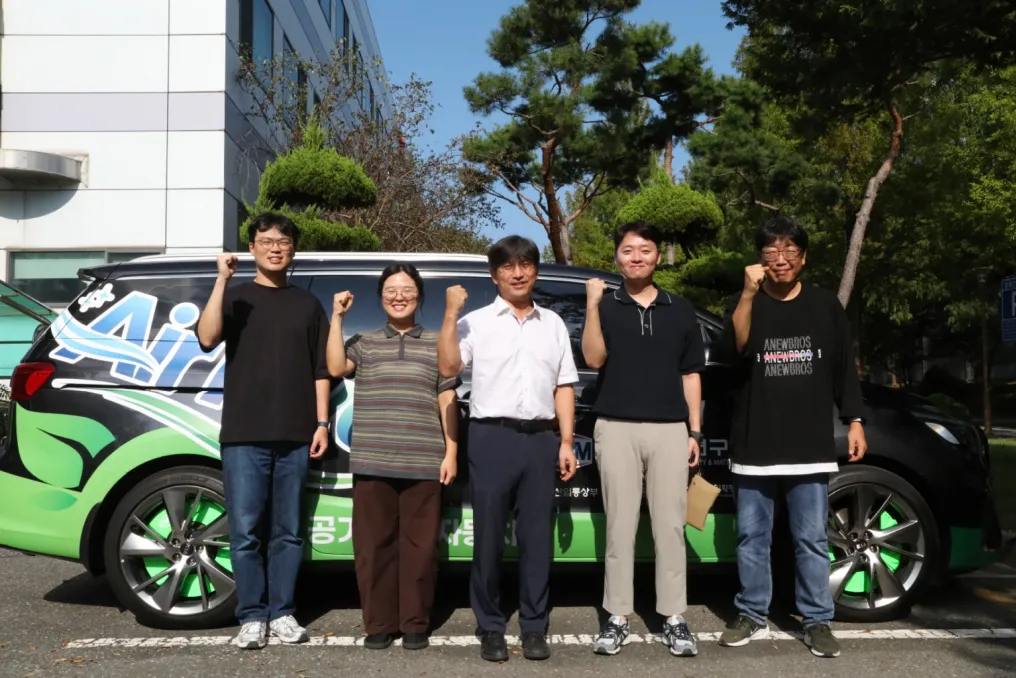
Korean Kit Transforms Regular Cars into Urban Air Purifiers
Read more
AutoPapo
autopapo.com.br

Korean Kit Transforms Regular Cars into Urban Air Purifiers

Researchers from South Korea have developed a kit that allows standard cars to be converted into urban air purification devices. The Korea Institute of Machinery and Materials (KIMM) created this system, which is capable of removing fine particles from the air while driving and collecting brake dust directly at the source.

The system was tested on two models: the Hyundai Sonata sedan and the Kia Carnival minivan. It utilizes existing vehicle components such as the front grille, braking system, and radiator fan.

The front grille functions as an electrostatic precipitator. Carbon filaments charge incoming particles, and plates with an opposite charge retain them. According to KIMM data, this system removes at least 95% of fine PM2.5 particles and 99% of particles between 2.5 and 10 micrometers at speeds of 30 km/h and 50 km/h. Each car can filter approximately 1800 cubic meters of air per hour.

Because the movement of the car itself pushes air through the grille, the kit does not require an additional road ventilator, and fuel consumption during tests changed by less than 1%. When the car is stationary at a wireless charging base, the radiator fan performs the function.

It is important to note that the 95% figure refers to the air passing through the grille; the system's impact on overall street air quality has not yet been measured.

The second component is designed to collect dust generated by the friction of pads and discs. Since these particles are already electrically charged, a collector installed behind the caliper uses charged plates to attract them, requiring no suction pump.

During standardized WLTC testing, the device collected 22.2 mg of dust per kilometer, achieving an average capture efficiency of about 61%.

In Europe, Euro 7 regulations come into effect on November 29th, which for the first time sets limits on brake dust for new models: 7 mg/km PM10 for internal combustion engine and hybrid vehicles, and 3 mg/km for electric vehicles.

Currently, this kit remains a research and development project, and information regarding partners, timelines, or cost has not been disclosed. The team plans to conduct further durability testing of the system under real road conditions.

Similar stories

Air pollution level in Delhi reached dangerous level, GRAP rules enforcement intensified
Read more
www.aajtak.in

Air pollution level in Delhi reached dangerous level, GRAP rules enforcement intensified

The air pollution level in Delhi has reached an extremely high figure. According to data from the Central Pollution Control Board, the Air Quality Index (AQI) was 349.

Due to the worsening pollution situation, GRAP rules were tightened starting November 1st. The administration is conducting thorough checks of vehicles. Violators are subject to fines and confiscation.

NGO suggests limiting plug-in hybrid tanks to 15 liters to encourage electric use
Read more
autopapo.com.br

NGO suggests limiting plug-in hybrid tanks to 15 liters to encourage electric use

The non-governmental organization (NGO) advocates that plug-in hybrid vehicles should have a fuel tank limited to 15 liters. Although these models promise to operate exclusively on electricity in urban environments, reality shows that many owners rarely connect the cars to the electrical grid, resorting to gasoline use.

To promote this change, the European NGO Transport & Environment (T&E) recommends that governments across the continent offer incentives only to models with a maximum tank capacity of 15 liters, given that the current average is 51 liters.

With a smaller tank volume, a driver who chooses not to recharge the battery would have to refuel 57 times a year, compared to the 17 times currently recorded. The total fuel cost would remain unchanged; the strategy aims for the inconvenience of going to the gas station to motivate the driver to use electric charging.

This proposal is based on consumption data collected directly by the vehicles themselves and compiled by the European Environment Agency. According to T&E, plug-in hybrids registered in 2024 emitted an average of 145 grams of CO2 per kilometer during actual use, a value almost six times higher than the 24 g/km established in official homologation.

This discrepancy occurs because official standards assume that these cars will travel more than 80% of the distance in electric mode, when in reality, this proportion was only 27%. As a result, they emitted only 14% less than combustion and conventional hybrid cars, contradicting the official promise of an 83% reduction.

Large capacity tanks intensify this problem. In Europe, Chinese manufacturers such as BYD and Chery, which owns the Omoda and Jaecoo brands, dominate sales in this segment with models offering over 1,000 km of total range, thanks to tanks close to 70 liters.

The 15-liter limit is associated with other requirements proposed by T&E. By 2030, the NGO wants there to be a minimum real electric range of 200 km, support for fast charging exceeding 100 kW, and an electric motor with a power at least three times greater than that of the combustion engine.

With 15 liters and a consumption of 14.9 km/l when the battery is discharged, the vehicle could travel approximately 220 km using only fuel, which is comparable to the distance traveled in electric mode.

It is important to note that this measure is a recommendation from the NGO and not a regulation from the European Union. However, the debate is relevant to Brazil, given that Chinese plug-in hybrids are among the best-selling electrified vehicles in the country.

Popular