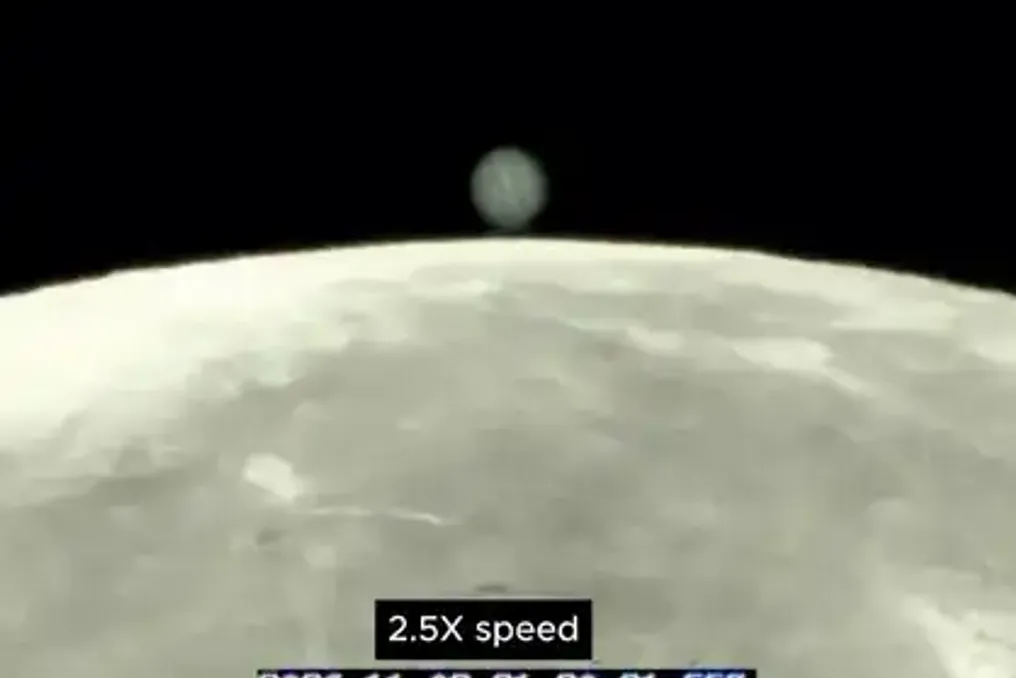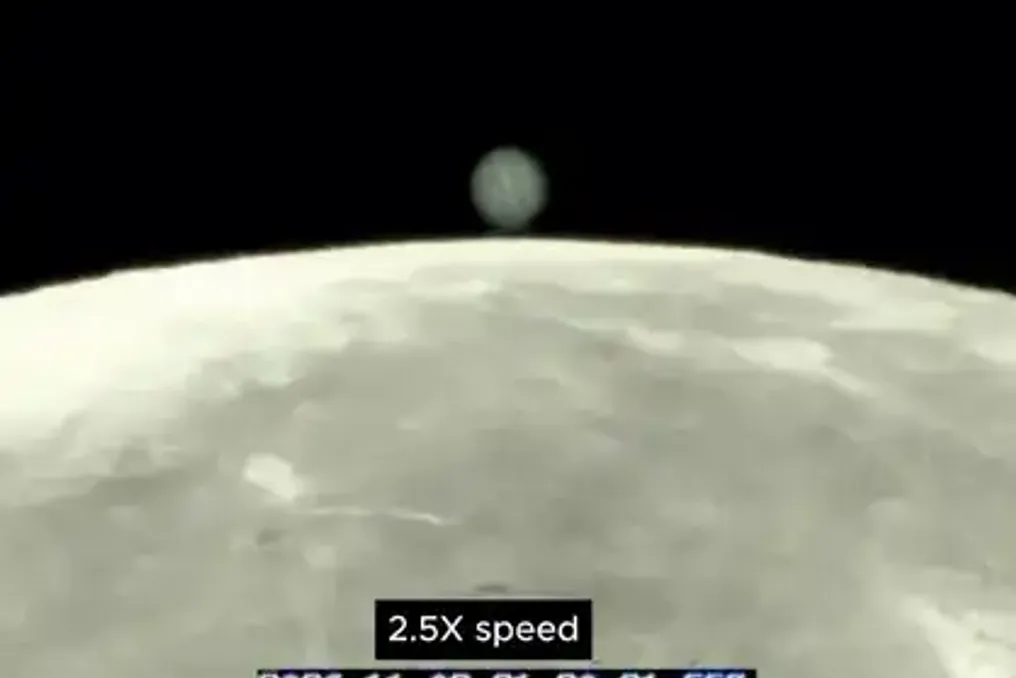
According to Olhar Digital, on Monday (the 2nd), the Moon passed in front of Jupiter, causing a phenomenon known as a lunar eclipse, which can only be observed in specific regions of Earth.
In Kuala Lumpur, Malaysia, where it was already early Tuesday morning (the 3rd), astrophotographer Shahrin Ahmad captured a striking effect during this event. In the resulting images, the planet appeared as if it were melting, disappearing behind the edge of the Moon.
A lunar eclipse occurs when the Moon passes in front of another celestial body, temporarily obscuring it from observers on Earth. Since the visible position of celestial bodies depends on the observation location, this phenomenon cannot be recorded across the entire planet simultaneously.
The visibility zone for the Jupiter lunar transit this week covered island nations such as the Maldives, Sri Lanka, Seychelles, and Mauritius, as well as Reunion, a French territory in the Indian Ocean. In southern and southeastern Asia and Oceania, the transit occurred during the day, which made observation difficult due to the brightness of the sky.
In Brazil, the celestial bodies did not come into contact, so no eclipse occurred. However, the Moon and Jupiter were very close to each other, in a configuration called an astronomical conjunction.
Other specialists and astrophotography enthusiasts worldwide were also able to capture this moment. Michael Theo from Ipoh, Perak, also in Malaysia, managed to capture not only the Moon and Jupiter. He reported to the platform EarthSky.org that during this lunar transit, two Galilean moons of the gas giant were visible. 'At the ingress phase (upper line), Io moves west of Jupiter, while Europa passes over the planet's surface. But at this moment, Europa was not visible due to resolution limitations, poor visibility conditions, and low contrast with the Jovian disk. At the egress phase (lower line), Io, trailing Jupiter, was still blocked by the Moon, while Europa appears, emerging from the eastern limb of Jupiter, thanks to much better visibility conditions and greater contrast with the darker Jovian limb.'
A recording by Atarva Maurya from Bhadohi, India, shows the Moon and Jupiter very close to each other in the sky, clearly demonstrating craters on the lunar surface and the characteristic bands of the planet in the background.
Jeljeta Walinski, at the Desert Bloom Observatory, Arizona, USA, photographed the Moon, Jupiter, and Mars. 'Sometimes astrophotography teaches us that capturing the universe is not always about magnification. Sometimes we need to broaden our perspective to appreciate the overall picture.'
Nishat Khan shared a picture taken in Vaughan, Ontario, Canada, on Instagram.
The phenomenon captured by Ahmad is an expression of the so-called black drop effect, which is mainly known from planetary transits when a planet passes between the Earth and the Sun.
According to Marcelo Zurita, president of the Paraiban Astronomy Association (APA), member of the Brazilian Astronomical Society (SAB), technical director of the Brazilian Meteor Observation Network (BRAMON), and columnist for Olhar Digital, no optical equipment can create images with absolutely perfect focus. Differences in focal lengths of frequencies, such as infrared and ultraviolet, can generate very weak secondary images that usually go unnoticed.
'This creates a kind of 'ghost' that we barely see in the image because it is very faint, very dim. But since this effect occurs in both bodies, in this case the Moon and Jupiter, when the 'ghosts' of each approaches and overlaps each other, it ultimately creates a slightly brighter bubble that expands the objects next to each other,' he explains.
This effect became particularly famous during the Venus transits in the 18th century. Since the planet has a dense atmosphere, observers of that time attributed the deformation to the presence of this layer of gases. However, observations also held significant scientific value: calculating the distance between the Earth and the Sun.
Zurita emphasizes that the idea originated with astronomer Edmund Halley, who proposed using parallax for such a measurement. This initiative led to the organization of expeditions in different parts of the world to observe the transit of Venus. Nevertheless, the deformation caused by the black drop effect complicated the determination of the exact moments of the planet's entry and exit from the solar disk.
'Halley suggested observing the transit of Venus as a way to measure the distance between the Earth and the Sun using parallax. Expeditions were then organized in different parts of the world to observe this phenomenon, and when it happened, it was impossible to determine the exact moments of Venus's entry and exit from the solar disk due to this effect known as the black drop,' the specialist explained in detail.'
The hypothesis that Venus's atmosphere caused the deformation lost its validity in 1999 when NASA's TRACE (Transition Radiation and Anisotropy Explorer) probe observed the same effect during Mercury's transit across the Sun. Since the planet has virtually no atmosphere, it was proven that this characteristic is not necessary for the phenomenon to occur.