Uzbekistan issued 432 subsoil use permits in ten months
Read more
UzDaily
uzdaily.uz

Uzbekistan issued 432 subsoil use permits in ten months

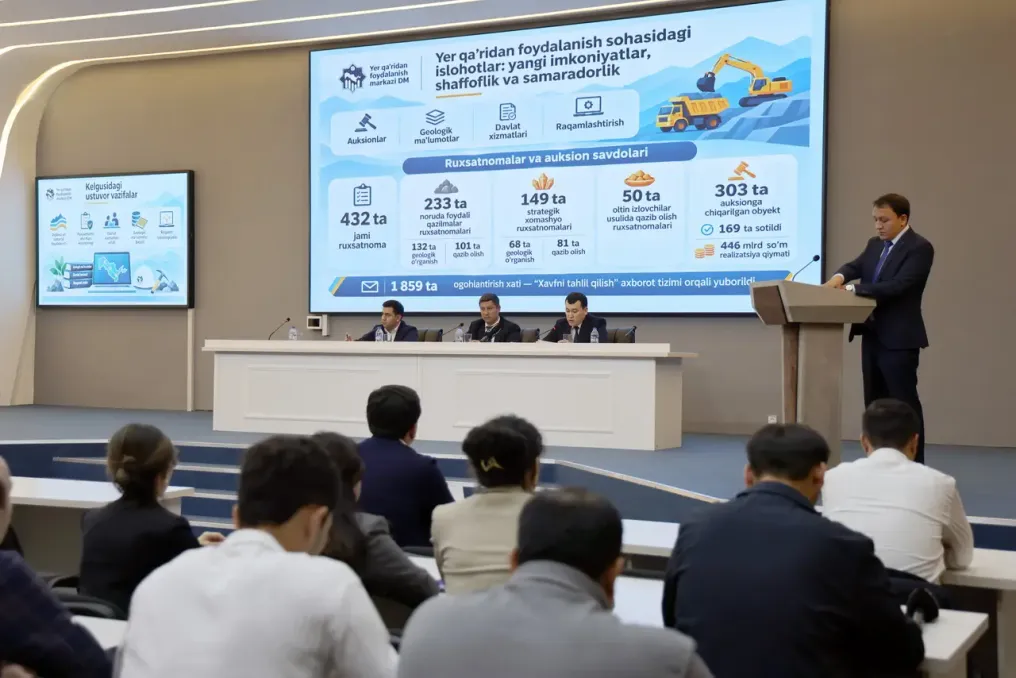
The Ministry of Mining and Geology and its subordinate state institution, the Subsoil Use Center, held a press conference in Tashkent on November 6. The event discussed reforms in the field of subsoil use, permit issuance procedures, auction transparency, access to geological information, and digitalization of public services.

Bahodir Rakhimov, head of the Ministry's Department of Mining and Geological Control and Non-metallic Raw Materials, along with deputies of the Center, Feruz Badalov and Yurabek Azimov, Center employees, media representatives, and entrepreneurs participated in the conference.

Permits and Auctions

From January to October 2026, the Center issued 432 permits for the use of subsoil plots. Of these, 233 concerned sites with non-metallic minerals, including 101 permits for mining and 132 for geological exploration. Another 149 permits were issued for plots with strategic mineral raw materials: 81 for mining and 68 for geological exploration. Additionally, 50 permits for artisanal gold mining were issued following electronic auctions.

To attract entrepreneurs, the Center prepared presentations and promotional materials for 303 plots put up for online auctions. Of these, 291 included non-metallic raw materials, nine concerned artisanal gold mining, and three concerned primary mineral resources. A total of 169 plots were sold for the amount of 446 billion soms. Through the risk analysis system, 1859 warnings were issued as part of monitoring compliance with permit conditions.

Geological Project Assessment

The Center prepared 331 expert conclusions: 166 on preliminary technical and economic calculations (including 34 on strategic raw materials and 132 on non-metallic minerals), and 165 on feasibility studies of projects related to non-metallic minerals. The right to conduct such assessments was transferred to the Center according to Presidential Decree No. PP-104. Entrepreneurs also received consulting support when preparing projects. Furthermore, 82 conclusions on design and estimate documentation were prepared.

Cadastre of State Subsoil Use

According to Presidential Decree No. UP-178 of July 27, 2022, and Cabinet of Ministers resolutions, land plots covering an area of 42,000 hectares containing deposits were reclassified as industrial lands and transferred to the Center for permanent use. Information on 2,427 deposits and prospective zones was integrated into the Unified State Cadastral System. 158 cadastral passports were prepared, and 20,000 conclusions on land use issues were issued.

Geological Data and Standards

Within the state registration system 3-GR, 65 projects were registered and 252 geological reports were accepted. Of these, 73 were prepared using budget funding, and 179 were submitted by entrepreneurs. The Center prepared 1,036 sets of vector data and 130 local databases, and provided 1,908 services for providing reports and data, including 166 for entrepreneurs. Additionally, 84 international and foreign standards were translated into the state language and submitted to the Institute of Standards.

Services and Digitalization

The Front Office system assisted 169 entrepreneurs, and the call center operating at number 1356 processed 743 requests. The Center also conducted seven off-site receptions. In the Geomonitoring information system, identification numbers were generated for 25 permits for strategic raw materials, information on 278 permits for non-metallic minerals was entered, and 125 deposits underwent new inventory. The Mining and Geological Services module is being implemented in stages. Permits for mining strategic and non-metallic minerals, as well as for artisanal gold mining after auctions, are already issued through the platform licenses.uz, which is integrated with the system.

At the end of the press conference, Center specialists answered questions from journalists and entrepreneurs. The Center's priorities remain the rational use of subsoil, improving control over compliance with permit conditions, enhancing the quality of public services, developing the geological data system, and implementing digital technologies.

Similar stories

Over 33.6 thousand real estate and vehicle transactions registered via escrow accounts in Uzbekistan in October
Read more
podrobno.uz

Over 33.6 thousand real estate and vehicle transactions registered via escrow accounts in Uzbekistan in October

During October, over 33.6 thousand sales transactions were processed through escrow accounts in Uzbekistan, covering both real estate properties and vehicles.

Transaction Details in Uzbekistan

Specifically, 33,631 contracts for the purchase and sale of real estate and automobiles were concluded in October. In the residential and non-residential real estate sector, 16,893 agreements were signed, which is 182 units, or 1.1%, more than in September. The transport sector recorded 16,738 transactions through the system.

Regional Volume Leaders

Tashkent showed the highest number of registered transactions among all regions of the republic, with 10,674 operations recorded, accounting for 31.7% of the country's total. The remaining regions and Karakalpakstan collectively accounted for 68.3% of all concluded contracts. Among them, Fergana region conducted 3,121 transactions, Samarkand region—2,933 operations, and Namangan region—2,179 contracts.

It should also be noted that commercial banks provided information on 6,509 operations during October. Of this total, 3,555 transactions were related to the sale of real estate, and 2,954 operations concerned the acquisition of vehicles.

Market services volume in Uzbekistan exceeded 1000 trillion soms in the first half of 2026
Read more
uzdaily.uz

Market services volume in Uzbekistan exceeded 1000 trillion soms in the first half of 2026

According to preliminary data from the National Statistical Committee, the volume of market services provided in Uzbekistan reached 1003.2 trillion soms at current prices for the period from January to September 2026. This figure demonstrated a real growth of 16.7% compared to the same period in 2025.

In the first nine months of 2025, market services amounted to 815 trillion soms, reflecting an increase of 14% relative to the same period in 2024. Statistical data for January-September 2025 and 2026 were adjusted after conducting population and agricultural censuses.

Service Distribution by Region

Tashkent accounted for 40.8% of the total volume of market services in the country, equivalent to 409.4 trillion soms. In the capital, the volume of services increased by 18.3% in real terms. Among the regions, Samarkand showed the largest volume of services—73.8 trillion soms, making up 7.4% of the national total. It is followed by Tashkent region with 68.3 trillion soms (6.8%), Fergana region with 66 billion soms (6.6%), and Andijan region with 51 trillion soms (5.1%).

The lowest volume of services was recorded in Syrdarya region—13.9 trillion soms, or 1.4% of the total volume. Outside the capital, the fastest growth in the service sector was observed in Samarkand region (17.3%), followed by Khorezm region (17.2%) and Andijan region (17.1%). Growth reached 16.9% in Navoi region, 16.8% in Syrdarya region, and 16.7% in Surkhandarya region. Kashkadarya and Tashkent regions showed growth at the level of 16.6%, and Fergana region—at 16.5%.

The volume of services grew by 15% in Namangan region and by 14.9% in Karakalpakstan Republic.

Services per Capita Level

The average volume of market services per capita across the country was 25.5 million soms, higher than the figure of 21.1 million soms the previous year; in real terms, this indicator increased by 14.7%. Tashkent demonstrated the highest per capita figure—126 million soms, representing an increase of 23.9 million soms compared to the previous year. Next are Navoi region with 19.7 million soms, Bukhara region with 18.8 million soms, and Tashkent region with 18.1 million soms. The lowest per capita figure was recorded in Surkhandarya region—10.4 million soms.

The fastest growth in services per capita was noted in Tashkent (16.4%), as well as in Khorezm and Navoi regions (both 15.3%). Namangan region showed the smallest growth rate (12.9%).

Contribution of Small Business and Service Structure

Small businesses provided services worth 567.5 trillion soms, accounting for 56.6% of the total national volume. At the same time, the volume of services provided by small enterprises grew by 17.4% in real terms. Fergana region has the highest share of small businesses in the total volume of services—76%. It is followed by Kashkadarya region (74.7%), Namangan region (74.4%), Andijan region (74.3%), and Surkhandarya region (73.7%).

In Tashkent, the share of small businesses in the service market was 42.9%, but the capital registered the largest volume of services provided by small enterprises, at 175.8 trillion soms, indicating a growth of 21.3%. In Bukhara region, small business services increased by 20.3%, while in Syrdarya region, this segment showed the lowest volume—9.1 trillion soms.

The main driver of overall growth was trade, financial, and transport services. Trade services grew by 17.4%, reaching 235.3 trillion soms, contributing 4 percentage points to the overall growth. Financial services increased by 22%, reaching 163.8 trillion soms, adding 3.4 percentage points, and transport services grew by 16.4% to 162.8 trillion soms, contributing 2.8 percentage points.

Accommodation and catering services grew by 11.3%, reaching 179.7 trillion soms, while information and communication services increased by 21.4%, amounting to 77.6 trillion soms. Educational services grew by 19.6%, and real estate services—by 15.3%. The greatest growth among the listed categories was shown by architectural, engineering-measuring, and technical testing, which grew by 24.2%.

Healthcare services increased by 14.2%, computer and household appliance repair grew by 11.1%, and rental services—by 9.5%.

In the overall structure of market services, trade accounts for 23.5%, accommodation and catering services—17.9%, financial services—16.3%, transport—16.2%, information and communication services—7.7%, and education—3.5%.

Since the beginning of 2026, statistics have been calculating the volume of trade services taking into account changes in inventories of goods intended for resale. The methodology was revised in accordance with the recommendations of international experts. A similar methodology was applied retrospectively to data for January-September 2025 to ensure comparability.

Statistics also provides a breakdown of individual service sectors. Catering services accounted for 96.1% of all accommodation and catering services. In the financial sector, insurance services accounted for 6.9%, auxiliary financial activities—7.3%, and other financial services made up 85.8%. Road transport accounted for more than half of all transport services, amounting to 52.5% or 85.4 trillion soms.

In the field of information and communication services, computer programming accounted for 48.4%, telecommunications—27.5%, information services—15.8%, and publishing activities—6.1%. Higher education covered 40.2% of educational services, while real estate rental and management accounted for 92.1% of real estate services. In healthcare, hospitals accounted for 32.3% of the total volume, medical practice and dentistry—14.4%, and other medical services—53.3%.

Tax benefits and payment deferrals introduced for tourist facilities near water bodies in Uzbekistan
Read more
podrobno.uz

Tax benefits and payment deferrals introduced for tourist facilities near water bodies in Uzbekistan

Entrepreneurs involved in developing tourism on reservoirs and adjacent territories in Uzbekistan will receive tax reductions and the possibility of deferring customs payments. These benefits will be valid until October 1, 2029.

This decision was officially enshrined in a presidential decree adopted on October 27, 2026. For companies that are legal entities, land tax and property tax rates will be reduced by up to 50% of the established norms.

Additionally, there is a provision for deferral or phased payment of customs duties for 120 days when importing GPS equipment for water transport, as well as rescue and protective equipment and modern sanitary-hygienic modules.

Safety and environmental requirements

Alongside the provision of benefits, strict standards in the field of ecology and safety are being established. Tourist facilities are obliged to provide visitors with necessary protective means. In case of emergencies, they must have their own rescue service or contract with qualified rescuers.

Entrepreneurs must also follow the rules for operating small vessels and their mooring areas. It is required to equip facilities with internal sewage systems and local treatment plants. Discharging untreated wastewater into water bodies is prohibited, and household waste must be disposed of according to established procedures.

Previously, a new reservoir appeared in the Peshkun district of Bukhara region, which generated significant public interest. Scientists from the Hydrometeorological Scientific Research Institute studied this reservoir and determined its origin.

Popular