Architectural practice SWA is developing toolkits to create more pedestrian-friendly urban spaces. The practice has rethought the pedestrian experience, naming it 'Cool & Connected Corridors,' and created modular street furnishing elements that integrate cooling infrastructure, greenery, and public lighting into the urban environment.
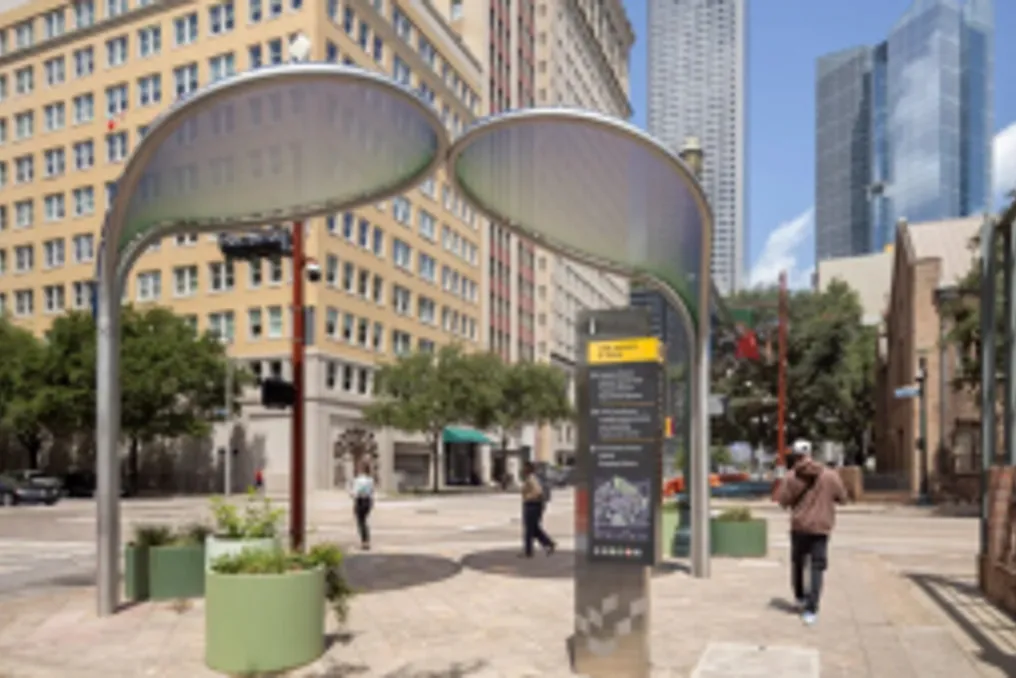
The 'Cool and Connected' toolkit was implemented in Houston, Texas, in response to rising temperatures in the city. It represents an adaptive solution combining three main components: petal-shaped shade pavilions, modular planters, and integrated lighting designed to enhance pedestrian safety at night.
This project launched as part of Houston's broader Public Space Action Plan, which aims to transform fifteen blocks of Texas Avenue into a more comfortable and walkable urban area.
The sculptural pavilions, designed by Höweler + Yoon Architecture, are made of polished stainless steel with sandblasting and covered with mesh membranes in gradients of blue, green, and purple. Their canopy-like shape provides shade during the day, while the built-in lighting turns them into glowing urban landmarks at night. These structures can function individually or be grouped to create larger compositions, simultaneously forming visual connections along the pedestrian route.
These interventions provide measurable environmental benefits. According to SWA reports, thermal imaging data shows a reduction in average ground surface temperature by 5°C under the pavilions, reaching as low as 16°C in some areas. Furthermore, the use of drought-resistant plantings that support pollinators and the planting of new trees contribute to achieving the project's ecological goals. Future expansions are planned along Texas Avenue and other central streets, making 'Cool & Connected Corridors' a compelling tool for climate-aware urban design development.