In a scenario marked by the Master and Ueno cases' crises, Brazil presents Pix as a prominent solution. While its neighbor Paraguay faces difficulties, Brazil has consolidated its instant payment system.
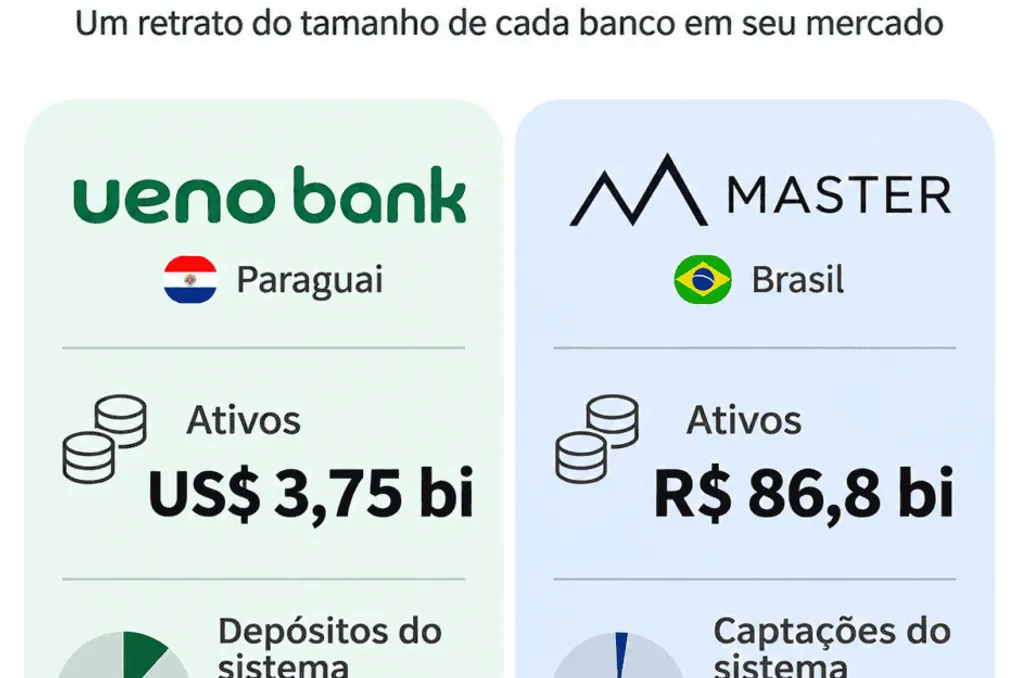
The Paraguayan case is considered more severe for the banking system as a whole when compared to the Ueno case. An important distinction is observed: Ueno focused on digital account opening, discounts, and cashback, whereas Master attracted investors through CDBs with returns higher than the market average.
Technology plays a fundamental role in financial inclusion by eliminating three major obstacles to accessing the financial system: distance, bureaucracy, and costs. Previously, it was necessary to visit a branch, present documentation, and pay fees. Currently, much of this process can be done via mobile phone.
This transformation goes beyond mere digital account opening. Applications allow individuals to create accounts without visiting physical branches, benefiting residents of remote areas with little infrastructure. Technologies such as facial recognition, automatic document reading, and digital identity verification (e-KYC) simplify customer registration.
A study conducted in Bangladesh showed that digital identification can reduce account opening time from four or five days to just five minutes. Digital banks, in turn, do not require the same physical structure as traditional banks, managing to reduce operating expenses and offer free or lower-fee accounts through automation and digital service.
Systems like Pix enable instant money transfers, dispensing with the use of physical currency or bank branches. This also encourages small merchants and informal workers to use financial accounts. According to the World Bank's Global Findex 2025, financial account ownership reached almost 80% of global adults, up from 50% in 2011, representing a drastic change in just over a decade.
Despite this, 1.3 billion adults still lack financial services. However, there is an enabling path: about 900 million of these people own a mobile phone, with 530 million having smartphones, indicating that the technological infrastructure to expand inclusion is already partially accessible.
In Latin America and the Caribbean, 70% of adults have a bank account, and more than half use this account digitally via card or mobile phone. The World Bank mentioned Pix in its statement, asserting that investments in instant transfer systems, such as UPI in India or PIX in Brazil, can help expand financial services, alongside improvements in consumer protection and security.
Digitalization, however, does not solve all problems. Cybersecurity is a primary concern. Globally, 86% of adults have a mobile phone, and 68% have a smartphone, according to the Global Findex Digital Connectivity Tracker 2025. However, the increased use of mobile phones for digital transactions introduces new risks; only half of the 4 billion adults in low- and middle-income economies with a mobile phone use a protective password.
The Bank for International Settlements (BIS) also points out crucial issues, such as digital fraud, over-indebtedness, algorithmic discrimination, misuse of data, and exclusion of people with low digital literacy. The BIS emphasizes that benefits come with vulnerabilities, such as an increase in scams and excessive debt, underlining the vital role of financial authorities in regulatory improvement to mitigate risks.
A Forbes Paraguay report, dated March 2026 and crediting Equifax Paraguay S.A., reported that the Ueno bank allowed over one million unbanked Paraguayans to enter the financial sector. The article pointed out that the launch of Ueno in December 2021 coincided with the growth of banking indicators reported by the World Bank.
However, time has shown that Ueno's success was not the result of state policy or business genius, but rather a personal enrichment project through politics. The AP agency recalled that the central bank had warned Ueno in June about excessive loans to companies linked to the owners, which violates strict limits, allowing the owners to direct client savings to their own businesses.
Paraguayan economist Luis Rojas commented to AP that there was great flexibility in financial and banking rules, which enabled the institution's rapid expansion, raising suspicions due to preferential treatment.
The collapse of Ueno exposed the contradictions of a financial expansion model marketed as modernization and social inclusion. With about 3 million clients, the institution grew with support from hundreds of millions of dollars in public resources and close ties with the political and economic elite. Business ties of President Santiago Peña with the controlling group, the presence of a former director at the Central Bank, and prior regulatory warnings before the intervention raise doubts about conflicts of interest.
Orkun Saka, professor of financial economics at City St George’s, University of London, told the BBC that the Ueno case is deeper than mismanagement: 'A bank belonging to a single business conglomerate concentrated the savings of most adults in the country, in addition to hundreds of millions of dollars in pension funds (...) It is not simply a story of a poorly managed bank. It is a system where the bank, the regulator, and the Presidency were so intertwined that none could impose limits on the others.'
The Paraguayan Justice system decreed the preventive arrest of former executives, including Juan Manuel Gustale, former president, and Federico Miguel Vázquez Villasanti, founder of the Vázquez Group. Bloomberg highlighted that Vásquez's participation was worth up to US$375 million, placing him among the wealthiest in Latin America before the collapse.
While those responsible for the crisis are being investigated, millions of Paraguayans are dealing with the consequences. Public resources, including pension funds, have been exposed, and the full recovery of funds remains uncertain. The Central Bank of Paraguay estimates that 97% of Ueno Bank depositors are entitled to full recovery via the Deposit Guarantee Fund. However, Moody's analyzed that only about 30% of the total deposit value was covered by the guarantee, highlighting resource concentration.
In Paraguay, coverage reaches 228.3 million guaraníes per depositor, equivalent to approximately R$ 203 thousand. In Brazil, the FGC guarantees up to R$ 250 thousand per CPF or CNPJ, per institution, with a maximum limit of R$ 1 million in four years.
In contrast to the Master and Ueno scenarios, Brazil has Pix. The Central Bank disclosed that between 2018 and 2023, the number of active users in the National Financial System (SFN) and Brazilian Payment System (SPB) who used Pix or electronic transfer doubled. This increase is attributed to greater digitalization, driven by emergency aid during the pandemic, the launch of Pix, and new institutions in the market.
The number of active SFN/SPB users grew by 103.2%, raising individual customers from 77.2 million to 152 million, representing a 97% increase in the customer base. In January 2025, the number of CPFs related to SFN exceeded 200 million. Pix has become a Brazilian State and public policy, an open and non-discriminatory infrastructure.
Even under criticism from the US Trade Representative (USTR) during Donald Trump's campaign against Brazil, who alleged that the Central Bank favors Pix over American systems, it is relevant to note that cards like MasterCard and Visa, and platforms like WhatsApp Pay, charge for the same service as Pix, which is free. Former federal deputy Eduardo Bolsonaro (PL-SP) suggested that Brazil negotiate Pix with the US, mentioning Zelle as the 'American Pix.'
Faced with these scandals, the citizen is defenseless. The democratization of secure banking services, a legitimate need, was used to hijack the economy. In the times of Master and Ueno, power projects for personal enrichment contrast with Pix, which is technology and belongs to Brazil. Brazil has an asset facing global banking challenges, but it is essential to remain vigilant against personal projects that override state policies.