Triplets Born in Dubai Eight Weeks Early Discharged After One Month in Intensive Care
Read more
Khaleej Times
www.khaleejtimes.com

Triplets Born in Dubai Eight Weeks Early Discharged After One Month in Intensive Care

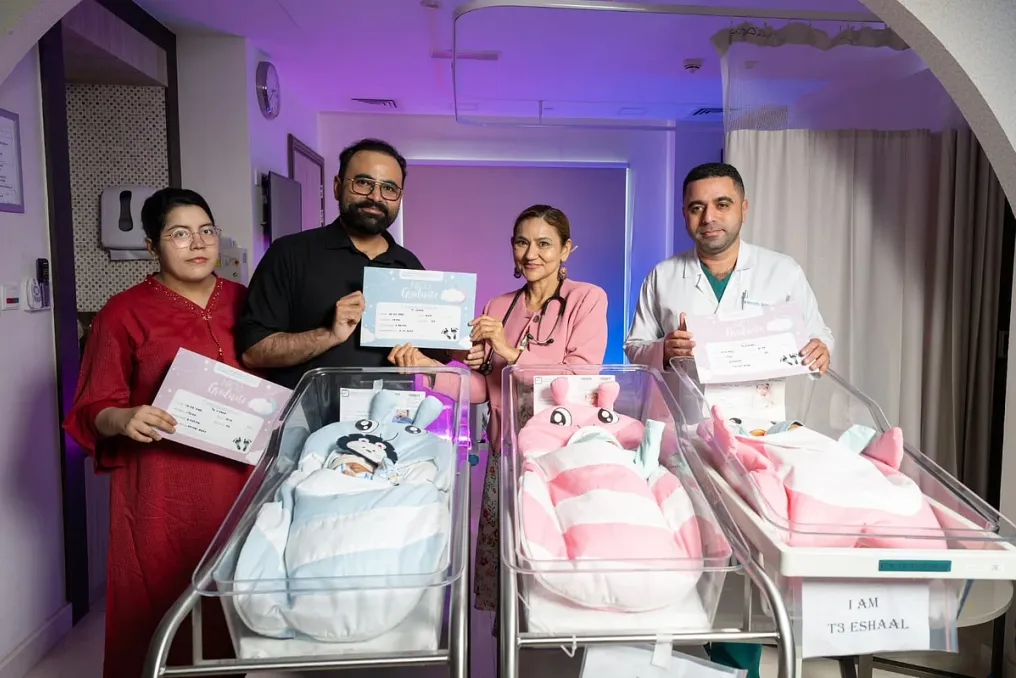
Three premature twins returned home with their parents after spending about a month in the neonatal intensive care unit at a Dubai hospital.

The children were born eight weeks earlier than the expected date due to complications that arose during a closely monitored pregnancy. At 32 weeks of gestation, all three newborns required hospitalization in the Neonatal Intensive Care Unit (NICU) at Emirates Specialty Hospital in Dubai Healthcare City.

The parents, Omar and Sahrish Iqbal, regularly attended prenatal consultations and underwent ultrasound examinations throughout the pregnancy, as doctors monitored the development of the infants and potential complications associated with carrying triplets.

Dr. Anfal Akram Al Mashahi, an obstetrician and gynecologist at the hospital, noted that a triplet pregnancy is associated with an increased risk of preterm birth, low birth weight, uneven fetal growth, and maternal problems, including anemia, hypertension, and gestational diabetes.

She emphasized that 'managing a triplet pregnancy requires a structured, multidisciplinary approach, with frequent prenatal assessments and individualized clinical planning.'

The situation became more critical when the mother was hospitalized with ruptured amniotic membranes and cervical dilation, indicating a possible imminent preterm delivery. Teams of obstetricians, fetal medicine specialists, anesthesiologists, and pediatricians were involved in the planning and management of the labor.

After birth, the three infants were transferred to the NICU, where they were monitored and treated according to their individual needs.

Dr. Monica Kaushal, a consultant in pediatrics and neonatology, stated that caring for premature triplets required advance preparation and clear division of responsibilities, especially from the delivery room to admission to the intensive care unit.

She explained: 'At 32 weeks, infants require careful monitoring because their organs and body systems are still developing.' Dr. Kaushal added that the focus was on meeting each child's clinical needs while informing and involving the parents in the care process, preparing them to take their children home.

Premature children may require support with issues such as breathing, feeding, thermoregulation, and infection prevention. With triplets, doctors and nurses also need to monitor each newborn separately, as their progress can differ in the first weeks after birth.

The hospital reported that its team of neonatal nurses provided continuous bedside observation, developed individualized care plans, and informed doctors of any changes in the infants' condition. Respiratory therapy specialists and other medical staff were also involved in the care.

For the parents, the hospital stay was marked by uncertainty and regular updates from the medical teams. They expressed relief that having obstetrics, fetal medicine, and neonatology services in one hospital provided them with confidence during pregnancy, labor, and NICU stay.

After approximately one month of specialized neonatal care, all three infants were discharged and returned to their family.

Similar stories

First National Early Childhood Week to Take Place in UAE with Over 700 Events
Read more
www.khaleejtimes.com

First National Early Childhood Week to Take Place in UAE with Over 700 Events

More than 700 events are planned to take place in the United Arab Emirates (UAE) as part of the first National Early Childhood Week. This new initiative will allow children to participate in various activities with a parent or guardian.

The Minister of Family, Sana bint Mohammed Suhail, announced that 130 organizations will participate in the program. These institutions will offer children opportunities for learning and play across all seven emirates.

This week will take place from November 16 to 22, 2026, and is part of the programs being implemented as part of the UAE Family Year.

How critically ill children are kept alive during transport in UAE air ambulances
Read more
www.khaleejtimes.com

How critically ill children are kept alive during transport in UAE air ambulances

In the environment of an air ambulance, there is very little room for error. A baby requiring intensive care needs to be moved between hospital beds, ground ambulances, and airplanes while maintaining medical support that ensures their stability. During flight, there is a risk of tracheal tube displacement, rapid drop in body temperature, or deterioration of the patient's condition before the journey is complete.

For specialized evacuation teams, the task is to make the transportation process itself an extension of the intensive care unit, where doctors and equipment are ready to respond promptly to any possible deterioration in the patient's condition.

Dr. John Barrett, a consultant in emergency and pre-hospital emergency medicine, and head of the Pre-Hospital Emergency Services group at Burjeel Holdings, emphasized that 'the level of medical care should not decrease just because the patient is in motion.'

Such transfers may be necessary if the hospital lacks necessary specialized services, including pediatric or neonatal intensive care, pediatric cardiac surgery, neonatal surgery, or extracorporeal membrane oxygenation (ECMO), which temporarily supports heart and lung function. Furthermore, some patients require travel abroad for highly specialized treatment or return home after treatment elsewhere.

The reasons for such transfers are varied: from extreme prematurity and congenital heart defects to infants requiring cooling after birth asphyxia, surgical emergencies, severe respiratory failure, sepsis, and serious injuries in older children.

Transporting a critically ill child involves risks that go beyond the distance traveled. Infants have limited physiological reserves and can quickly lose heat, oxygen, and blood sugar levels. Their small airways also make breathing tubes vulnerable to displacement when moving between a hospital bed, a ground ambulance, and an airplane.

Even in a sealed cabin, oxygen availability decreases, and trapped gas can expand. This can be significant for patients with pneumothorax or bowel distension. Noise, vibration, and limited space create additional difficulties, especially for premature infants.

Therefore, the medical team must anticipate possible complications even before the trip begins and possess the necessary experience and equipment to treat them en route. Depending on the patient's condition, this may include advanced ventilation, high-frequency oscillation for respiratory support, inhaled nitric oxide, medications to maintain blood pressure, active cooling, invasive monitoring, and emergency airway management.

Barrett noted: 'Deterioration can happen during transport, so the team must be able to treat it, not just observe it.'

For some patients who cannot maintain adequate oxygen levels despite intensive treatment, standard support may not be enough. In certain cases, specialized teams may initiate ECMO procedures at the sending hospital and transport the patient while the circuit supports heart and lung function. The decision depends on the patient's condition, their suitability for treatment, and the availability of a receiving center equipped to continue care.

Barrett added that 'the possibility of using ECMO also depends on the entire system of surgeons, perfusionists, and the receiving unit, not just the aircraft.'

The need for specialized transport is illustrated by a case handled by ICATT Response Plus. It involved a young boy with congenital laryngeal atresia—a rare airway disorder—and a history of multiple upper airway surgeries. According to the company, the team transported the child from the UAE to Europe for specialized care.

Satish Munoli, CEO of ICATT Response Plus, stated: 'The boy had a complex medical history and required specialized care, which led to the transfer from the UAE to Europe.'

ICATT Response Plus, a joint venture between ICATT Air Ambulance and RPM, launched its neonatal and pediatric transport service in the UAE in March. The company reported placing a specialized team and equipment in the country to support the transport of critically ill infants and children. Although its broader operations in India include neonatal transport and ECMO experience, the UAE service is designed to provide specialized medical support to patients who need to be moved between hospitals both locally and internationally.

Transporting a newborn presents an additional challenge: ensuring the child's safety and maintaining a proper environment when changing vehicles or aircraft.

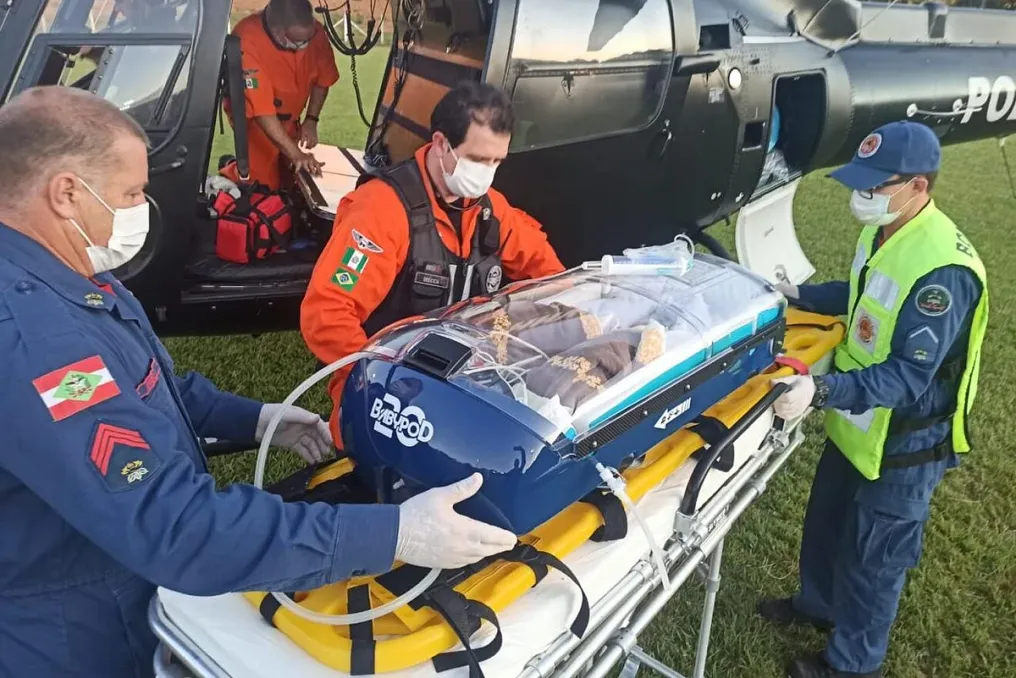
One of the devices presented by ICATT Response Plus is the BabyPod 2—a lightweight neonatal transport module designed for infants weighing from 2 to 8 kg. Weighing about 9.2 kg, it is designed to be secured in airplanes, helicopters, and ground ambulances. This module helps simplify transitions between vehicles and reduces the need for multiple handling of the infant. According to the manufacturer, it is X-ray transparent and compatible with CT scans but not with MRI. ICATT Response Plus reported that this device has not yet been used in a neonatal transfer within the UAE.

Barrett explained that this module is not a complete replacement for a traditional transport incubator. Incubators offer important advantages, such as a heated and often humidified environment for premature infants, as well as the ability to integrate equipment like ventilators, monitoring systems, and suction. When using the module, some of this equipment may require separate transport and securing. He also noted that data on the results of using neonatal modules are still emerging.

Ultimately, the equipment and medical team must meet the patient's needs. The goal is not just to get a critically ill child to another hospital, but to ensure that the necessary care to maintain the child's stability continues throughout the journey.

Popular