When the word 'death' is mentioned, most people feel anxiety and fear, as no one wishes to witness the final moments of a loved one. However, a question arises: what happens to a person approaching the end of life? Do they see something or start talking to someone?
According to a report by Daily Star, a nurse from America shared observations based on her personal experience. She found that many patients in their final days see things that evoke joy and smiles, rather than fear, which she described as a 'beautiful' experience associated with the proximity of death.
Julie McFadden, a nurse living in Los Angeles, specializes in end-of-life care. On social media, she is known as 'Hospice Nurse Julie' and has about 1.7 million followers on TikTok. Julie's goal is to reduce the fear of death among people and encourage open discussion of this topic. In her videos, she explains how a person's behavior and experiences can change in the last days or weeks of life.
In one of her videos, she described two types of experiences she often observes in patients approaching death.
First experience—intense observation of something
According to Julie, some patients close to death suddenly begin to stare continuously at a specific part of the room. Their gaze fixes on one point, and they do not look away. Julie calls this state the 'death stare.' She notes that attempts to get the patient's attention, such as snapping her fingers in front of them or redirecting their focus, are sometimes unsuccessful because they continue to stare at one spot.
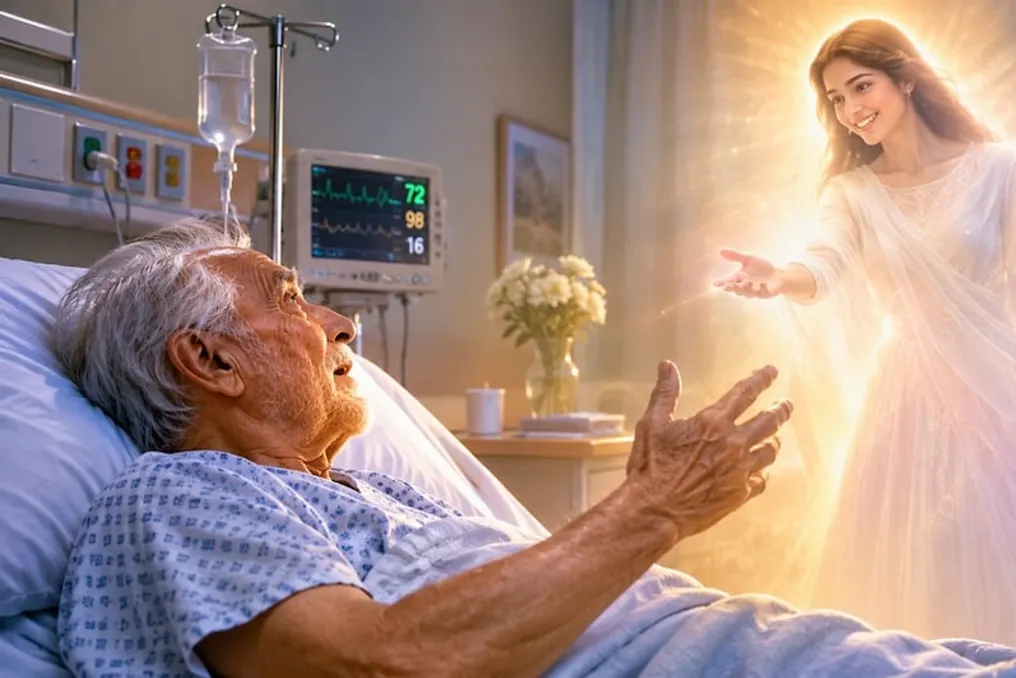
Some patients simply stare into space, while others begin talking to someone who is not in the room. Often, a wide smile appears on their face, as if they are seeing something that brings them great happiness.
Second experience—seeing deceased loved ones
Julie also mentioned another phenomenon in patients near death, called 'end-of-life visioning.' In this situation, patients speak of seeing or communicating with people who have already died. For example, someone might talk about meeting deceased parents, while others may be visited by old friends or other family members. According to Julie, sometimes patients start talking to someone right in front of those present, whom others do not notice.
She gave an example of a patient who had a very wide smile, giving the impression that he was looking at someone in another part of the room. Julie wanted the patient's wife to see this scene because, in her belief, such experiences can help the family understand how close the patient is to the end of life.
Julie shares that during her work, she has repeatedly encountered similar phenomena. According to her, these changes can begin several weeks or about a month before a person's death. Nevertheless, she emphasizes that every patient's experience is unique. Furthermore, what patients see can vary depending on their religious beliefs. Some reported seeing beautiful clouds and flowers, others saw Jesus, God, or angels. However, some people experienced no religious experiences. Julie notes that the most notable feature of these moments is that many patients appear happy and smiling, rather than frightened.
Julie believes there is a strong fear in people regarding death and the final stages of life. By sharing her experience, she hopes to reduce this fear so that people can openly discuss this topic and better understand the final moments of their loved ones.
It is important to remember that the experiences described by Julie are based on the behavior of patients observed by her during her nursing work. It cannot be assumed that this will happen to every person. Medical science also considers various versions regarding these phenomena, so they should not be viewed as a prediction of inevitable death or as an established fact about the moment of death.