Tesla plans to cease Cybertruck production at its Texas factory by mid-2027
Read more
TechCentral
techcentral.co.za

Tesla plans to cease Cybertruck production at its Texas factory by mid-2027

Tesla CEO Elon Musk announced on Friday that the company will stop producing the Cybertruck at its Texas Gigafactory around mid-2027. This decision came after several years of weak sales for the futuristic model, which was initially positioned as a competitor to traditional pickup trucks but sold only in a limited number of markets due to its massive and angular design.

Musk stated in a post on the social media platform X that halting production would allow the automaker to increase output of the recently launched Cybercab, which he considers a central element of Tesla's ambitions in robotaxis.

It was not immediately clear whether Cybertruck production would be moved to another facility or completely discontinued, but the Tesla plant in Austin is the only one known to be equipped to manufacture specialized components for this model. Responding to a user on X, Musk called the Cybertruck 'the best car Tesla has ever made,' and the cessation of production 'the end of an era.'

Tesla did not immediately respond to a request for comment sent outside of regular business hours.

The American electric vehicle manufacturer began delivering Cybertrucks to customers only at the end of 2023. According to Kelley Blue Book, only 20,237 units of the Cybertruck were sold in the US last year, which is 48% less than the 38,965 sold in 2024. Before the launch, Musk had projected annual sales of 250,000.

Former Aston Martin CEO Andy Palmer noted: 'It is pointless to continue its production if it does not meet target figures.' He added that any rational automotive expert would agree with this, and although it might be a minor deviation in Tesla's balance sheet, the statistics speak for themselves.

Controversies surrounding the Cybertruck

Since its debut in 2019, the Cybertruck has been controversial for Musk. Proponents of classic pickup trucks mocked its angular appearance, while safety experts predicted it would face difficulties obtaining approval in key markets such as Europe.

The presentation itself was marred by a moment when Musk attempted to demonstrate the car's shatterproof windows by throwing metal balls at them, resulting in large cracks forming on two of the windows. At the official Cybertruck launch in 2023, Musk presented it as a futuristic competitor to trucks from General Motors and Ford, stating: 'Finally, the future will look like the future.'

However, the vehicle failed to live up to these expectations. Automotive analyst Felipe Muñoz stated that while the Cybertruck is being labeled a failure due to poor sales, electric pickups from Ford and others have also struggled in the US. Muñoz emphasized: 'They all lost the competition because electric pickups are not popular in the US.'

Nevertheless, the sharp stainless steel design of the Cybertruck limited its chances in markets like Europe, where electric vehicles are more sought after. Obtaining regulatory approval in Europe proved impossible due to rules concerning pedestrian impact. Palmer stated: 'In any place where accident regulations considering pedestrian impact apply, the Cybertruck will not pass, it cannot pass.'

Musk's New Bet

The Cybercab, which features gullwing doors and lacks a steering wheel, pedals, or mirrors, is one of Musk's key bets in his effort to transform Tesla from a mere car manufacturer into a company focused on artificial intelligence and robotics. Musk views it as Tesla's primary autonomous model, intended for servicing a global network of robotaxis.

After years of delays in achieving self-driving goals, Tesla began offering paid rides with a small fleet of Cybercabs in Austin in September. Nevertheless, the company still needs to answer questions from US vehicle safety regulators regarding whether it has properly certified the Cybercab as compliant with federal vehicle safety standards.

Weight Morrill, lead engineer of the Cybertruck, stated on X: 'The Cybertruck was an incredible technological platform for development and continues to live through the Cybercab.'
Similar stories

Tesla plans to reduce Cybertruck production in Texas to focus on Cybercab robotaxi expansion
Read more
olhardigital.com.br

Tesla plans to reduce Cybertruck production in Texas to focus on Cybercab robotaxi expansion

Tesla plans to gradually decrease the manufacturing of the Cybertruck at its plant located in Austin, Texas, with an expected timeline for mid-2027. This change aims to free up production capacity to intensify the manufacturing of the Cybercab, a two-seater vehicle designed to operate as an autonomous taxi.

Currently, there is no official confirmation regarding whether the pickup truck's production will be relocated to another factory unit or permanently discontinued. The Austin factory is currently the only known unit responsible for producing this model.

The Cybertruck was introduced by Elon Musk in 2019 with the goal of competing with pickups from established manufacturers. At that time, the executive estimated annual sales close to 250,000 units; however, over the last three years, Tesla has recorded the sale of only a few tens of thousands of units in total.

The discrepancies between initial projections and observed results are also evident in the technical specifications and cost. During the presentation, the company promised an entry-level version costing less than US$40,000 (equivalent to about R$218,000) and offering a range of up to 500 miles (approximately 805 kilometers). Both goals were not met.

The launch suffered a two-year delay, partially attributed to the Covid-19 pandemic. When it finally reached the market at the end of 2023, the initial price had already increased to around US$60,000 (R$327,000), and the range of the most expensive version was reduced by more than 100 miles.

Furthermore, the model faced commercial challenges due to its controversial design, coupled with occurrences of recalls and quality control issues.

Wes Morrill, Chief Engineer of the Cybertruck, commented on this production shift in a post made on X, stating: 'The Cybertruck was an incredible platform for technological development and lives on in the Cybercab.'

The reduction in pickup production aligns with Elon Musk's strategy to reorient Tesla into a company focused on artificial intelligence, robotics, and autonomous driving. In this context, the two-seater Cybercab is featured as one of the automaker's central projects.

In the last two months, the company began circulating the vehicle on the streets of Austin. Tesla plans to extend its operations to other locations, starting with Dallas this November.

The automaker's participation in the driverless vehicle sector also includes autonomous versions of the Model Y. Currently, these cars are operating in Austin, Houston, and Dallas, Texas, as well as Miami, Orlando, and Tampa, Florida, and the San Francisco area, California.

This modification in Cybertruck production is not the first decision by Tesla to make room for robotics initiatives. At the beginning of 2026, the company opted to cease the manufacturing of the Model S sedans and Model X SUVs. The industrial space previously dedicated to these two models will be allocated to the production of the Optimus humanoid robots.

Tesla Roadster rocket booster system runs for five seconds and requires up to six hours to recharge
Read more
autopapo.com.br

Tesla Roadster rocket booster system runs for five seconds and requires up to six hours to recharge

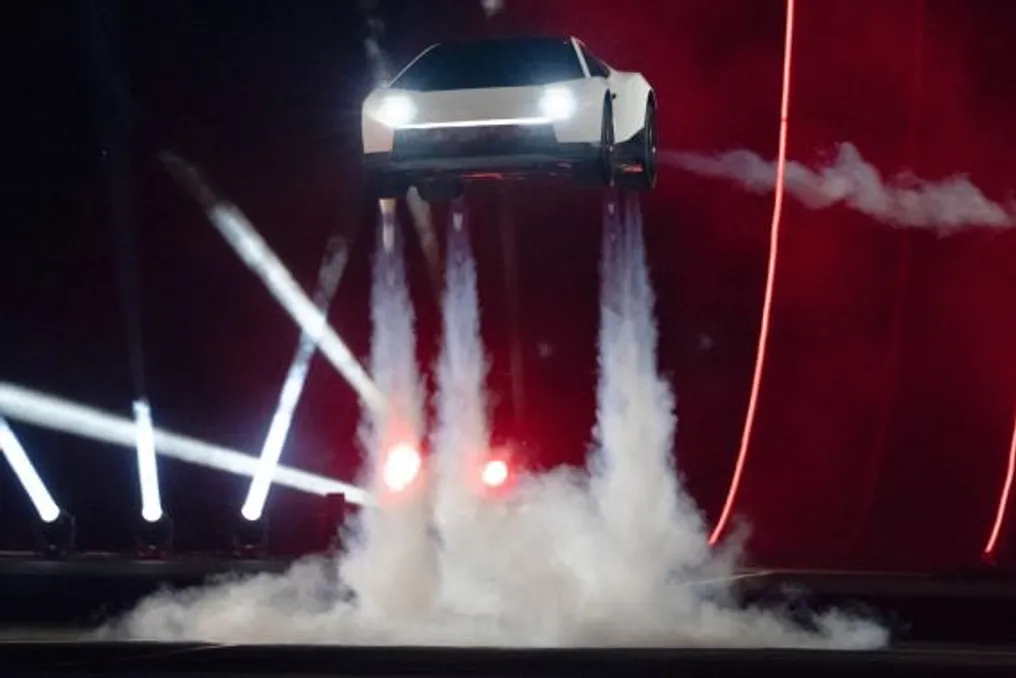
The new Tesla Roadster made an impression during its presentation by jumping over other cars. However, this trick comes at a time cost.

According to Lars Moravy, Vice President of Vehicle Development at Tesla, the Thrust version's engines operate for about five seconds, and currently, recharging them takes between two and six hours. This information was presented in a video for the British magazine Top Gear.

The manufacturer's goal is to reduce this time to less than thirty minutes. The boosters were developed in collaboration with SpaceX, Elon Musk's rocket company. These devices, called cold gas thrusters, do not burn fuel; they release compressed nitrogen in short bursts from a reservoir.

In the Thrust version, the reservoir holds 200 liters and operates at a pressure of up to 10,000 pounds per square inch (psi)—which is more than 300 times higher than the pressure in a car tire calibrated to 32 psi. Moravy described the refueling process by connecting the car to an external nitrogen source. Since most common high-pressure systems reach about 6,000 psi, the owner will require specialized industrial equipment to fill the tank, according to Motor1's website.

The Rocket version, which is single-seater and equipped with approximately ten boosters distributed across the body, uses even larger reservoirs, around 600 liters. The Roadster was unveiled on October 15th in Texas (USA). At the event, the car climbed a ramp, flipped over, and jumped over five models of the same make.

Tesla offers the car in three variants: Performance, without boosters; Thrust, with rear boosters that, according to the company, allow the car to accelerate from 0 to 96 km/h in less than 0.9 seconds; and Rocket.

Currently, the manufacturer charges only for the reserve version: 267 thousand reals ($50,000 USD) for Performance and 1.3 million reals ($250,000 USD) for Thrust. The Rocket version is available only by invitation. Elon Musk, CEO of Tesla, promises to begin production in 2028. The supercar was first introduced in 2017, with the initial launch scheduled for 2020.

Video of Tesla self-driving car with skeletons goes viral
Read more
www.aajtak.in

Video of Tesla self-driving car with skeletons goes viral

A video showing a self-driving car from the American company Tesla with two skeletons inside has gone viral on social media. This clip was published in honor of Halloween.

The video was posted on Tesla's official account on X, showing the company's Cybercab autonomous vehicle driving down the road. Two skeletons are seated inside this car, and there is no driver present. Both skeletons are comfortably positioned in their seats and have fastened their seatbelts. The company accompanied the video with the witty caption 'Bone Voyage,' a play on words referencing the French 'Bon Voyage'—a wish for a good trip.

Tesla's Cybercab is a vehicle designed for autonomous driving without a human driver. It is positioned as a robot-operated taxi. Thanks to cameras, sensors, and artificial intelligence installed in the car, it is capable of recognizing surrounding objects and navigating the route independently. The goal of implementing this technology is to create a taxi service that allows users to book a ride and reach their destination without needing to operate the vehicle.

Following the appearance of the video, social media users actively reacted to it, making numerous jokes. One commenter suggested that the skeletons are in the Cybercab because they lack the courage to drive the car themselves. Another user noted that Tesla's humor is incomprehensible. A third jokingly remarked that they booked the Cybercab to test whether a failure in the autonomous driving technology would occur. Some users pointed out the skeletons' seatbelts, joking that even after death, they care about their safety. One commenter questioned who would issue a fine if the police stopped this autonomous vehicle—the skeletons or the company itself.

Halloween is celebrated annually on October 31st, a day when people dress up in costumes, decorate houses in a spooky style, and use elements such as skeletons, ghosts, and witches. Tesla also marked Halloween by presenting this video featuring the Cybercab. The company attracted public attention by showing eerie skeletons in an autonomous vehicle. The funniest part of the video is that instead of a driver, there are two skeletons, but both have fastened their seatbelts.

Popular