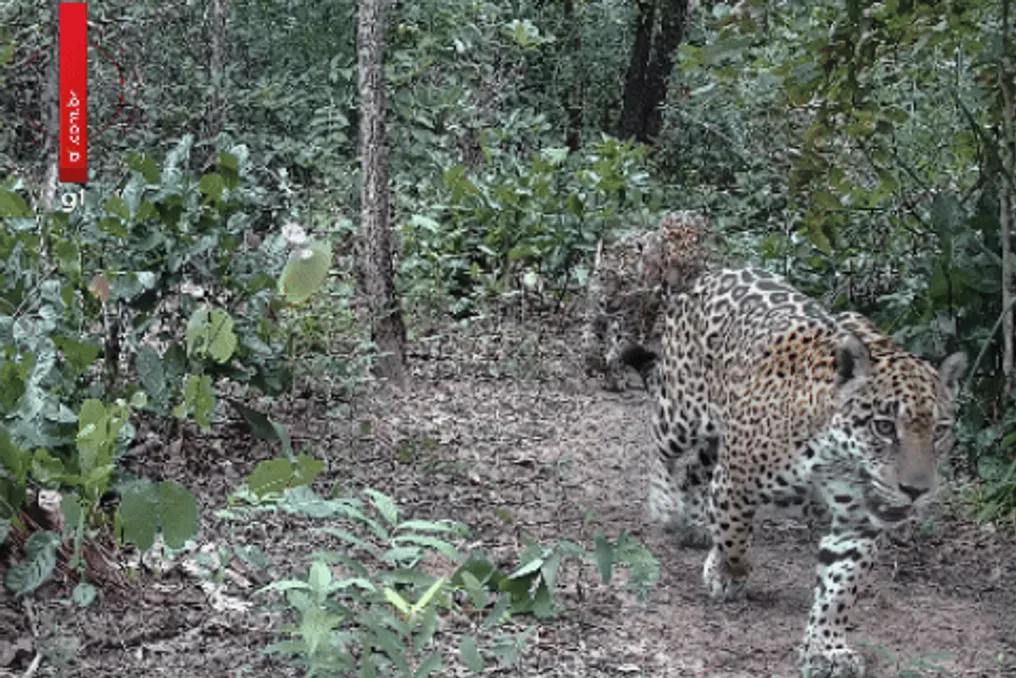
The jaguar identified as Cynthia, responsible for attacking domestic animals at the Lambari settlement in Poconé (MT), was spotted with two cubs. This sighting occurred after approximately one year without new incidents of cattle attacks in the area, which was protected by electric fences, according to data provided by the Impact Institute.
The sighting of the felines took place in May of this year and was shared by the institute on social media in the last week of September. The Impact Institute reported that during about ten months of monitoring following the installation of the fence, no new attacks were recorded in the protected zone.
Paul Raad, a veterinarian and president of the institute, clarified that the objective of the initiative is to ensure the safety of livestock without interfering with the jaguars' ability to live in their natural environment. He emphasized that there is no proof that the installation of the fence caused the birth of the cubs.
Raad commented on the initial situation, stating: 'There was no villain in this story: there were affected producers and a jaguar that needed to continue living in its habitat. We needed to find a solution for both.'
The protection system uses electrically charged wires placed at various heights around the area where the cattle are guarded, especially at night. When attempting to cross this barrier, the jaguar receives a brief electric pulse, which causes discomfort and aims to deter it from entering, without intending to cause injury.
The work began in 2022, aiming to offer producers practical methods to prevent jaguar attacks. Paul mentioned that the project was guided by researcher Rafael Hoogesteijn, his mentor in the field, and with the cooperation of the WWF Brazil organization, dedicated to nature preservation.
He observed: 'We realized there was a gap between scientific knowledge and the practical application of coexistence strategies. The goal has always been to transform this knowledge into solutions that work in the reality of the Pantanal.'
One of the first implementations occurred at Fazenda Piuval, also known as Fazenda Ypiranga, located in Poconé. The owner, Eduardo Campos, reported that the attacks mainly affected calves kept in open areas. The adopted solution was to keep the cows and calves in a maternity area enclosed by corrals equipped with electric fencing.
Campos stated that after the electric fence was installed, there was no predation inside the maternity ward, although reports of attacks still exist when the animals are released from it. According to the Impact Institute, a comparative analysis of two consecutive fourteen-month periods in the monitored area showed a decrease of about 83% in animal losses caused by jaguars.
In the 14 months prior to the fence installation, 23 deaths were recorded, while in the 14 months following, this number dropped to only four. Eduardo's property already has three of these protective structures. The farmer also links the protection of cattle to local tourism activity, which depends on wildlife maintenance.
He declared: 'I couldn't have this relationship of killing jaguars because it is worth more alive than dead. This coexistence of livestock farming with tourism must exist.'
The setup cost varies depending on the size of the area and the necessary infrastructure. Paul estimated that a fence built from scratch to protect an area capable of holding about 100 animals could cost between R$ 8 thousand and R$ 10 thousand. Eduardo, from Fazenda Piuval, informed that each electric corral cost approximately R$ 10 thousand.
The Impact Institute reported that it has already assisted more than 15 properties in both the Pantanal and the Amazon. In Mato Grosso Pantanal, actions are primarily focused on Poconé, but also cover initiatives in Cáceres and other locations.
The team seeks to establish partnerships to enable the installation of these structures on properties of producers with lower purchasing power, while simultaneously offering technical advice to evaluate each situation. The purpose is to increase the use of measures that reduce losses in livestock farming and promote harmonious coexistence between farmers and jaguars.