Smart launches electric car Smart #2 in China; European deliveries expected in 2027
Read more
Pandaily
pandaily.com

Smart launches electric car Smart #2 in China; European deliveries expected in 2027

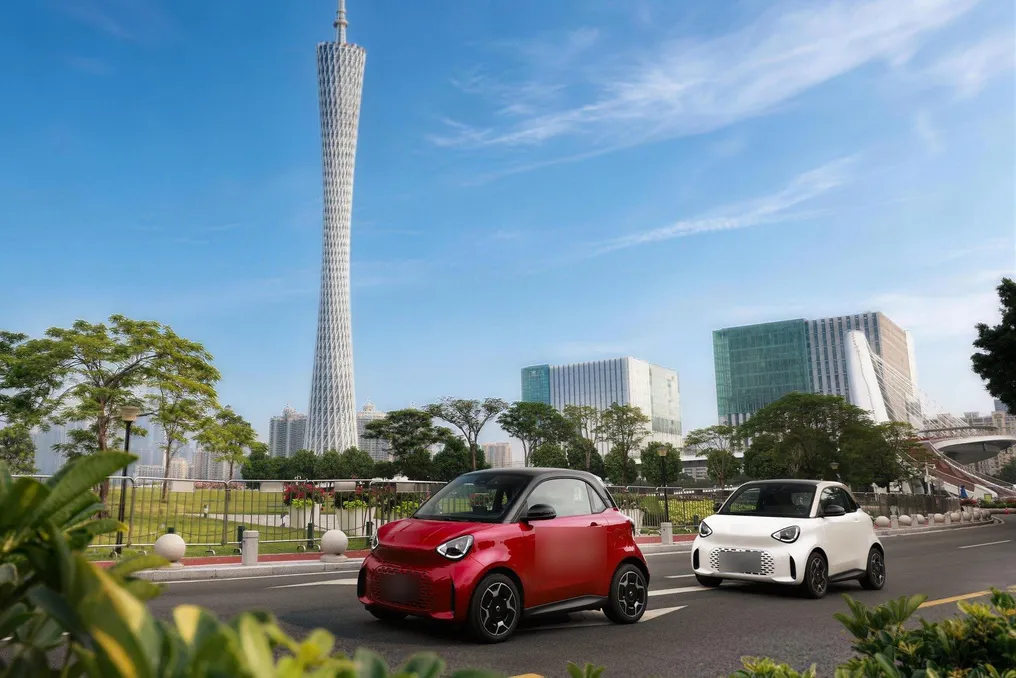
The company smart has introduced the fully electric model Smart #2 Premium in China. The launch took place on November 5th in Guangzhou, where the two-seater city car was presented, which the brand positions as a revival of its original format.

The company announced that mass production has already begun, and the first deliveries to customers in China are scheduled for the coming weeks. As for Europe, deliveries are planned for 2027.

The global debut of the Smart #2 occurred on October 12th at the Paris Motor Show. According to smart, the limited edition Smart #2 Couture Edition is completely sold out in both China and all European markets where it has been offered until now. The exact number of Couture Edition units was not disclosed by the company.

Tong Xiangbei, global CEO of smart, noted that as a pioneer of two-seater city cars, smart constantly explores new possibilities for urban mobility, and the company is 'reimagining the concept that helped define our brand.' Kan Yi, global marketing director of smart, emphasized that for smart, 'premium has never been defined by size,' and the new model retains the characteristics of the original while adding modern technology and enhanced comfort.

The car was designed by a global team of Mercedes-Benz designers and is based on smart's new Electric Compact Architecture (ECA). The company asserts that ECA was developed specifically for the compact electric vehicle and was not adapted from a larger vehicle platform. The body uses smart's new Tridion Cell Evo safety structure, which forms a protective cell around the cabin in the small space of the car.

The Smart #2 has a bumper-to-bumper turning radius of 6.95 meters, is equipped with a rear electric motor with rear-wheel drive, and features a five-link rear suspension, which smart calls class-leading. The company indicates a battery capacity of 35.8 kWh and a target combined WLTP range of 290 km.

These battery and range figures apply to the Smart #2 version for the European market. smart warns that the stated range is preliminary and subject to final European certification, and specifications may vary depending on the market; specifications for the Chinese market must be confirmed locally. In September, smart's technology workshop in Beijing indicated a target WLTP range of about 300 km.

smart stated that the car was developed jointly by engineering teams in China and Europe and will be manufactured in China. The testing program included checks on winter driving in sub-zero temperatures, as well as hot weather conditions. China will be the first market to receive customer deliveries. In Europe, information regarding prices, specifications, equipment, and availability will be announced incrementally for each market.

Similar stories

XPENG launches MONA L05 in China with prices starting from 139,800 yuan for EV versions and increased range
Read more
pandaily.com

XPENG launches MONA L05 in China with prices starting from 139,800 yuan for EV versions and increased range

XPENG has released the MONA L05 model in China, which is the first five-seater large SUV in the MONA series. The model is available in six configurations, including both fully electric and extended-range versions.

According to an XPENG press release to Chinese media and a report by IT Home, the event took place on October 29th in Guangzhou. Official recommended prices range from 144,800 to 176,800 yuan, while launch prices start from 139,800 to 171,800 yuan. XPENG announced that the first 5,000 units have already left the special production line, and deliveries began on November 1st.

The lineup of pure electric versions includes the 560 Plus (launch price 139,800 yuan), 535 Max (149,800 yuan), 635 Max (159,800 yuan), and 635 Ultra SE (171,800 yuan). Extended-range versions are represented by the 1310 Max (149,800 yuan) and 1310 Ultra SE (161,800 yuan). These prices are approximately 20,000–30,000 yuan lower than the pre-sale range of 169,800 to 191,800 yuan, announced on October 15th, as noted by Chinese publications, including National Business Daily and Bitauto. Orders placed before December 15th are eligible for additional launch bonuses.

This SUV measures 4,870 mm in length, 1,930 mm in width, and 1,636 mm in height, with a wheelbase of 2,940 mm, which is longer than the XPENG G6. The exterior design was led by Juanma Lopez, who previously served as the head of external design at Ferrari. Storage space includes a front trunk of 102 liters and a rear trunk of 702 liters, which expands to 1,913 liters when the rear seats are folded down.

Each electric version is equipped with a rear motor of 183 kW and lithium iron phosphate batteries with capacities of 58.2 kWh or 71.1 kWh, providing a CLTC range of 560 km, 535 km, or 635 km, respectively. XPENG states an energy consumption of 11.7 kWh per 100 km, acceleration from 0 to 100 km/h in 6.8 seconds, and the ability to charge from 30% to 80% in 15.8 minutes. The extended-range model combines a 70 kW, 1.5-liter range extender and a 37.2 kWh battery, yielding an electric range of 310 km and a total CLTC range of 1,310 km.

The driver assistance system is based on a visual setup. The Max versions are equipped with the XPENG Turing AI chip with an effective computing power of 750 TOPS and run on the distilled VLA Lite model, while the Ultra SE versions use two Turing chips to achieve 1,500 TOPS and the full second-generation VLA model, whose architecture, according to XPENG, is similar to their Robotaxi program's architecture. All modifications support NGP city and highway assistance, as well as parking assistance from spot to spot. The cabin is equipped with a 26.8-inch W-HUD display, a 17.3-inch central screen, an optional roof-mounted rear screen, and the Master Agent voice assistant for route finding and trip planning.

The chassis uses a MacPherson front suspension and a rear multi-link suspension with DCC adaptive dampers. The vehicle has a turning radius of 5.4 meters and a braking distance from 100 to 0 km/h of 34.22 meters. XPENG asserts that the vehicle was designed according to five-star safety standards of China, Europe, and Australia, and is equipped with seven airbags, as well as standard automatic emergency braking and steering systems.

Chinese cars evolve from cheap options to leaders in automotive technology
Read more
autopapo.com.br

Chinese cars evolve from cheap options to leaders in automotive technology

Those who have followed the Brazilian automotive market for several decades remember the first wave of Chinese cars that arrived in the country. Initially, these vehicles were characterized by attractive prices, but often presented deficiencies in terms of finishing, manufacturing quality, and longevity. At that time, it was unlikely to predict that the Chinese industry would achieve such rapid advancement, challenging global automotive manufacturing giants in less than two decades.

The Chinese presence in Brazil gained traction in 2006, with the start of operations of Chana Motors, which later adopted the name Changan. The brand was known both for its compact utilities and for the jokes its name generated among Brazilians. Its portfolio was modest, consisting of a passenger van, a truck, and a small pickup, without offering significant sophistication or technological innovations.

In the following year, Hafei emerged, introducing the Towner Junior model. The participation of Chinese manufacturers remained discreet, focused mainly on low-cost commercial vehicles. The landscape began to change in 2009 with the arrival of Chery, which launched models such as the Tiggo SUV and the QQ compact, in addition to the later Face and Cielo. These products aimed to attract consumers willing to invest less in a new car.

Another company that sparked great interest was JAC Motors, which started its activities in Brazil in 2011. The brand invested heavily in advertising, even using the 'Domingão do Faustão' program to promote its vehicles, betting on the J3 and J3 Turin compacts. The JAC emblem itself also generated discussion due to its similarity to the symbol of Chrysler, the American manufacturer.

However, the offer of low prices and advertising campaigns was not enough, as the first Chinese cars faced a greater barrier: public distrust. At that time, the Chinese automotive industry had little experience compared to traditional European, American, and Japanese manufacturers. Many of its products displayed simple finishes, questionable quality materials, and durability issues, resulting in a poor image, especially in the used car market.

The Brazilian consumer observed these automobiles cautiously, as acquiring an affordable vehicle could imply high maintenance costs, rapid depreciation, and mechanical failures years later, making the cost-benefit ratio uncertain. Despite this, the Chinese industry demonstrated a remarkable capacity for learning, a phenomenon that had already occurred on the global stage. It is relevant to mention the trajectory of Japanese cars, which began gaining international space in the 1960s and took about two decades to consolidate the reputation for reliability and quality they possess today. South Korean manufacturers followed a similar path, rapidly evolving to compete with established European and Japanese players.

The Chinese followed this same path, but at an even faster pace. In just over ten years, they transitioned from producers of simple and cheap cars to manufacturers of vehicles with excellent build quality, refined finish, and advanced technology. The disparity between the initial models and the current ones is considerable.

If the improvement in quality was already noticeable, it was with electric and hybrid vehicles that the Chinese industry redefined its global position. While many traditional automakers were still debating electrification routes, Chinese companies dedicated massive investments to the development of batteries, electric motors, electronic systems, and new charging technologies. This effort bore fruit in just a few years.

Currently, China holds a prominent position in the development of electrified vehicles. Its manufacturers offer cars with high performance, good autonomy, sophisticated finishing, and technological features that, in some cases, directly rival products from much older brands. A curious situation has occurred: European and American automakers, once references for the Chinese industry, are now seeking partnerships and technologies developed in China itself to boost their electrification projects.

This reversal of roles was unimaginable when the first Chery QQ, JAC J3, and small Chinese utilities circulated on Brazilian streets. The consumer witnessed this metamorphosis, and Chinese cars ceased to be sought solely for their low price, beginning to generate interest in performance, integrated technology, and the variety of equipment offered.

The evolution of products paved the way for a new wave of expansion in the Brazilian market. Companies such as BYD, GWM, Caoa Chery, and JAC Motors assumed relevant positions in this movement, implementing distinct commercial and industrial strategies. BYD and GWM, for example, advanced to local production, signaling that their plans for Brazil go beyond mere vehicle importation. Other companies, including Omoda, Jaecoo, GAC, Leapmotor, Geely, and Zeekr, have also begun to compete for buyers' attention.

However, not all managed to keep up with this expansion. Neta, which entered the Brazilian market with ambitious goals, suffered losses due to financial problems faced by its Chinese parent company, serving as a warning that Chinese origin and high-tech offerings do not automatically guarantee a manufacturer's commercial success.

The range of Chinese brands operating in Brazil increased even further with the arrival of Jetour, MG, Denza, and Changan, which have already debuted in the national territory. Jetour, associated with the Chery group, focuses on hybrid SUVs, while Denza, BYD's luxury line, targets the premium car consumer. MG, a traditional British brand under the control of the Chinese group SAIC, also began sales in the country, as did Changan, which returned to the Brazilian market in collaboration with the Caoa group. Each adopts distinct tactics to compete in practically all price segments.

This intense movement is already having repercussions on traditional automakers. To deal with the new competitors, many are being forced to revise price lists, increase equipment packages, and accelerate the development of electrified vehicles. This occurs because the Chinese have identified a highly effective commercial formula: delivering a lot of technology, equipment, and performance for competitive prices, a combination that demands an immediate response from established brands.

Those who saw the first Chinese cars sold in Brazil recognize the vast distance between those initial models and the current ones. In about twenty years, an industry initially viewed with skepticism has come to compete with century-old manufacturers and, in certain technological areas, taken the lead. Chinese cars have stopped being mere economic alternatives; they have become competitors that traditional brands can no longer ignore.
BYD releases third-generation Qin Plus DM-i sedan
Read more
technode.com

BYD releases third-generation Qin Plus DM-i sedan

BYD introduced its third-generation Qin Plus DM-i plug-in hybrid sedan on October 27. As part of a limited promotion, the vehicle is available at prices ranging from 76,900 to 97,900 yuan. Standard retail prices for three variants range from 79,900 to 100,900 yuan.

The new model can travel up to 220 kilometers purely on electric power, and the total claimed range reaches 2,290 kilometers. The car has a length of 4,840 mm and a wheelbase of 2,800 mm.

It is equipped with BYD's fifth-generation DM hybrid system. When the battery is depleted, the stated fuel consumption according to the NEDC standard is 2.58 liters per 100 kilometers. Buyers also have the option to order the God’s Eye B driver assistance system, which supports automatic parking, as well as navigation assistance in both urban and highway settings.

Popular