When planning the purchase of a Philips TV in 2026, it is essential to analyze various technical attributes, such as panel type (whether LED, QLED, or MiniLED), resolution, refresh rate, and image processing technologies used. Only through this complete evaluation can it be determined if the device meets the user's daily needs.
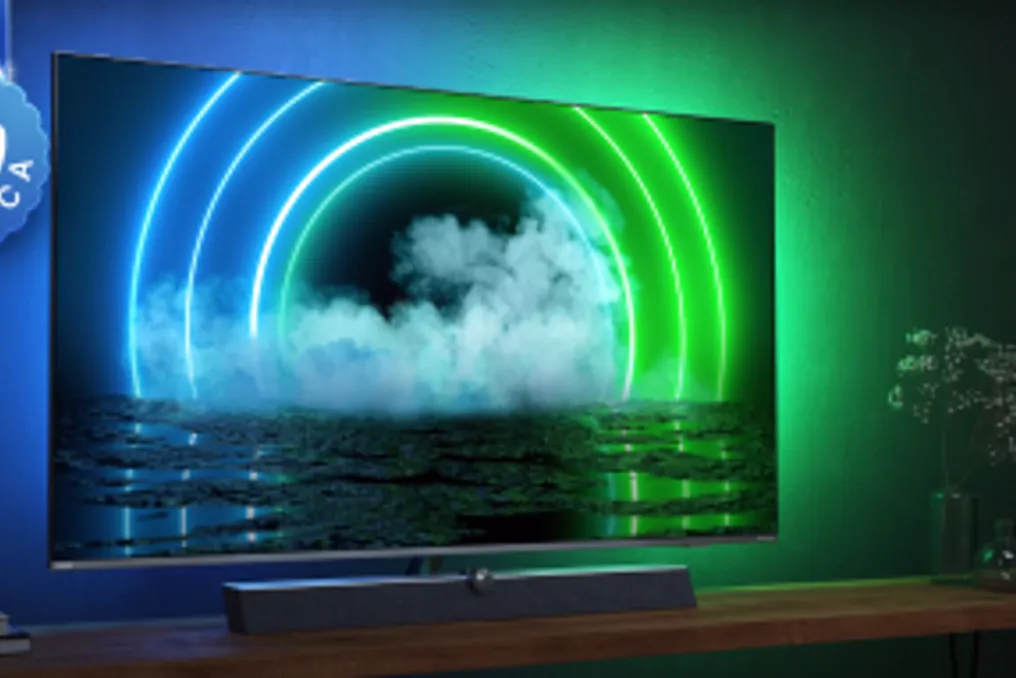
Some Philips models stand out due to the Ambilight lighting system, which projects image colors directly onto the wall. Additionally, the company's televisions incorporate recognized operating systems, such as Google TV and Roku OS, ensuring smooth and uncomplicated navigation.
In this guide, Tecnoblog details six Philips TV models suitable for different usage profiles, presenting the pros and cons of each before the final purchase decision for home or office.
Philips The Xtra 4K Ambilight
The Philips The Xtra 4K Ambilight is available in 55-inch, 65-inch, and 75-inch sizes. Although it uses an LCD panel, this model incorporates miniLEDs to manage illumination in different areas of the screen, resulting in improved contrast, increased brightness, and deeper blacks.
This set supports Dolby Vision, HDR10+, and HLG formats, enhancing visual quality in compatible content. Its native refresh rate is 120 Hz, an advantageous feature for gamers. The equipment is also equipped with Dolby Atmos, Wi-Fi, Bluetooth 5.0, and specific gaming features such as VRR, ALLM, and AMD FreeSync Premium.
Philips The One 4K Ambilight
The Philips The One 4K Ambilight has an LCD panel with traditional LED backlighting and is available in 55", 65", and 75" versions. It uses the P5 Perfect Picture Engine processor to adjust colors, sharpness, and contrast; however, inherent panel limitations may be noticeable in dark scenes, leading to loss of detail.
For watching movies and series, the model supports Dolby Vision and other HDR standards, in addition to Dolby Atmos compatibility. Regarding gaming, the manufacturer guarantees features such as VRR, ALLM, and AMD FreeSync Premium. In terms of connections, it features 4 HDMI ports (2 of which are HDMI 2.1) and 2 USB ports. Wireless connectivity is managed by Wi-Fi 5 and Bluetooth 5.2.
Philips QLED 4K
Available in 55", 65", 70", and 75", the Philips QLED 4K features an LCD panel that uses a quantum dot filter. These components help increase color reproduction compared to models with standard LED backlighting.
HDR10+ compatibility allows for the display of content with dynamic metadata, which directs image adjustments according to each scene. The operating system used is Titan OS, providing access to applications such as Netflix, YouTube, Prime Video, Disney+, and Globoplay. In terms of connectivity, it offers dual-band Wi-Fi, Bluetooth 5.0, three HDMI inputs, two USB ports, and an Ethernet port for wired internet connection.
Philips LED 4K Ambilight
This TV is an entertainment alternative, ideal for those who want a more immersive experience when watching movies and series. Available in 50", 55", 65", and 75", the model features Ambilight technology, which projects content colors onto the wall corresponding to what is displayed on the screen.
Regarding image processing, Pixel Precise Ultra HD works to enhance definition, while Micro Dimming optimizes contrast by analyzing different image zones. The model also integrates Dolby Atmos and DTS:X, audio technologies capable of providing a greater sense of spatiality with compatible equipment and content.
The operating system is Titan OS, providing access to services such as Netflix, YouTube, Prime Video, and Disney+. For connectivity, it offers dual-band Wi-Fi 5, Bluetooth 5.0, three HDMI 2.1 inputs with support for ALLM and VRR, plus two USB ports. The Philips LED 4K is recommended for those seeking a large screen and access to the Google application ecosystem to consume movies, series, and other streaming content.
In 65 and 75-inch sizes, the platform aggregates streaming apps and services like Netflix, YouTube, Prime Video, and Disney+, and also allows for personalized recommendations. Google Assistant can also be used via voice commands. Image quality is reinforced by Dolby Vision support, an HDR format that optimizes brightness, contrast, and colors according to the scene. The audio is compatible with Dolby Atmos, providing a greater sense of spatiality in appropriate content. Connectivity includes four HDMI inputs (2.0 and 2.1), Bluetooth 5.0, and Wi-Fi for wireless internet access.
Philips QLED HD
The Philips QLED HD is suggested for smaller environments, such as bedrooms and offices, for those who prioritize color quality in a compact format. With a 32-inch screen, its differential lies in the QLED technology, which is uncommon in TVs of this size.
The panel uses quantum dots to intensify color reproduction, while the Pixel Plus HD processing focuses on improving image definition. However, the HD resolution implies less detail compared to Full HD and 4K screens available on the market. The device also has Dolby Audio and operates with the Titan OS system, which provides access to applications such as Netflix, YouTube, Prime Video, and Disney+.
In terms of connectivity, it offers Wi-Fi 5, two HDMI 2.0 inputs, two USB 2.0 ports, optical audio output, and an Ethernet connection for wired internet.
Before purchasing a Philips smart TV, it is crucial to examine certain aspects: Ambilight is a lighting system with LEDs located on the back of the TV; these lights follow the colors displayed on the screen and project illumination onto the surrounding walls. This effect visually increases the illuminated area during movies, series, music, and games, creating a more immersive experience.
The Philips LED 4K Ambilight represents a good cost-benefit option, as it combines 4K resolution, Ambilight, HDR10+, Dolby Atmos, VRR, and ALLM for gaming, eliminating the need to invest in more expensive models, such as miniLED.
The Philips The Xtra 4K Ambilight ranks among the best TVs for PS5 or Xbox Series in this guide. Its Mini LED panel has a native refresh rate of 120 Hz and offers VRR, ALLM, and AMD FreeSync Premium. HDMI inputs 1 and 2 accept 4K signals up to 120 Hz, allowing for better utilization of console graphics quality.
The Philips QLED HD is the most appropriate solution for small rooms due to its 32-inch size and HD resolution. The QLED panel uses quantum dots to boost color, and Titan OS groups the streaming applications. However, it should be noted that HD resolution offers less definition than 4K models.
Philips TVs can be advantageous for consumers looking for an affordable smart TV to accompany everyday movies, series, and TV shows. The brand also caters to enthusiasts of the Ambilight lighting effect, which enhances the TV viewing experience, and gamers looking for models with features such as high refresh rates, VRR, and ALLM. The final choice, therefore, will depend on the usage profile, desired size, and specific features of each model.
Philips TVs operate with two distinct platforms: Google TV and Titan OS. Google TV centralizes applications, content suggestions, and integration with Google Assistant, while Titan OS concentrates streaming services within its own interface. The platform varies depending on the line, so it is essential to check the system of the selected model.
Philips and Philco offer televisions with different proposals and price ranges. Generally, Philips concentrates more specialized features for those seeking Ambilight and Mini LED, while comparison with Philco depends on the model and the price found. Philips offers options with miniLED, QLED, and Ambilight technologies, as well as models with Google TV and Titan OS. Philco also operates in the entry and mid-range segments, with LED, QLED TVs, and platforms like Roku TV and Google TV. Thus, it is necessary to compare the resolution, frequency, connections, and operating system of TVs from both brands. No, the brand's offerings focus on technologies such as LED, QLED, and Mini LED. Those looking for a quality OLED TV should consider other brands present in the Brazilian market.