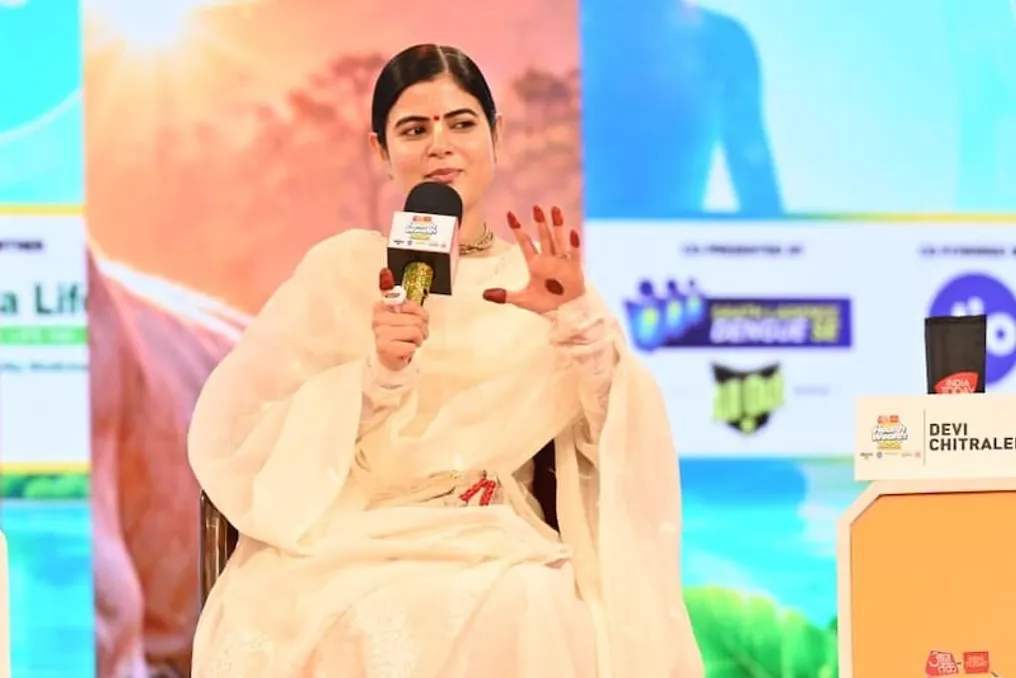
In a special episode of the Knowledge series dedicated to Diwali, Sanjeev Kaura, Director of Corporate Social Responsibility at The Times of India, conversed with Aruna Lohia Goenka, catalyst at iImpact, about the concept of abundance, which is one of the five pillars of her YASHA philosophy.
The discussion covered the paradox of wealthy people who feel poor, as well as the exceptional power of love, gratitude, and mindfulness. During the conversation, it was revealed that prosperity begins not with what a person possesses, but with how they perceive life.
Sanjeev Kaura noted that Diwali is a festival of prosperity, but Aruna Lohia Goenka countered, asserting that abundance is not closely related to the amount of money in a bank account. She emphasized that abundance is a feeling, and love lies at the core of this feeling. A person can possess very little and still feel wonderfully well-off, just as someone can own vast wealth yet experience a deep sense of need.
When Kaura suggested that theoretically he could be a billionaire and still remain poor, Goenka clarified that this is entirely possible. She gave the example that one can rule the world without having mindfulness, or have power over millions without controlling one's own mind. She questioned what use there is in owning the world if every morning a person feels a lack of something.
Goenka explained that the opposite of abundance is not necessarily poverty; sometimes it is the inability to recognize what one already has. Kaura raised the issue of how difficult it is to avoid comparisons with others, as the world constantly reminds us of others' superiority. Goenka called comparison one of the main enemies of abundance, noting that looking at someone else's house, car, or success can suddenly make yesterday's happiness seem insufficient, thereby turning abundance into scarcity without any real changes in life.
Responding to the question of developing an abundant consciousness, Goenka advised starting by acknowledging what is already present in a person's life: health, relationships, the ability to learn, the opportunity to serve, as well as things like the sunrise or love, which do not need to be bought or earned through financial transactions. She suggested imagining that the Universe sends bills for sunlight and fresh air, which might make people realize their true wealth. However, she added that gratitude is only the beginning; an abundant consciousness also implies seeing opportunities where others see limitations, and seeking chances to contribute instead of competing.
Regarding the central role of love, Goenka explained that love changes a person's attitude towards the world. When thinking in a state of scarcity, a person asks: 'What can I get?', whereas when thinking in a state of abundance, they begin to ask: 'What can I give?'. Love, compassion, kindness, and encouragement are exceptional forms of wealth that can be shared without diminishing one's reserves, much like a candle loses nothing by lighting another.
When asked by Kaura whether one can tell a person struggling for sustenance that poverty is merely a feeling, Goenka categorically answered no. She stressed that material lack, hunger, lack of healthcare, education, and opportunities are real problems requiring collective solutions. When she says that poverty can be a feeling, she refers to the internal experience of deficit, not the denial of economic hardships. On the contrary, an abundant consciousness should enhance awareness of the suffering of others, not diminish it; true abundance is the aspiration to ensure the prosperity of others.
Kaura asked if gratitude could lead to complacency. Goenka dispelled this myth, saying that gratitude does not mean abandoning ambition. One must be grateful for what one has while remaining enthusiastic about what one can create. The difference lies in the source of ambition: fear or possibility. Scarcity dictates: 'I must achieve more because I am not enough,' whereas abundance affirms: 'I am grateful for who I am, and excited about who I can become.' Calmness and ambition are not enemies; one provides peace, the other provides purpose.
In conclusion, Goenka linked the philosophy of abundance to her vision of YASHA for Viksit Bharat 2047. She noted that YASHA integrates Yuva, Anna, Shiksha, Hunar, and Abundance, with Abundance serving as the spirit connecting the other four elements. She questioned the meaning of educating children if they believe success means defeating someone else, or the meaning of skill development if it is not used to create opportunities for others, or the meaning of prosperity if it does not lead to overall well-being.
In her concluding message for Diwali, Goenka urged lighting a lamp at home, but also lighting a fire in one's own consciousness so that it illuminates gratitude instead of comparison and love instead of fear.