Indian Rupee Recovers Against US Dollar, Reaching Six-Month High
Read more
Aaj Tak
www.aajtak.in

Indian Rupee Recovers Against US Dollar, Reaching Six-Month High

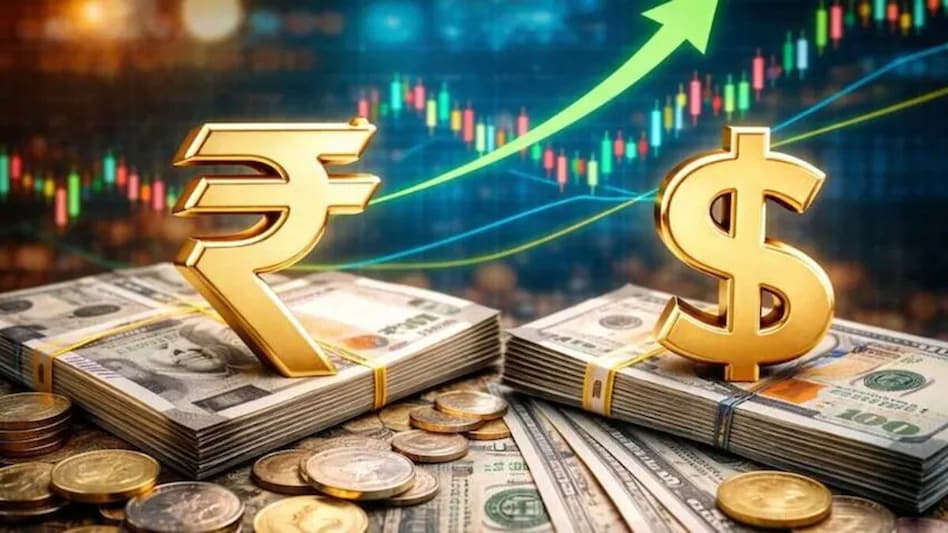
The Indian Rupee showed significant recovery against the US Dollar on Friday. Although the trading day started weakly, the rupee then gained momentum to reach the level of 93.89. This is the strongest intraday level for the rupee since May 7, meaning the Indian currency reached this height after approximately six months.

The rupee received support due to active purchases by foreign investors in the Indian stock market. Nevertheless, high crude oil prices and a strengthening dollar initially created pressure.

The rupee opened against the US Dollar at 94.50, while it closed at 94.41 on Thursday. Thus, at the start of trading, the rupee weakened by 9 points. However, there was a gradual improvement afterward, and it strengthened to the level of 93.89. This means that 93.89 rupees are now required to buy one dollar. As a result, the rupee strengthened by 52 points compared to the previous close and by 61 points compared to the opening level of today.

Until now, the market was under pressure due to rising crude oil prices in the international market and the strengthening dollar. According to Forex traders, the rise in Brent Futures oil prices by 2.04%, reaching $100.30 per barrel on Friday, put pressure on the Indian currency. Since India imports most of its oil and gas needs from abroad, the increase in crude oil prices requires oil importing companies to use more dollars. This increases the demand for the dollar and puts pressure on the rupee.

Furthermore, the Dollar Index, which measures the dollar's strength against six major world currencies, rose by 0.17% to reach 101.71, which also poses a challenge to the rupee.

Purchases by foreign investors played a decisive role in strengthening the rupee. According to exchange data, Foreign Institutional Investors (FIIs) made a net purchase of shares worth 14,974.68 crore rupees in the Indian stock market on Thursday. The inflow of funds from foreign investors into the Indian market can support the rupee.

There was also strong growth in the domestic stock market on Friday. The Sensex index rose by 1700 points, exceeding the 81,000 mark, while the Nifty grew by more than 400 points, reaching above 25,000.

Foreign exchange experts believe that the rupee's rate may remain positive in the near future. Anuj Chaudhary, an analyst at Mirae Asset Sharekhan research department, believes that the rupee may continue to receive support due to the resilience of the domestic market and increased purchases by FIIs. Furthermore, the rupee may strengthen if the dollar weakens and US Treasury bond yields decrease after the US Congress elections.

However, the rupee faces certain challenges. Geopolitical tensions related to the war and the situation in the Middle East could limit the rupee's growth. The market will closely monitor both crude oil prices and dollar movements. In the coming days, the direction of the rupee will be determined mainly by three factors: the volume of foreign investment in the Indian market, the trend of crude oil prices in the international market, and the strength of the dollar.

Similar stories

Gold and Silver Price Changes on Dhanteras: Current Rates from Delhi to Patna
Read more
www.aajtak.in

Gold and Silver Price Changes on Dhanteras: Current Rates from Delhi to Patna

Significant changes in the prices of gold and silver have occurred due to the celebration of Dhanteras. In Delhi, there was a slight increase in the price of gold, while silver prices rose by only 100 rupees.

For the fifth consecutive day, an increase in the prices of gold and silver has been recorded in the precious metals market. Over the last five days, the cost of 10 grams of 24-carat gold has risen to ₹7150, and 22-carat gold to ₹6560.

A rise was also recorded in the capital, Delhi, today: 10 grams of 24-carat gold increased by ₹10, and 22-carat gold by ₹10. Additionally, silver showed growth, rising by 100 rupees.

In Delhi, the price of 24-carat gold is ₹1,46,180, and 22-carat is ₹1,34,010; the price of 18-carat gold reaches ₹1,09,680.

In the financial center of Mumbai, the prices are as follows: 24-carat gold costs ₹1,46,030, 22-carat ₹1,33,860, and 18-carat gold ₹1,09,530.

In Kolkata, the prices for 24-carat gold are ₹1,46,030, 22-carat ₹1,33,860, and 18-carat gold ₹1,09,530.

In Chennai, 24-carat gold is valued at ₹1,46,030, 22-carat at ₹1,33,860, and 18-carat gold at ₹1,09,560.

In Bangalore, 24-carat gold costs ₹1,46,030, 22-carat ₹1,33,860, and 18-carat gold ₹1,09,530.

In Hyderabad, 24K gold costs ₹1,46,030, 22K gold ₹1,33,860, and 18-carat gold ₹1,09,530.

In Lucknow, 24-carat gold is priced at ₹1,46,180, 22-carat at ₹1,34,010, and 18-carat gold at ₹1,09,680.

In Patna, 24-carat gold costs ₹1,46,080, 22-carat ₹1,33,910, and 18-carat gold ₹1,09,580.

In Jaipur, 24-carat gold is valued at ₹1,46,180, 22-carat at ₹1,34,010, and 18-carat gold at ₹1,09,680.

In Ahmedabad, 24K gold costs ₹1,46,080, 22K gold ₹1,33,910, and 18-carat gold ₹1,09,580.

There has been a second consecutive day of growth in silver prices. Previously, between October 29 and 31, the price of silver per kilogram fell by ₹20000, then its value remained stable for four days, and now it has risen by ₹10100 over two days.

Today in Delhi, one kilogram of silver is sold at ₹2,10,100, which is 100 rupees higher, and this same rate applies in other cities. The exception is Chennai, where a kilogram of silver is available for ₹2,09,000.

Experts predict significant weakening of the Indian Rupee against the US Dollar
Read more
www.aajtak.in

Experts predict significant weakening of the Indian Rupee against the US Dollar

Following a period of strengthening, the Indian currency, the rupee, has faced a serious warning that raises concerns for the Indian economy. Analysts from Axis Bank Research suggest that the rupee could significantly depreciate against the US dollar.

According to the forecasts, by December next year, the rupee could fall to the level of 102 against the US dollar. If these predictions materialize, it will have a substantial impact on the economy. Experts are also examining how this currency depreciation will occur.

The report presented by Axis Bank Research contains a forecast suggesting that by December 2027, the rupee could decline to ₹102 against the US dollar. However, the decline will not stop there; by the last month of 2028, the rupee could weaken to 106 against the dollar.

In its report published on Tuesday in The Middle (Kingdom) Path, Axis Bank Research confirmed its initial assessments, forecasting the USD/INR exchange rate in the range of 97–99 by March 2027 and 98–100 by June 2027.

The report explains the reasons for the expected weakening of the rupee. It indicates that the recent recovery of the Indian currency may only provide temporary relief, as structural pressure from the external sector, capital outflow, and the need to replenish foreign exchange reserves continue to put pressure on the rupee. Specialists expressed serious concern about the pressure on India's external financial positions.

It is noted that despite attempts by the central bank to stabilize rupee fluctuations, constant intervention by the RBI has led to a reduction in effective foreign exchange reserves. Consequently, replenishing these reserves remains a priority, which limits the potential for a strong rupee appreciation even with an improvement in foreign capital inflow. The report also highlights outflows of approximately $2–3 billion monthly under the Liberalised Remittance Scheme and about $3 billion from foreign direct investment.

Despite the long-term pessimistic outlook, the Indian rupee showed signs of recovery last week. Against the dollar, it strengthened by 37 points due to improved portfolio investments from the US, lower yields on US treasury bonds, and support from a stable dollar. Data from NSDL shows that the net inflow of portfolio investments last week was about $2 billion. Furthermore, the 10-year yield on US treasury bonds decreased to approximately 4.9%, reducing pressure on emerging market currencies. There was also a softening in crude oil prices, with Brent Crude reaching $105 per barrel.

Currency depreciation in any country negatively affects its economy. In the case of the Indian rupee, a decrease in its value makes all dollar-related expenses, such as importing crude oil and goods, more expensive. Rising oil prices increase the risk of inflation in the country. Additionally, studying abroad, international travel, and imported goods require more rupees.

For example, education expenses of $50,000 at an exchange rate of ₹95 per dollar would cost ₹47.5 million. However, if the rupee reaches the forecasted 102 to the dollar by December 2027, this amount will rise to ₹51 million, representing additional costs of ₹3.5 million. Since India imports most of its crude oil and pays for it in dollars, the rupee's weakening will lead to a significant increase in import costs, which could cause a rise in gasoline and diesel prices in the country. The increased cost of diesel, in particular, will raise the cost of transporting necessary goods and intensify inflationary pressure in the country.

Ibovespa starts higher while dollar falls, with focus on Fed decisions and election results
Read more
g1.globo.com

Ibovespa starts higher while dollar falls, with focus on Fed decisions and election results

The Ibovespa, the main indicator of the Brazilian stock exchange, started Tuesday's (27th) session in an upward trend, registering a gain of 0.43% around 10:15 AM, reaching 177,362 points. Simultaneously, the dollar showed a drop of 0.86% in the same period, trading at R$ 5.3543.

The previous day, the US currency experienced its largest daily rise since 1999, increasing by 8.21% to R$ 5.4027. In contrast, the Ibovespa had fallen drastically by 13.88%, reaching 176,608 points, its worst performance since March 2020, the period of the Covid-19 pandemic.

The developments of the presidential elections in Brazil continue to influence the market this Tuesday, prompting investors and businesspeople to demand new signals of fiscal adjustment from the government. Internationally, attention is focused on the next interest rate decision by the United States, scheduled for tomorrow. Furthermore, the elections in Israel and oil prices are also under observation.

Lula's (PT) election altered the market outlook regarding interest rates, exchange rates, stock markets, and government finances. Given concerns about public debt, investors and businesspeople are pushing for government fiscal adjustment. There is fear of deteriorating financial conditions, which could lead to more expensive credit and a possible increase in the Selic rate if the dollar raises inflation.

In the external scenario, the focus is on the new interest rate determination by the Federal Reserve (Fed), the American central bank, expected the following day. Data from CME Group indicates that most of the market anticipates the institution maintaining rates. Investors are also awaiting any additional statements from Fed Chairman Kevin Warsh.

In the Middle East, the elections in Israel are highlighted. This is the first time the country has held an election after the war in Gaza, in a contest that will define the future of the current Israeli Prime Minister, Benjamin Netanyahu, potentially leading him to abandon politics or reinforce his position to continue his military plan in the country.

Among commodities, oil prices remain high due to concerns generated by recent Houthi attacks on Saudi territory. Around 9:15 AM, the Brent barrel, the international standard, registered a drop of 0.80%, quoted at US$ 114.88. Meanwhile, West Texas Intermediate (WTI), the reference in the US, was falling 0.70% at the same time, at US$ 101.05 per barrel.

Impact of Lula's victory on market projections

President Lula's (PT) victory for a fourth term generates strong downward pressure on domestic assets. Lula won the Palácio do Planalto race with 51.78% of valid votes, surpassing Senator Flávio Bolsonaro's (PL) 48.22%, considering almost 100% of the ballots counted.

Since most polls released in recent weeks predicted Bolsonaro's advantage in the second round, the re-election of the PT candidate surprised some investors, who are now analyzing the potential impacts of the new mandate on interest rates, exchange rates, the stock market, and public accounts.

Gabriel Mollo, analyst at Daycoval Corretora, stated that 'the main focus of investors will be the conduct of fiscal policy in Lula's fourth term. The trajectory of public debt, expense control, and the credibility of fiscal targets will be decisive for the confidence of economic agents.'

Despite this, experts point out that the government may seek to regain market confidence. Jason Vieira, chief economist at Lev DTVM, declared that 'in parallel, the economic team signals a PEC with a review of mandatory expenses and a search for the center of the fiscal target.'

There is also the prospect of legal challenges. Some professionals believe that the PT candidate's victory will not be the only factor of instability in the financial markets. The decision by Supreme Federal Court (STF) Justice Cristiano Zanin to extend voting hours from 5 PM to 7 PM, due to mobility issues for voters in several cities, may raise legal questions.

After the defeat, Flávio Bolsonaro did not accept the result and announced that he will request the annulment of the election. William Castro Alves, chief strategist at Avenue, commented to Reuters that 'it is impossible to rule out discussions about a possible judicialization of the result or other political developments. This environment of uncertainty tends to impact asset prices.'

Global Markets

In Asia, Chinese stocks lost the gains made at the start of trading and closed at their lowest level in 14 months, following the decline of technology sector stocks. The SSEC, Shanghai Index, and CSI300, which aggregates large Chinese corporations, registered a retraction of 1.3% during the session.

In contrast, the Nikkei in Japan rose by 1.73%, and the Kospi in South Korea appreciated by 3.09%. The Hang Seng in Hong Kong suffered losses of 0.73%.

Popular