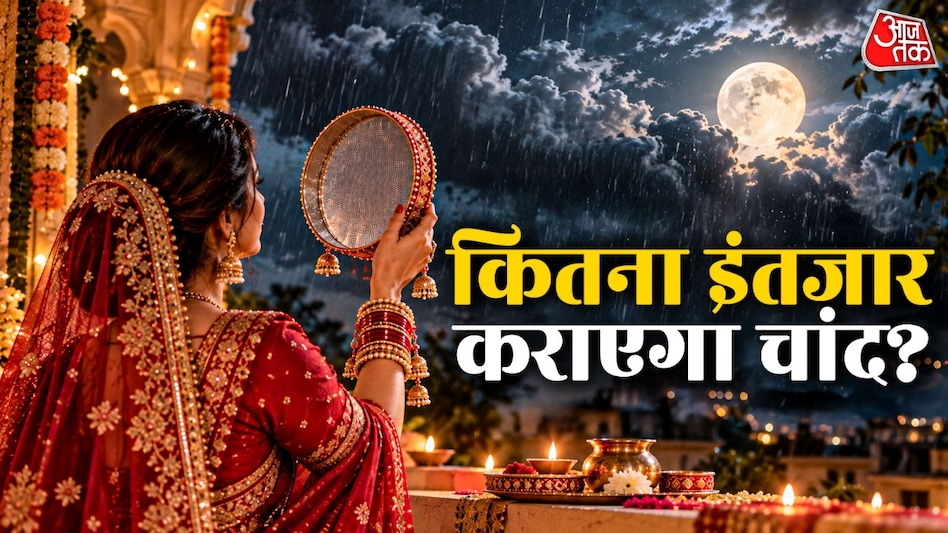
On this day, women across the country observe the Karwa Chauth fast. They spend the entire day performing religious rituals and are permitted to break the fast only after seeing the moon at night.
However, in several major cities across the country, the moon is expected to make married women wait longer. The weather in the Delhi-NCR region has changed. The Meteorological Department has issued a yellow alert for Delhi.
In the morning of October 29, heavy rain was observed in some areas, and the sky remains covered with black clouds. If this weather persists, there is a possibility that the Karwa Chauth moon will remain hidden among the clouds for a long time. Below is the time when the moon can be expected to appear.
According to the Meteorological Department data, due to Cyclone Arnab, which formed in the Bay of Bengal, rains with thunderstorms and black clouds are expected in areas adjacent to Delhi. If the evening weather remains the same, the moon may appear late in cities such as Ghaziabad, Noida, Faridabad, Gurugram, and Meerut. Therefore, residents of these areas should monitor both the predicted moonrise time and the local weather.
The moon on October 29, the day of Karwa Chauth, may rise above the capital Delhi around 8:17 AM. Nevertheless, due to geographical differences, the moonrise time varies across different states and major cities in the country. Sometimes the moon appears on time, but it might not be visible due to cloud cover.
The best time for performing the Karwa Chauth ritual is scheduled between 5:38 PM and 6:56 PM. During this interval, women can worship the gods Shiva, Parvati, and Karwa Mata. There is also a tradition of listening to or reading stories about Karwa Chauth during the worship. Before determining the ritual time, it is recommended to check the astronomical calendar for your city.
Fasting Duration: This fast is observed from sunrise until moonrise. According to tradition, women observe the fast without water, although some choose the option of consuming only water.
Clothing Color: There is a belief that on the day of the fast, black and white colors should be avoided; red is considered auspicious, and yellow clothing is also permissible.
Jewelry and Food: Traditionally, sixteen types of adornments are performed on Karwa Chauth, and nutritious food is consumed during the sargi.
Precautions in Case of Illness: If a woman is ill or finds it difficult to observe the fast without water, she should prioritize her health. In some families, the decision is made for the husband to fast instead, but this is not a mandatory rule of all traditions.
On Karwa Chauth, it is necessary to take a morning shower and wear clean clothes. Then, according to one's faith and ability, one must take an oath to observe the fast without water. A platform is set up on the east or north side of the house, upon which approximately a quarter-meter of red cloth is laid. After this, worship is performed to Lord Ganesha and Mother Houri according to the ritual, using turmeric, mangal, rice, and incense with a lamp. Items for adornment are offered to Mother Houri, and blessings are received by touching her feet.
In the ritual, wheat is poured into the karva bowl, and sugar powder or sweets are placed on top. A vessel filled with water is also placed on the altar. After this, prayers are offered for the longevity of the husband and peace in marriage. When the moon appears at night, an offering (arghya) is made to it. Then, according to tradition, the woman touches her husband's feet, and she breaks the fast by drinking water from his hands.