Uzbekistan presented eight artifacts at the Global Antiquity exhibition in Milan
Read more
UzDaily
uzdaily.uz

Uzbekistan presented eight artifacts at the Global Antiquity exhibition in Milan

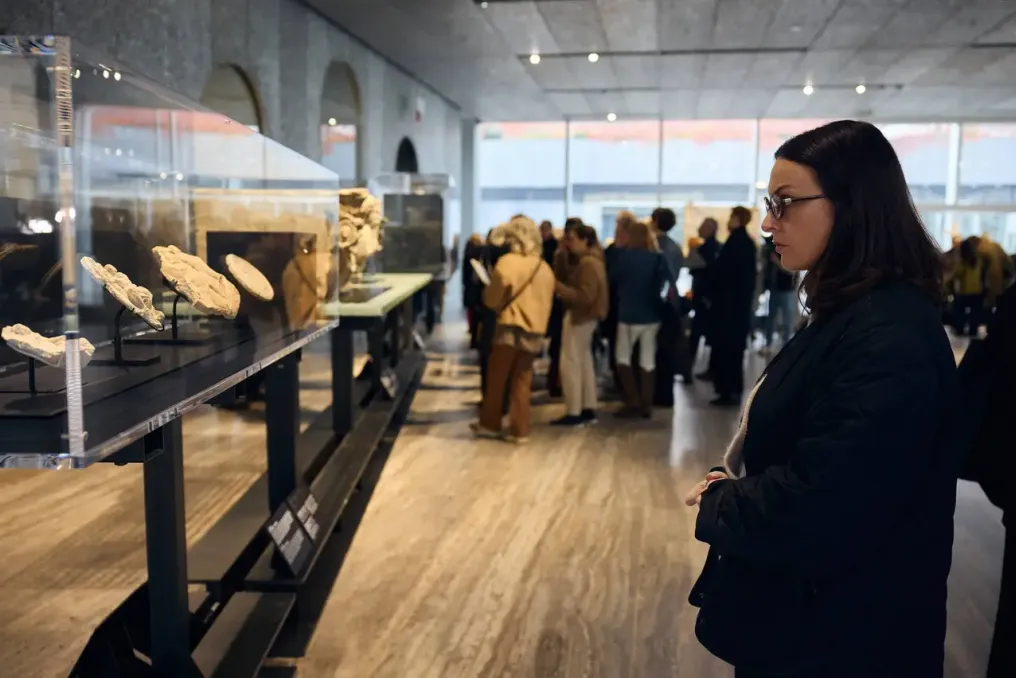
Uzbekistan participated in the international exhibition Global Antiquity, which opened on November 5th at the Prada Foundation in Milan. Eight museum artifacts from Uzbekistan were presented at this exhibition.

The exhibition is dedicated to studying cultural exchange between Asia and the Mediterranean, spanning over 1600 years. The exhibition brings together more than 150 works of art and historical artifacts demonstrating centuries-old connections between the regions of Eurasia.

Curation and Design

Salvatore Settis, Anna Anguisola, and Chiara Ballestracci served as curators for the exhibition. The architectural and spatial design of the exhibition was developed by the studios Rem Koolhaas and AMO/OMA.

Exhibits Presented

The Art and Culture Development Fund of Uzbekistan (ACDF) provided eight items from its museum collections. Among them are a sculptural depiction of a prince from Khalchayan, reflecting the artistic heritage of ancient Bactria, as well as seven chess pieces found in Afrasiab.

These exhibits illustrate the material culture of the region and serve as evidence of the development of the population's intellectual life during that historical period. The Global Antiquity exhibition will be available at the Prada Foundation in Milan from November 5, 2026, to March 1, 2027.

Similar stories

French Specialists Conduct Restoration of Exhibits from the Romanov Palace Collection in Tashkent
Read more
podrobno.uz

French Specialists Conduct Restoration of Exhibits from the Romanov Palace Collection in Tashkent

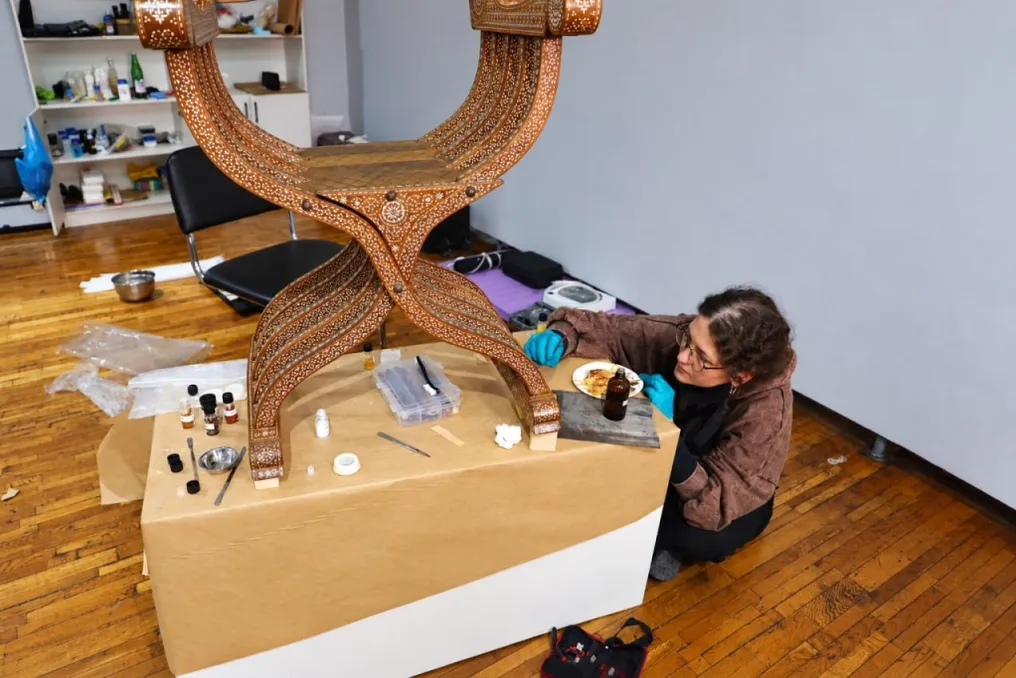
From October 6 to 30, the State Museum of Arts of Uzbekistan hosted the first restoration mission organized by French specialists. The goal of this mission was to preserve and restore historical and artistic items belonging to the Romanov Palace collection.

Nine experts from France participated in the work, focusing their efforts on two main areas. A group of five specialists, led by Delphine Eli-Lefevre, worked on restoring seven pieces of furniture from the historical fund.

Concurrently, a team of four experts under the leadership of Patricia Verge-Libay restored four paintings from the same collection, including their frames. The execution of this mission is intended to contribute to the preservation of the cultural values of the Romanov Palace, guarantee their authenticity, and strengthen international partnership in the field of restoration.

It should be noted that the Romanov Palace has been undergoing restoration since 2021. Earlier this year, in May, there was public outcry regarding a closed fashion show held on the palace grounds. Residents and public figures criticized the holding of a commercial event at a heritage architectural site that remained closed to the public.

Later, the Fund for the Development of Culture and Art clarified that the event took place exclusively on the adjacent territory and did not affect the interior premises of the palace. The agency also reported that after the completion of the work, the site will be opened to visitors as a modern museum space.

Exhibition 'Levitation' held in Tashkent dedicated to the memory of sculptor Bayat Mukhtarov
Read more
gazeta.uz

Exhibition 'Levitation' held in Tashkent dedicated to the memory of sculptor Bayat Mukhtarov

The exhibition titled 'Levitation' was held at the Uzbekistan National Museum of Fine Arts (NBU) in memory of the Uzbek sculptor Bayat Mukhtarov, who lived from 1946 to 2015. The exposition showcases works created by the artist in the final years of his life, during which he sought to move away from traditional concepts of sculpture.

The exhibition features works from the collection of the National Bank of Uzbekistan, as well as from the artist's private collection, provided by his relatives. Bayat Mukhtarov was born in Andijan, but his personality developed in Tashkent. In 1979, he studied at the Tashkent Theatre and Art Institute, specializing in monumental and decorative plasticity.

Nevertheless, in his creative process, the sculptor consciously refused to adhere to academic standards. He was interested in non-standard forms and avant-garde approaches. As recalled by his classmate Ludvig Nesterovich, Bayat always possessed a spirit of freedom and disliked naturalistic copying, preferring to find new methods of expressing thoughts through composition, combining various materials, and using symbolic imagery.

After graduating from the institute, when the demands for realistic portraits lessened, Mukhtarov began working in his own unique style. Ludvig Nesterovich notes that the value of his work lies precisely in this individuality, in being unlike others.

One of the significant influences on Bayat Mukhtarov was the British sculptor Henry Moore, known for his monumental semi-abstract figures. Mukhtarov was attracted to the expressiveness of unusual forms, and according to Nesterovich, he saw energy and monumentality in Moore's works even where proportions might seem incorrect or the solution quite simple. However, Mukhtarov never copied others' methods, striving to create his own artistic language.

Literature and philosophy also played an important role in Mukhtarov's life. Among his favorite authors were Kant, Hegel, Hemingway, Vonnegut, Bradbury, Lao Tzu, and Confucius. Marina Borodina, a sculptor, emphasizes that, like many members of his generation, the artist was fascinated by science fiction, and this interest was reflected in his works. Fantastic and mythological plots served as a tool for discussing the real world and its potential.

Marina Borodina notes that in Mukhtarov's works, Eastern Islamic art, classical American literature, and philosophy are uniquely combined. Islamic art often features the fragmentation of large surfaces into numerous small details, which removes weight from the volume and creates a sense of dissolution in space. The artist achieved a similar effect by using details to impart a light feeling. He avoided precise anatomical depiction, allowing figures to be guessed at through silhouettes and motifs, which attests to the artist's broad scope in culture and history.

Mukhtarov worked with diverse materials, including metal, stone, ceramics, glass, enamel, and sand. In his layered compositions, rough textures are placed next to shiny metallic elements and colored inserts. Individual components retain their independence and are not mixed into a single mass.

Borodina explains that, unlike academic sculpture, which is based on power and monumentality, Mukhtarov dismantled these canons, striving to give the sculpture an almost weightless appearance. Even heavy metal in his works seems to 'float' in space due to his unconventional approach to materials, allowing him to create a multilayered synthesis that is relevant today.

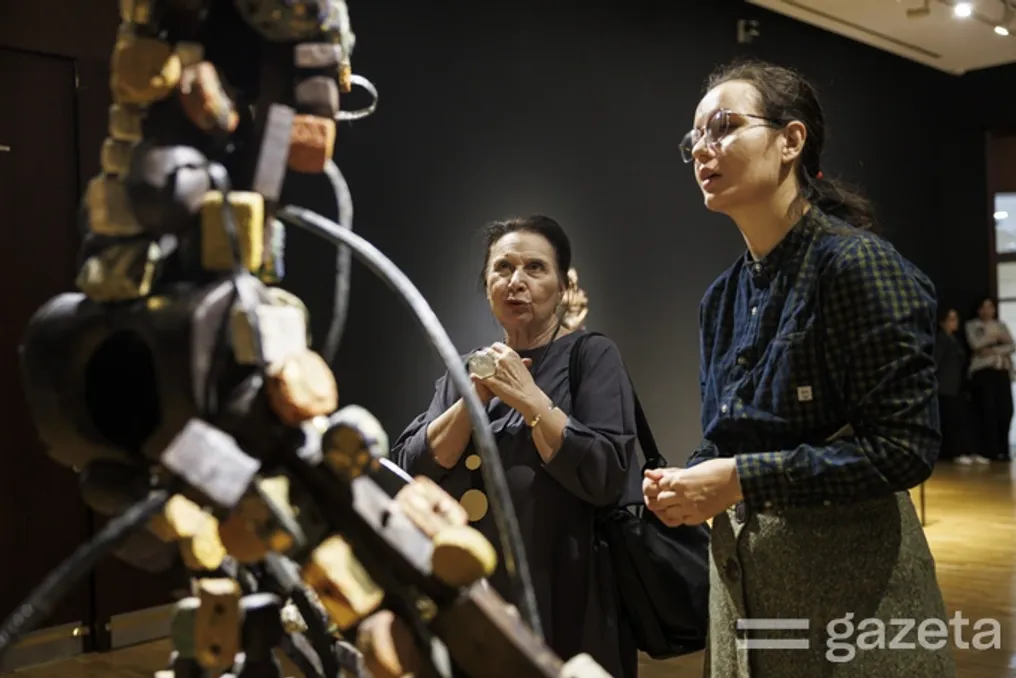
The name of the exhibition is directly related to the central work—a sculpture from 2009 made of wood, metal, and enamel. This sculpture lacks a single solid volume. Its core consists of wooden beams and plates, metal details, and blue-and-white enamel fragments. The composition is framed by metal arches that freely curve around it and extend beyond its boundaries. The space between the elements allows the viewer to see through the sculpture, and the open structure creates a sense of movement and lightness.

Ludvig Nesterovich believes that the title reflects not only the visual impression of the work but also the inner state of the artist during its creation, comparing it to a state of 'floating.' He asserts that Mukhtarov's works evoke such otherworldly sensations.

In addition to sculptures, the exhibition also features relief canvases. Marina Borodina shares that the artist initially found the image in graphic works and only later transferred it to three-dimensional space. Over time, the drawing acquired independent value.

Borodina concludes that Mukhtarov's works require careful study. Initially, the viewer's attention is drawn to individual details—be it the curve of metal, a fragment of wood, a colored insert, or an image on a panel. Then, these details come together to form an image that can transform when viewed from different angles. Mukhtarov's example demonstrates that there is no need to follow established rules in art; one can find their own path and create something original.

The 'Levitation' exhibition will be available until November 14th. The gallery operates from Tuesday to Saturday from ten in the morning to six in the evening, and entry to the exhibition is paid.
Uzbekistan Presents the Heritage of Transoxiana at UN Conference in Geneva
Read more
uzdaily.uz

Uzbekistan Presents the Heritage of Transoxiana at UN Conference in Geneva

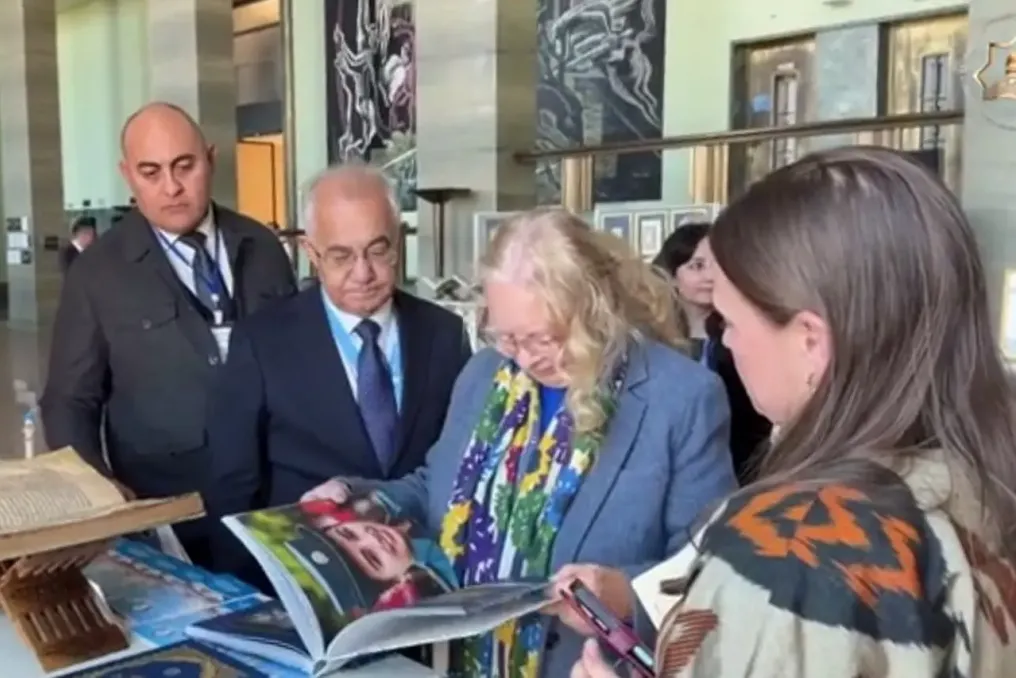
At an international academic conference held at the United Nations headquarters in Geneva on October 22, 2026, Uzbekistan presented its spiritual and scientific heritage of Transoxiana. This was reported by the press service of the National Center for Human Rights of Uzbekistan.

The conference, titled 'Islamic Civilization: The Great Spiritual and Scientific Heritage of Transoxiana and Horizons of Enlightenment,' took place in the Palace of Nations. The main speech at the opening was delivered by Akmal Saidov, Director of the National Center for Human Rights of Uzbekistan and a member of the Legislative Chamber of the Oliy Majlis.

The event was organized by the Islamic Civilizational Center in Uzbekistan, the Committee for Religious Affairs, the Academy of Sciences of Uzbekistan, the international research centers named after Imam Bukhari, Imam Maturidi, and Imam Termizi, as well as the Permanent Mission of Uzbekistan to the UN Office and other international organizations in Geneva.

This conference was part of an initiative put forward by President Shavkat Mirziyoyev at the 80th session of the UN General Assembly in September 2025. This initiative called for a special presentation at the UN on the spiritual and scientific heritage of Imam Bukhari, Imam Termizi, and Imam Maturidi.

The goal of the event was to familiarize the global community with the contribution of Transoxiana to world civilization, promote the spiritual and scientific heritage of the Uzbek people, and strengthen international cooperation in the fields of science, education, and culture, as well as enhance efforts to develop enlightenment and tolerance.

Participants included diplomats, international scientists and experts, representatives of state institutions and research organizations of Uzbekistan, as well as foreign specialists. At the opening, Tatiana Valovaeva, Director-General of the UN Office in Geneva; Eldiyor Toshmatov, Permanent Representative of Uzbekistan in Geneva; Firdavs Abdulhalikov, Director of the Islamic Civilizational Center; and Saidov spoke.

Popular