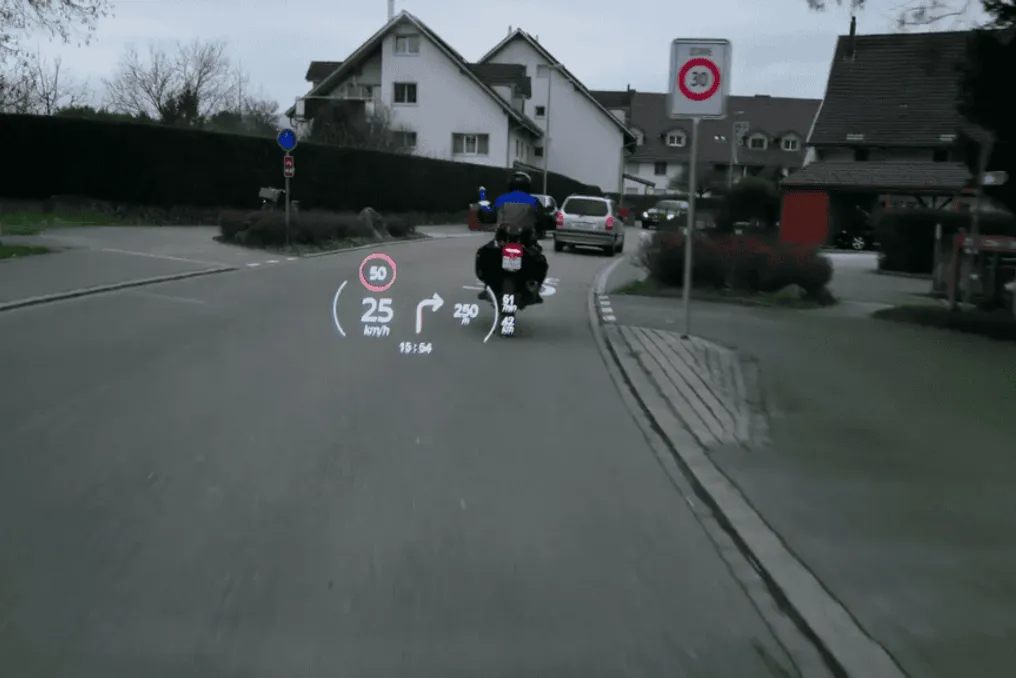
The Swiss firm Aegis Rider has introduced an augmented reality system for motorcycle helmets capable of replacing traditional devices such as GPS, maps, and speedometers. The core concept of the product is to eliminate the need for the driver to look away from the road to view this information.
The system costs start from 849 British pounds (equivalent to 6,271.98 Brazilian reais) and reach 1,399 British pounds (10,335 Brazilian reais) for more advanced configurations. The helmet itself weighs about 2 kg, which is slightly more than standard models, but it is made of carbon fiber to avoid additional weight increase.
The helmet used by Aegis Rider is manufactured by Nexx in Portugal and holds a European safety certificate, while the system itself was developed by the Swiss startup.
From a technological standpoint, the system functions like glasses that display the entire interface, including the speedometer and route. For enhanced safety, the operating mode automatically switches off during turns and when the driver looks in another direction.
The main advantage of this system lies precisely in this change of approach. Other helmet interface gadgets are usually connected to the motorcycle's visor and can obstruct viewing the road while riding.
Location sensors are installed in the chin area of the helmet and track the distance between the rider and the motorcycle. Internal sensors manage head direction and turns, activating or temporarily disabling the interface.
Additionally, there is a camera on the top of the helmet for recording road scenes, capable of shooting up to 20 hours of video in 1080p resolution.
The helmet also supports Bluetooth connectivity and microphones, allowing users to listen to music, receive navigation instructions, or take calls.
Before mounting the motorcycle, integration between the vehicle and the helmet must be performed. The company's application collects motorcycle data, such as its dimensions (weight, length, and width), in about 10 minutes and can save information for five different motorcycles to avoid repeating the process multiple times.
In the future, the company plans to implement sensors to detect objects in the motorcycle's blind spots to prevent collisions and accidents. The helmet is already available for purchase within the specified price range.