Apple's partnership with Chinese AI company faces difficulties
Read more
TechNode
technode.com

Apple's partnership with Chinese AI company faces difficulties

Apple's partnership with a Chinese artificial intelligence company has gone through a difficult period. On November 4th, Apple Intelligence began beta testing in China, utilizing Alibaba's Qwen model in select features of Siri, Writing Tools, and Visual Intelligence. This collaboration marked an unusually rapid ascent for the family of models launched in 2023.

According to data from Hugging Face, in the first seven months of 2026, the Qwen model received over 2 billion downloads on its Hub, surpassing Google and Meta. However, Qwen's journey was not smooth: the model faced internal skepticism, fierce competition, and the departure of key employees before achieving global recognition.

Qwen's path to Apple did not begin as a story of inevitable victory. Alibaba introduced Tongyi Qianwen in April 2023, months after ChatGPT triggered a race in China's tech industry to develop large language models. The model soon began publicly releasing weights, gradually making open source code a central element of Qwen's strategy.

Even within Alibaba, Qwen was not the automatic choice. Some teams continued to use Meta's Llama until 2024, while Fliggy and Alibaba.com experimented with DeepSeek's R1. The models had to earn the trust of their own company before they could capture a wider market.

Open source became part of the solution. Developers refined Qwen, created derivative versions, and fed improvements back to the team, which noted this feedback in the Qwen2.5 expansion across language, coding, and mathematics.

By the end of 2024, Qwen2.5 began gaining traction among developers in China and the US, as well as more teams within Alibaba. Then came DeepSeek. Its R1 reasoning model raised the stakes across the Chinese AI industry, putting new pressure on competitors to achieve stronger reasoning at lower costs.

According to The Information, Alibaba founder Jack Ma repeatedly demanded development updates from executives. In the final push, mattresses appeared under desks for short naps, and some employees slept only a few hours in the last week.

Qwen3, released in April 2025, entered this new battleground with eight open models and hybrid reasoning, switching between a slower 'thinking' mode for complex tasks and faster responses when deep reasoning was not required. Its largest open model utilized a Mixture-of-Experts architecture, activating only 22 out of 235 billion parameters simultaneously to reduce inference costs.

Reuters presented this launch as part of the intensifying Chinese AI race following DeepSeek's growth. Over the next year, Qwen continued to expand its model family and developer reach. However, by early 2026, the pressure on the team became not only technical.

In March, technical lead Junyang Li suddenly announced his departure in three words: 'Goodbye, my beloved Qwen.' Head of Post-Training Boweng Yu also left after senior researcher Binyuan Hui earlier that year. Alibaba did not publicly disclose the reasons for Li's departure.

36Kr reported tensions related to proposed reorganization, team boundaries, hiring, and computing resources. At an emergency meeting, researchers questioned why Alibaba Cloud customer payments could secure computing power while the Qwen team itself faced resource shortages. Management acknowledged communication issues, stating that the changes were intended to strengthen, not weaken, Qwen.

This incident highlighted the broader tension facing cutting-edge AI labs: the most advanced models require centralized capital and massive computational resources, whereas top research groups often rely on autonomy and rapid decision-making. Alibaba responded by tightening coordination. In June, the company created Token Foundry, merging key model development teams under CEO Eddie Wu.

By September, Daichen Liu, a long-time Qwen researcher, was appointed head of the Qwen large language model project, bringing clarity after several rounds of reorganization. Qwen evolved from a simple family of models into a broader stack: foundational models for language, coding, and multimodal tasks; Alibaba Cloud Model Studio for developers and enterprises; and consumer products like the Qwen App.

This breadth of coverage was significant for Apple. After evaluating Chinese AI providers, including Baidu, Tencent, ByteDance, Alibaba, and DeepSeek, Apple selected Alibaba as its partner for Apple Intelligence in China. By August 2026, Apple also trained a China-specific model with Alibaba's support, with the approved configuration including Qwen.

Apple's broader AI investment strategy also encompasses foundational models and native AI applications, as well as integrating AI into existing business processes. By May 2026, Alibaba stated that its expenditures would exceed the initial plan of 380 billion yuan. The deal with Apple marks a new phase. Maintaining Qwen's pace, focus, and ingenuity may become a more complex challenge as its surrounding infrastructure becomes increasingly massive.

Similar stories

Chinese film entirely made with AI earns little, but generates investor interest
Read more
olhardigital.com.br

Chinese film entirely made with AI earns little, but generates investor interest

Artificial intelligence (AI) still needs to prove its ability to attract cinematic audiences. In the Chinese context, the first major attempt to create a complete film using this technology did not achieve the expected success. The title Sanxingdui: Future Past earned only 1.7 million yuan (equivalent to about R$ 1.3 million) at the box office, despite having a cost of tens of millions of yuan.

The production was screened in Beijing, China, and gained attention for incorporating AI into almost all its visual aspects. The technology was also used in sound effects, although the editing was done by human professionals. However, its commercial performance fell considerably short of projections.

The Guardian reported watching the feature in an almost empty cinema hall in the Chinese capital. Furthermore, critical reception was not enthusiastic. The plot is set in a futuristic society where all decisions have been delegated to algorithms and AI systems, resulting in a global catastrophe. To reverse the disaster, the characters must decipher a secret code linked to the Sanxingdui bronze sculptures, which are connected to the ancient Shu kingdom.

The narrative blends elements of astronauts, Ancient Egypt, and travel through space-time vortices. The dialogues also demonstrate the use of an internal scriptwriting tool called Bowen, developed by the producer itself.

However, the failure of this film does not imply that the Chinese audience completely rejects AI-generated content. The country already has a robust industry of AI-created microdramas. These are short productions, typically lasting one to three minutes, made to be consumed on mobile devices.

According to The Guardian, tens of thousands of these contents are distributed monthly on streaming platforms. This industry, which was almost non-existent a few years ago, currently moves approximately US$ 3 billion (about R$ 16.5 billion).

One possible reason for the poor performance of Sanxingdui: Future Past lies in the competition with this microdrama format. While the ticket for the feature cost 50 yuan (approximately R$ 37), similar content could be accessed for free on mobile phones. A cinema specialist blogger synthesized the distinction: AI microdramas serve as entertainment, whereas cinema films need to offer an experience that justifies the viewer's investment.

For critic Yu Yaqin, the audience shows a greater willingness to pay for productions that provide a genuinely distinct experience.

Apple Intelligence available in beta for developers in China with Qwen integration
Read more
technode.com

Apple Intelligence available in beta for developers in China with Qwen integration

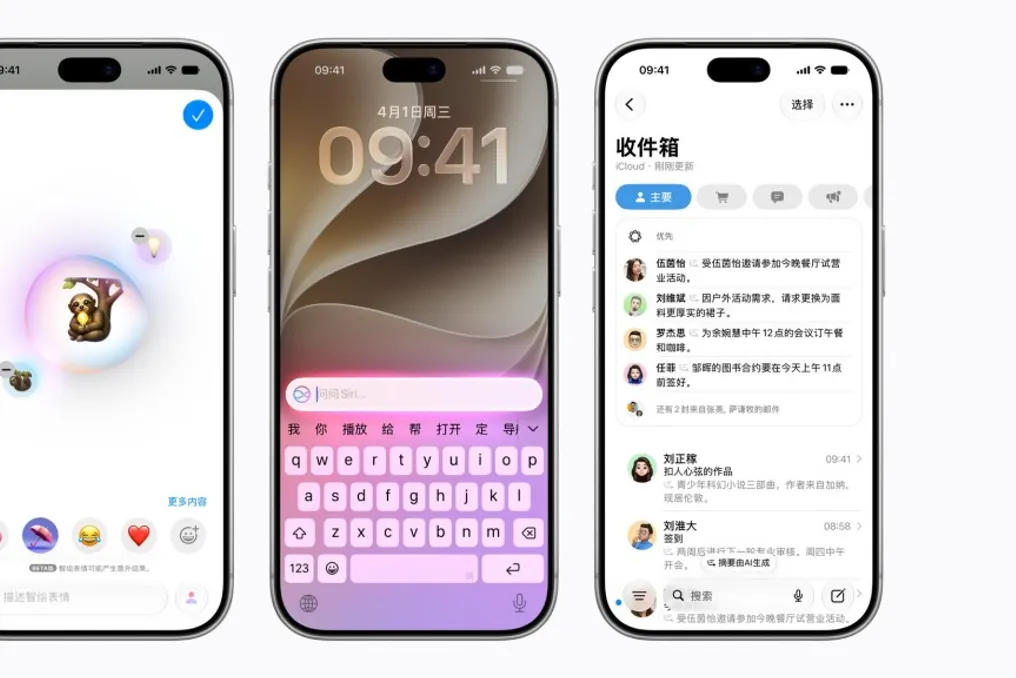
Apple began testing its Apple Intelligence system in mainland China on November 4th Beijing time as part of the developer beta for iOS 27.3. Developers using compatible iPhones can activate these features after installing the update, allowing Apple's artificial intelligence system tools to enter the market ahead of the planned public release in December.

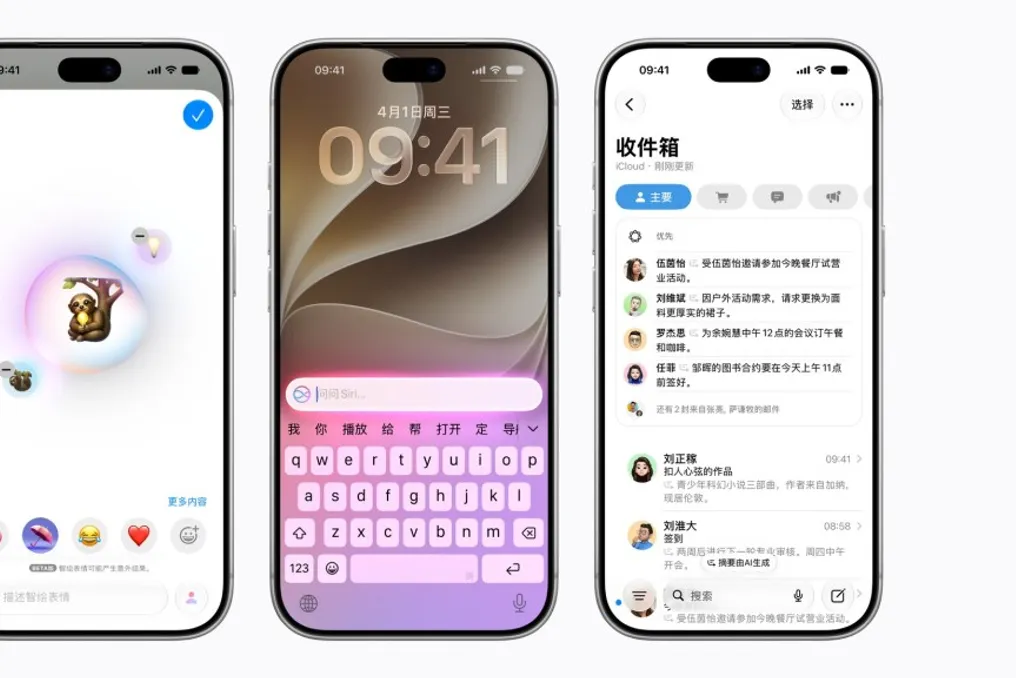
The beta version includes tools such as Writing Tools, Live Translation, Visual Intelligence, the Clean Up and Genmoji photo editing tool, as well as a feature for generating summaries for notifications and emails.

Alibaba's Qwen model is integrated into Siri, Writing Tools, and Visual Intelligence. This integration enables more detailed answers, text generation, and image understanding. However, this beta testing version does not include the next generation of AI Siri or other new Apple Intelligence features that were presented at WWDC 2026.

Apple confirms integration of Qwen for AI launch in China; beta testing begins November 4
Read more
technode.com

Apple confirms integration of Qwen for AI launch in China; beta testing begins November 4

Apple has announced the start of testing for the Apple Intelligence feature in mainland China, beginning on November 4. This launch will integrate Alibaba's Qwen model into components such as Siri, Writing Tools, and Visual Intelligence.

These new capabilities will initially be available as a beta version for iOS developers before being released more widely with the iOS 27.3 update in December, as Apple stated on October 31.

Users will be able to ask the Qwen model questions about texts, images, and documents directly through Apple's system functions. Access can be gained by logging in with a Qwen account or using the 'Sign in with Apple' feature. Additionally, Writing Tools will gain the ability to generate original content using Qwen.

The initial implementation phase includes support for live translation, photo cleanup, Genmoji generation, natural language image search, and creating summaries of messages, notifications, and recorded conversations. Support for other Apple platforms will follow after obtaining the necessary permissions. [Apple, in Chinese]

Popular