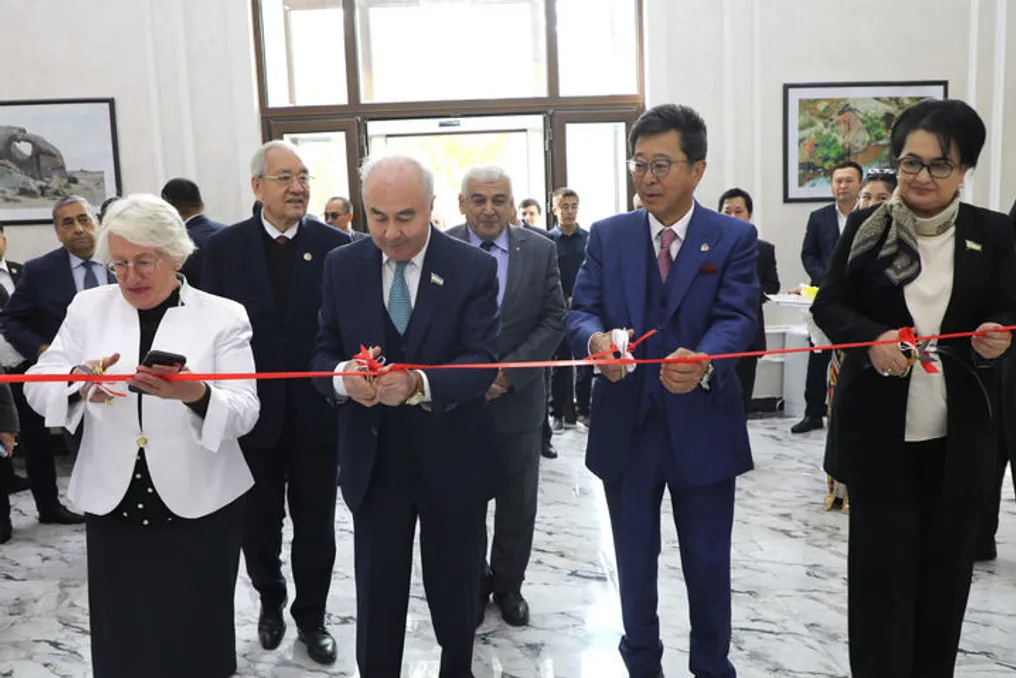
Scientific center for desert studies opened in Samarkand with participation from Japan
Read more
Podrobno.uz [uz]
podrobno.uz

Scientific center for desert studies opened in Samarkand with participation from Japan

A Desert Research Center has been launched at Samarkand State University as a result of collaboration with the University of Tottori in Japan. The main task of the center's scientists is to conduct research in the arid zones of Central Asia, develop land restoration methods, and create agricultural technologies suitable for water-scarce conditions.

This new center is intended to become an international scientific platform that promotes knowledge exchange, joint projects, and the training of qualified personnel. The center's activities will focus not only on studying arid landscapes but also on finding effective solutions to ensure sustainable development for both Uzbekistan and neighboring countries.

Opening Event

The opening ceremony gathered several important guests, including Rector of SamSU Rustam Holmuradov, President of the University of Tottori Tasuku Harada, representatives of the Ministry of Higher Education, Science and Innovation, the administration of the Samarkand region, and delegations from Japanese scientific and international organizations.

During the meeting, participants discussed issues related to desertification processes, the potential for international partnership, and the possibilities of applying scientific developments in the agricultural sector. Results of arid region studies were demonstrated, and the experience of the international project Blue-SATREPS was presented, along with plans for further cooperation between the two universities.

Significant attention was paid to integrating scientific research with the education system and implementing advanced technologies in agriculture. The center is expected to support the creation of innovative solutions and the training of specialists capable of working in conditions of climate change.

Previously, Uzbekistan put forward an initiative to create an International Hub for Arid Territory Ecosystems. This hub should consolidate research concerning the conservation of desert biodiversity and the restoration of degraded lands, including the Aral Sea region.


Similar stories

Meteosat satellite detected six-hour dust cloud over Tashkent and surrounding areas
Read more
podrobno.uz

Meteosat satellite detected six-hour dust cloud over Tashkent and surrounding areas

The National Committee on Ecology and Climate Change, along with relevant departments of Tashkent and the Tashkent region, in collaboration with representatives from Ecopolice, the General Prosecutor's Office, and the Waste Management and Circular Economy Development Agency, organized inspections to prevent atmospheric pollution.

A special commission continuously monitors the state of the airspace. On the night of October 24 to 25, a sharp decrease in air quality was noted in the capital due to unfavorable meteorological conditions. During the evening and night, the concentration of suspended particles PM increased, causing the values according to the international Air Quality Index (AQI) to reach the 'unfavorable' category and remain at this level for people sensitive to pollution.

However, according to the national index, the average indicator across the entire city corresponded to a 'green' level for PM2.5 particles and a 'yellow' level for PM10. Specialists attribute the accumulation of PM2.5 and PM10 particles in the lower layer of the atmosphere to weakened winds and nighttime cooling, which slowed down the process of air exchange in the lower atmospheric layers.

Furthermore, data from the Meteosat meteorological satellite showed that on October 25, between 02:00 and 08:00, temporary dust pollution was observed over Tashkent and neighboring areas. Throughout the night, a mobile environmental laboratory conducted measurements, establishing that in most locations, the content of fine PM2.5 particles was classified as 'unfavorable' and 'very unfavorable' according to the international AQI scale.

Director of Climate Center Explains Causes of Dust in Uzbekistan
Read more
podrobno.uz

Director of Climate Center Explains Causes of Dust in Uzbekistan

Uzbekistan is located in a zone that can be called the 'Great Desert Route,' situated between the Gobi and Sahara deserts, which leads to the natural and frequent appearance of dust. This was reported by Farrukh Sattarov, director of the National Center for Climate Change, during a press conference.

The expert specified that dust comes not only from natural sources but also from neighboring countries, including China, Kazakhstan, and Afghanistan. Furthermore, the republic's distance from the sea coast also negatively affects the level of dustiness in the region.

The topic of urban planning was raised during the event. Participants asked about the possible violation of wind rose patterns in Tashkent due to irrational development. Sattarov acknowledged existing problems with compliance with standards, despite the country having an environmental expertise center.

The director noted that there are instances where environmental expertise requirements are ignored; for example, when permission is granted to build a four-story building, it is constructed higher. He emphasized that it is incorrect to deny this problem.

Nevertheless, Sattarov announced the tightening of the legislative framework in this area. Last year, a law on environmental expertise was adopted, which included strategic expertise. Starting this year, subordinate acts and expertise of objects during the construction of urban and industrial zones covering vast territories are being implemented.

It was previously recorded that during atmospheric temperature inversion in Tashkent, about a ton of fine particulate matter PM2.5 can accumulate if the height of the inversion layer is approximately 200 meters. With weak winds, these particles disperse poorly and can settle near the ground surface, leading to an increase in pollutant concentration.

Popular