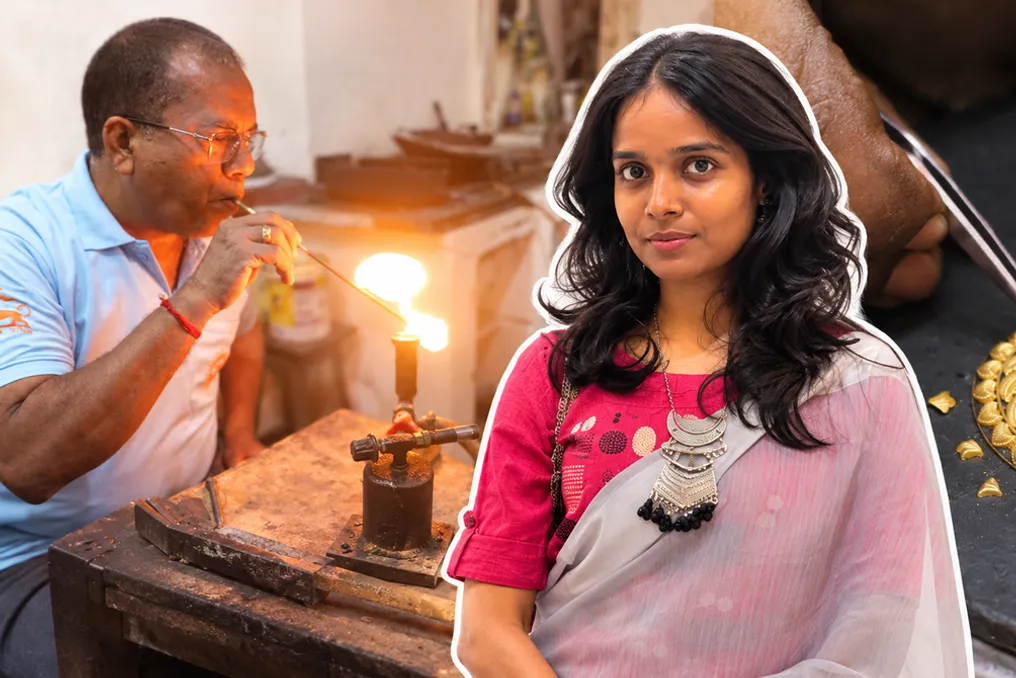
In a small workshop in Goa, barely fitting one person, the furnace burns, and the air is saturated with heat and the faint smell of melting gold. The master leans over the workbench, holding a thin sharpened wire in his hand, and begins engraving a name on a ring, executing every stroke with particular care, without using any machines.
This world became the subject of the documentary film 'Bhaangar Kalakusar Karigiri,' directed by Prachi Shirodkar. She knew this environment very well, as her father and grandfather had previously worked in this field.
The 28-year-old director, who also handled filming and voiceover, had her father write the script and her partner handle the editing.
In 2020, when the country implemented quarantine, Shirodkar was in her first year of architecture bachelor's degree. When classes were suspended and the outside world was closed off, she found herself alone with her thoughts for the first time in many years. She recalls that it was during that period that she truly got to know herself.
During this time, she discovered that she was drawn not to design, but to storytelling, which had always been her true passion. Although she grew up surrounded by theater and acting, the lack of family members in the film or media industry led her to choose architecture as a safer and more familiar option after school.
Quarantine gave her the opportunity to reevaluate her priorities, and she switched to mass communication. She asserts that this was her calling: 'It is me. I know what I am doing, and I love it.'
For her graduation project, Shirodkar turned the camera toward the jewelers she had observed since childhood. She emphasized that her goal was not to present the entire community, but to highlight their craftsmanship and art. Furthermore, she consciously decided to include female artisans in the film, noting that 'it is no longer just men who do this.'
The decision to film in Konkan was never a matter of choice. She explains that as a Goan, filming in Goa, she used her native language. She also notes that even within this language, there are slight differences between the Mapusa, Pernem, and Margao dialects.
Her father, who also had experience in the industry, wrote the film's script using specific terminology, which provided her with a foundation for creating the picture. The project almost fell through: it started as a group assignment in college that could not be realized due to team issues, and Shirodkar postponed it until after graduation. Her partner, Mario Pimenta, convinced her to resume work on it. She expressed gratitude to him for insisting on it.
He took on the editing, while she independently managed the filming, directing, and voiceover, despite having absolutely no experience with a camera. The film was shot without a fixed schedule and with an extremely limited budget. She said that the only decisive factor was what she had on hand. Shooting days depended entirely on the free time of her subjects, many of whom were relatives and long-time friends. This meant shooting in short segments over several weeks, rather than as a continuous process. Assembling a coherent narrative from these fragments became one of the most challenging tasks.
One moment remains unforgettable to her: a craftsman engraves a name on gold using only a thin metal wire. She notes that it looks not like a knife, but like wire, and that he carved the entire name using only it. 'Our hands are so skillful.'
The film's festival run began with rejections. This was followed by an unexpected first selection at Jackson Doc Fest in Tennessee, USA, as well as screenings in Kerala at the International Folklore Film Festival and selection for the International Cultural Journal in Uzhorod, Ukraine. The film also won the Best Documentary Film award at the Miseentage Indian Film Awards. Recently, Shirodkar received the Young Achiever award from Rotary International for her contribution to culture. She shared her impressions of the moment: 'They just called my name, and I was genuinely surprised.'
She currently works as a director's assistant in Mumbai, and the scale of commercial production has changed her approach to her own filmmaking. She believes that theoretical knowledge differs greatly from practical experience. If she were to make the film again today, she would write a more complete script and hire a professional cinematographer instead of doing everything herself.
Her advice to other young filmmakers starting without money or a team is extremely straightforward: find people you trust, even if the team is small. She is confident: 'If you have the right people around you, everything falls into place.' She urges not to let the lack of budget become an obstacle to starting, reminding that there are directors who have succeeded with minimal resources. Her final advice: 'You have a camera, you have a story. Just shoot it. And first look closer to home, because the strongest stories are often near you. Start where you belong, and then move forward step by step.'