Perplexity launches Teammates, an AI agent system for continuous tasks and collaboration
Read more
Olhar Digital
olhardigital.com.br

Perplexity launches Teammates, an AI agent system for continuous tasks and collaboration

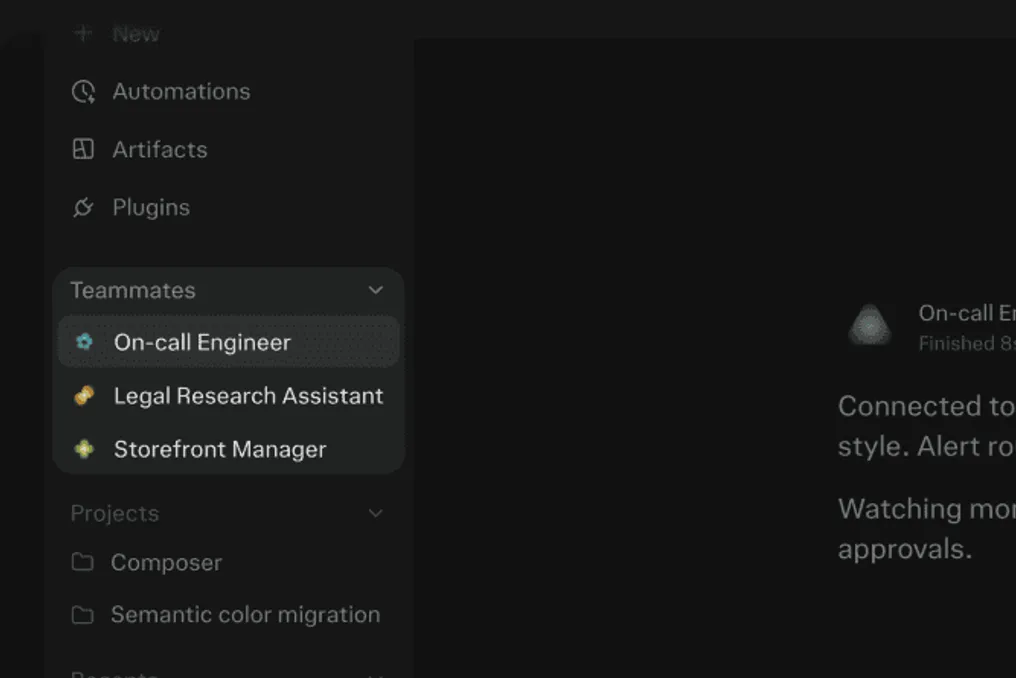
Perplexity has unveiled Teammates, a new artificial intelligence (AI) agent system designed to manage tasks continuously in corporate environments. This feature allows for the assignment of distinct responsibilities to assistants operating in parallel, monitoring projects and taking actions automatically upon detecting changes, without the need for new instructions at each stage.

The functionality was presented this Thursday (5) and operates integrated with Perplexity Computer, the company's platform that employs agents for activity execution. The differentiator of Teammates lies in its ability to maintain active processes, structure large-scale work, and interact with other agents and collaborators.

Each agent has access to projects, skills, memories, files, and tools previously configured by the user within Perplexity. The main objective is to eliminate the repetition of context explanation whenever a new task is initiated.

Initially, this novelty is available on the web version for subscribers of the Max plan, which costs US$ 200 monthly (equivalent to about R$ 1,092). Although the company has plans to launch native applications for mobile and desktop devices, they have not yet been released.

Teammates requires a subscription to Perplexity Max, the most advanced plan, which can be contracted monthly for US$ 200 or annually for US$ 2,000 (approximately R$ 10,924). This addition expands the capabilities of Perplexity Computer, which already supported the use of various AI models and tools to solve complex problems. With Teammates, the company seeks to convert these resources into assistants with permanent responsibilities, surpassing the function of mere responders to isolated requests.

Aravind Srinivas, CEO of Perplexity, expressed the company's vision that organizations will be able to count on hundreds of agents working for each employee. The executive stated in an X post: 'Over time, we imagine that every organization will have hundreds of teammates working for each person.'

This launch places Perplexity in a fierce competition for the development of AI agents focused on the workplace. OpenAI introduced Dots in September, offering assistants capable of operating continuously, learning from the user, and executing tasks through their own cloud computer. Anthropic also released a preview of Claude Duet research in October, a tool that also uses proactive agents for professional activities.

These initiatives signal a transformation in how AI is used. Companies are moving from a model based solely on question and answer to systems that can receive goals, plan steps, utilize tools, and monitor tasks over long periods. Perplexity's proposal is to apply this model to various organizational functions, promoting collaboration and information sharing among agents.


Similar stories

Use of Artificial Intelligence for Content Review and Question Training for Enem 2026
Read more
g1.globo.com

Use of Artificial Intelligence for Content Review and Question Training for Enem 2026

Artificial Intelligence (AI) presents itself as a potential aid in preparation for the National High School Exam (Enem), offering students support in reviewing subjects, creating mock tests, and identifying weak points. However, specialists emphasize the need to check the information provided by these tools in reliable sources.

Vinícius Gonçalves, coordinator of the Computer Science and Systems Analysis and Development courses at Uninassau Teresina, suggests that an effective approach is to use past Enem exam papers to guide the answers generated by AI. He explained that the best tactic for students, especially when generating questions, is to input models of previous exams into the artificial intelligence, instructing it to base its new questions exclusively on this data.

This methodology allows participants to request exercises similar to those covered in previous years and review topics that are recurrent in the exam.

How to apply AI in content review

The technology can be used to create summaries, mind maps, and mock tests, in addition to clarifying conceptual doubts. Students also have the option to ask questions about specific subjects and monitor their own progress during study. According to Vinícius, the customization of learning depends on constant monitoring of performance. By recording their successes and difficulties in various tasks, the student can use this data to define the next focus areas for review.

The professor warns, however, that AI tools can produce false or invented data, a phenomenon called AI 'hallucination.' For this reason, he advises students to always validate answers and demand references to confirm the origin of the information. He advised: 'It's simple, always ask for the source. After you see an answer that doesn't cause you much discomfort or you have a study material and what the AI is saying does not match the study material, ask it to identify the source, so you can validate where this information is coming from.'

The central recommendation is to compare the obtained answers with official materials and reliable answer keys, since AI assists in explaining questions but should not be seen as an infallible source of information.

Precautions in the final phase before Enem

In the final stage of Enem preparation, the professor advises prioritizing exercise resolution over trying to absorb large volumes of new content all at once. During this period, AI can be useful for creating exercises based on old exams, helping candidates get used to the structure of the assessment.

Vinícius points out that regular practice helps the student identify testing patterns and develop efficient methods for solving questions. The tool also has the capacity to present new scenarios for topics frequently addressed in the test. However, the coordinator warns that the use of technology must not replace the student's critical thinking. If it is used only to deliver ready-made solutions, AI can foster dependence and compromise the development of autonomy.

He warned: 'You can turn it into a crutch instead of a tool, where the student becomes totally dependent on the answers from this artificial intelligence.'

Therefore, the guidance is for the student to try to solve the exercises before consulting the tool and subsequently check the answers in secure sources. In this way, AI acts as a learning support, without supplanting the effort and practice necessary for Enem.

Infinigence AI developed a three-component character agent, halving the time to generate the first token using split output
Read more
pandaily.com

Infinigence AI developed a three-component character agent, halving the time to generate the first token using split output

Infinigence AI, in collaboration with Three-Body Universe, the developer of Liu Cixin's franchise 'The Three-Body Problem,' unveiled a character agent at the 'Three-Body Day' event in Beijing on October 25, 2026. The Chinese name of this agent corresponds to the concept of Sophon from the novels and it serves as an administrator of a mini-universe from the books.

The presentation was conducted by Infinigence CEO Xia Lixue and Three-Body Universe CEO Zhao Jilong, according to reports from QbitAI and Zhidx. According to the QbitAI article, the information was provided by Infinigence itself.

An interesting aspect is the process of creating and maintaining such an agent. It operates on Infinigence's AgentWorks platform. Source material is uploaded into grouped knowledge bases, which are automatically parsed, chunked, and converted into embeddings. The character's personality is defined through multi-level structured prompts, rather than a single long instruction.

A memory module called Infini Memory allows the agent to retain facts between sessions, preventing contradictory or fragmented memories. Responses pass through a cycle involving several agents: first, a response is generated, then it is evaluated, and only failed parts undergo refinement. Personality generation and knowledge retrieval are performed in parallel to save time, while a separate reviewer agent checks each response for deviations from the character and inconsistencies with the novel's setting.

For testing, Infinigence created a tracing-based evaluation system that automatically verifies results against the source text, while the Three-Body Universe content team manually reviews the obtained data.

Infinigence Infrastructure Achievements in Serving

In the field of serving, Infinigence's infrastructure plays a key role. Typically, the output of large models is divided into a prefill stage, which reads the prompt, and a decode stage, which forms the response. Infinigence's proprietary heterogeneous inter-cluster architecture, named PDD, goes further by breaking this two-stage chain into a three-stage disaggregated structure, which they label P-RLD-MD, distributed across separate clusters.

Since agent traffic often reuses the same query prefixes, the decode side applies RadixCache prefix caching. This ensures that the overall context, such as personality, is not transmitted or recalculated with every call. The company claims that this reduces the volume of KV data transferred between clusters tenfold, allowing the use of standard Ethernet, reducing time to the first token by 51.5%, and decreasing cost per token by 37.5%.

For a chat character with a long fixed personality and a large number of regular users, savings on common prefixes constitute the main part of the costs.

AI-driven vulnerability detection has doubled and is causing concern among security experts
Read more
olhardigital.com.br

AI-driven vulnerability detection has doubled and is causing concern among security experts

Artificial intelligence is accelerating the process of discovering software vulnerabilities, reducing the time allocated for their remediation. Cybersecurity experts polled by Reuters predict new disruptions in digital services as companies and governments attempt to prepare for the exploitation of these flaws.

A study conducted by VulnCheck, scheduled for publication in the coming days, shows that the number of discovered digital vulnerabilities has doubled compared to the previous year. Issues registered this week on European government websites demonstrate the pressure such discoveries can cause.

Disruptions began on Wednesday after vulnerabilities were found in PHP, a programming language used in many parts of the internet. To prevent attacks, operators rushed to fix their systems. Some temporarily took sites offline because they could not apply updates before potential intrusions.

This race for fixes occurred during a week already marked by other security issues. Vulnerabilities were disclosed in Node.js and Plex, as well as incidents related to the AI platform LiteLLM and the development platform Railway. The Indian certification authority eMudhra also drew attention due to the use of an extremely weak cryptographic key, which could have jeopardized internet users.

Matthew Prince, CEO of Cloudflare, told Reuters that he is aware of other serious vulnerabilities in software critical to network operation. In his assessment, the sector will face difficult months ahead. He noted: 'I think we will have several years where it feels like the sky is falling every week.'

Previously, searching for vulnerabilities in complex programs required specialized knowledge. Developing tools to exploit them could take weeks or months, giving system administrators time to prepare fixes and distribute updates. However, artificial intelligence is shortening this timeframe. Models are capable of continuously analyzing large codebases, finding issues, and helping develop exploitation tools in just a few hours.

Shane Fry, CTO of RunSafe Security, emphasized the change in the pace of this process. He stated: 'What is fundamentally and undeniably changing is the time required both to discover vulnerabilities and for adversaries to be able to exploit them.'

In light of this situation, security teams must handle tasks that go beyond simply identifying code errors. Specialists are concerned about the reduced response time, but there is no consensus on whether accelerated vulnerability discovery will lead to a wave of successful attacks.

Daniel Steinberg, lead developer of the curl file transfer tool, notes that some vulnerabilities found by AI models are complex and difficult to exploit. Rami Rahman from security company ArmorCode also points out that publishing more vulnerabilities does not necessarily mean an increase in successful attacks. The PHP case serves as an example of this difference: threat intelligence firm Hunt.io discovered aggressive exploitation attempts but reported that by 2 PM Eastern Time on Thursday, the tracked attackers had apparently not yet managed to develop a functional tool to use this vulnerability.

Prince mentioned signs of intrusion related to the vulnerability. Nevertheless, he believes that accelerated problem discovery can bring long-term benefits by allowing the fixing of errors that have remained hidden for years.

Popular