Ocient Raises $100 Million to Accelerate Enterprise Agent AI Solutions
Read more
Ventureburn
ventureburn.com

Ocient Raises $100 Million to Accelerate Enterprise Agent AI Solutions

Ocient, a technology company based in Chicago, has successfully raised $100 million in a Series C funding round. The investment round was co-led by BOKA Capital and OCA Ventures. This infusion brings the company's total raised capital to $260 million.

Several existing investors participated in the new round, including Greycroft, In-Q-Tel, and Blue Bear Capital. Returning sponsors included Buoyant Ventures and PSP Growth. Pritzker Group Venture Capital and Eron Wolf also joined the round. Dallas Venture Capital is a new investor.

This investment is aimed at accelerating the delivery of OcientAIQ Solutions. These solutions are designed for organizations implementing agentic AI on petabyte-scale high-dynamic datasets, enabling deeper insights to be extracted from massive data volumes.

Founded by CEO John Morris, Ocient develops a unified platform for data and analytics. The company's technology allows enterprises to run AI agents against large-scale data. The platform supports real-time analytics both in the cloud and on-premises.

OcientAIQ unifies data ingestion, analytics, management, and orchestration processes into a single operational layer for enterprise AI applications. This platform enables organizations to gain valuable insights and activate automated decisions. Its solutions are intended for industries managing constantly growing volumes of data, such as telecommunications, defense, and national security. Other data-intensive sectors can also benefit.

Clients can analyze information in full resolution without relying on sampling. This capability helps organizations retain critical details during analysis. The platform integrates governance elements into agent activities, covering data access, policies, and data provenance. This facilitates result verification and maintains control over AI operations.

Ocient asserts that its analytical processing occurs within its proprietary data engine. This approach ensures result reproducibility and reduces unnecessary data movement, potentially lowering token costs associated with language model processing. The company forecasts tripling its revenue this year.

Ocient plans to accelerate the deployment of industry-specific solutions. Priority will be given to organizations using AI agents for big data workloads. Each offering addresses specific operational needs. The investment will support engineering work, implementation, and commercial growth.

The company will be able to strengthen client deployments and expand expertise for production needs. Earlier this year, the company formalized its operations in India and established Ocient National Security Solutions as a specialized subsidiary. These steps support commercial and governmental work.

John James, CEO of BOKA Capital, emphasized the importance of reliable data processing, noting the growing demand in the defense sector. BOKA believes that Ocient is capable of solving complex, large-scale data challenges. OCA Ventures also affirmed its confidence in the company.

Jim Duggan, Founding Managing Partner, highlighted the technological progress, stating: 'This latest capital infusion demonstrates our continued support for the technology. As the adoption of AI infrastructure in enterprises continues to grow, successful deployment could position OcientAIQ as a dominant platform for data-driven industries.'

Organizations require robust systems for processing enormous volumes of data. Ocient intends to provide this through a combination of analytics and governance. This method bridges the gap between AI and corporate information. The company's growth will depend on product realization and adoption.

The company notes that this can reduce workflow fragmentation and redundant data movement. Ocient competes with established data platforms and analytics tools. Morris states that the company's technology can complement existing infrastructure. The next step for the company is to convert investor trust into actual customer adoption.
Similar stories

Sentra raises $150 million to protect data from AI agents amid growing corporate AI adoption
Read more
ventureburn.com

Sentra raises $150 million to protect data from AI agents amid growing corporate AI adoption

With the increasing use of AI agents in large companies, these automated tools have gained unrestricted access to the organization's client files and records. However, most companies still cannot accurately determine which specific data these agents are viewing. In light of this, Sentra has raised $150 million in a new funding round led by Capital One Ventures to ensure data protection before it reaches the agents.

The company, based in New York and Tel Aviv, reports that its total raised capital now exceeds $250 million. Furthermore, Capital One Ventures has secured a seat on the board of directors. Additionally, existing investors, including Bessemer Venture Partners, Zeev Ventures, Standard Investments, Munich Re Ventures, and Key1 Capital, have decided to increase their investments.

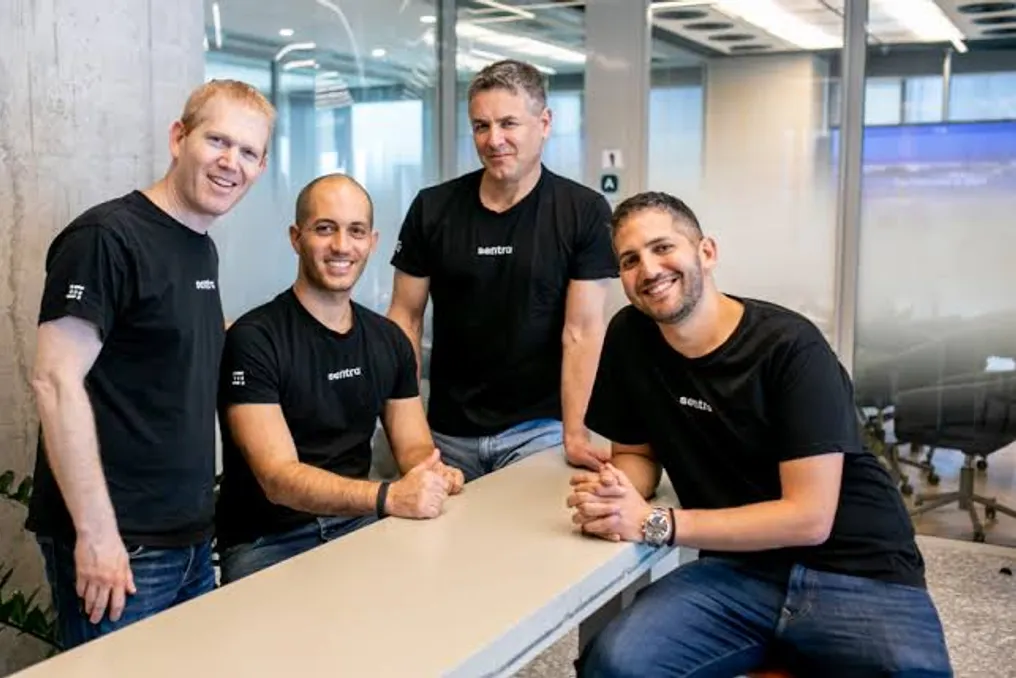
The Sentra team has deep roots in cybersecurity. The four founders launched Sentra in 2021, including CEO Yoav Regev and President Asaf Kochan, both of whom previously served as commanders in Unit 8200. They developed Sentra using four security tools: DSPM, DDR, data access management, and DLP.

Simply put, Sentra can detect sensitive data, determine who or what can access it, and revoke access for those who do not require it. Sentra's advantage is that it operates within the client's own environment; sensitive data is never sent to Sentra. The system works in three stages: before an incident, it classifies data and enforces the principle of least privilege; during an incident, it flags suspicious access and revokes permissions; after an incident, it provides an exact list of data the agent could have accessed.

CEO Yoav Regev emphasized that AI agents have become the most active consumers of corporate data. Nevertheless, many of these agents inherit access rights that most businesses and individuals do not properly verify. He noted that the problem of one employee with excessive access rights is serious, but an agent with the same level of access performing thousands of queries per hour poses a much greater threat.

Lyft is already collaborating with Sentra. Its Chief Information Security Officer, Haim Sanders, stated that his teams aim to rapidly implement AI, but they need to know what data the agents can access before activating them. This risk is precisely what Sentra's offering addresses.

Regev also reported that since the last round, the company has tripled in size, and local valuations place its worth near one billion dollars, demonstrating over 300% year-over-year growth. The company serves about 100 large corporate clients in the US and Europe, generating tens of millions of dollars in revenue. The company employs 130 people, half of whom are located in Tel Aviv.

The raised funds will be directed towards deepening visibility into agents and copilots, maintaining continuous least privilege control, and accelerating the localization of issues in case of agent misconduct. Additionally, Sentra plans to double its staff, open an office in London, and begin pursuing federal contracts in the US starting in late 2027.

This funding round comes amidst competitor activity: Cyera reached a $12 billion valuation after raising $600 million in June, Zenity received $125 million in August for agent activity monitoring, and Veeam agreed to acquire Securiti for $1.725 billion last year. Investors believe that AI data security is the next necessary expense. The involvement of a bank's venture arm in fundraising also signals the importance of this area, as banks hold some of the most sensitive data on the planet.

For founders and security executives, the conclusion is clear: when implementing agents, the data map is as important as the model itself. Sentra is betting $150 million on the fact that most companies have yet to create this map.

Collective raises $100 million to expand AI-based financial services
Read more
ventureburn.com

Collective raises $100 million to expand AI-based financial services

San Francisco-based startup Collective has raised $100 million to develop its financial services designed for individual entrepreneurs. The platform integrates various business functions, including accounting, payroll, tax reporting, and other services.

The funding includes a $40 million Series B round, as well as $60 million from General Catalyst's Customer Value Fund. General Catalyst, QED Investors, and Gradient Ventures led the equity round; Intuit Ventures, FT Partners, and SemperVirens also participated.

Collective's founder is Hooman Radfar, who learned about the financial benefits of business tax planning through his family. Reports indicate that his father's business structure helped him save significantly more on self-employment taxes than his mother's.

The $60 million comes from General Catalyst's Customer Value Fund. Unlike traditional equity financing, this arrangement supports client acquisition through a revenue-based repayment model. Thus, the total funding package reached $100 million.

The company has not disclosed its current valuation or the specific repayment terms for the customer acquisition mechanism. General Catalyst has used similar mechanisms to support other companies in the financial and business software sectors, but the specific terms of the Collective agreement have not been made public.

A separate $40 million Series B round provides traditional equity financing for broader company expansion. Collectively, these funds support both product development and customer base growth. General Catalyst partner Pranav Singhvi noted that small businesses represent a significant opportunity and expects AI adoption to accelerate growth in this market.

Previously, Collective raised $8.65 million in a seed round in 2020, followed by $20 million in a Series A round in 2021, and $50 million in July 2023. The market potential is assessed as substantial.

Collective serves individual entrepreneurs, independent consultants, and freelancers. The company's comprehensive membership provides business registration, bookkeeping, invoicing, payroll, and tax filing. Collective members are also offered health and business insurance.

In July 2026, the company launched its Insurance Center in partnership with Coverdash and Solo Health. In April 2026, Collective acquired the AI bookkeeping startup Open Ledger. The new funding will help expand these offerings into the banking sector and add additional insurance products.

Collective reports 127% year-over-year business growth and cumulative tax savings of $350 million for its members. According to the company, its most profitable clients save up to $40,000 annually. However, the company has not disclosed revenue or customer numbers, so these figures remain metrics provided by the company itself. The company estimates that over 30 million businesses in the United States have no employees, and AI tools can help a larger number of independent founders manage complex financial operations without hiring specialized teams.

Collective faces competition from financial platforms serving independent workers and small businesses, notably Lettuce Financial. The market has also experienced turbulence, including the sudden closure of Bench in December 2024. Other AI bookkeeping startups target audit firms and corporate finance teams, which differs from Collective's approach focused on the needs of individual entrepreneurs. Collective's strategy is to automate more workflows within a single integrated platform, potentially reducing the need for separate tools for accounting, taxation, and insurance. Radfar believes that AI can enhance the efficiency of independent founders, and the next phase of the company will focus on testing its integrated financial platform's ability to deliver on this promise at scale.

Hyphenate raises $45 million in Series A round to create financial management AI agents
Read more
ventureburn.com

Hyphenate raises $45 million in Series A round to create financial management AI agents

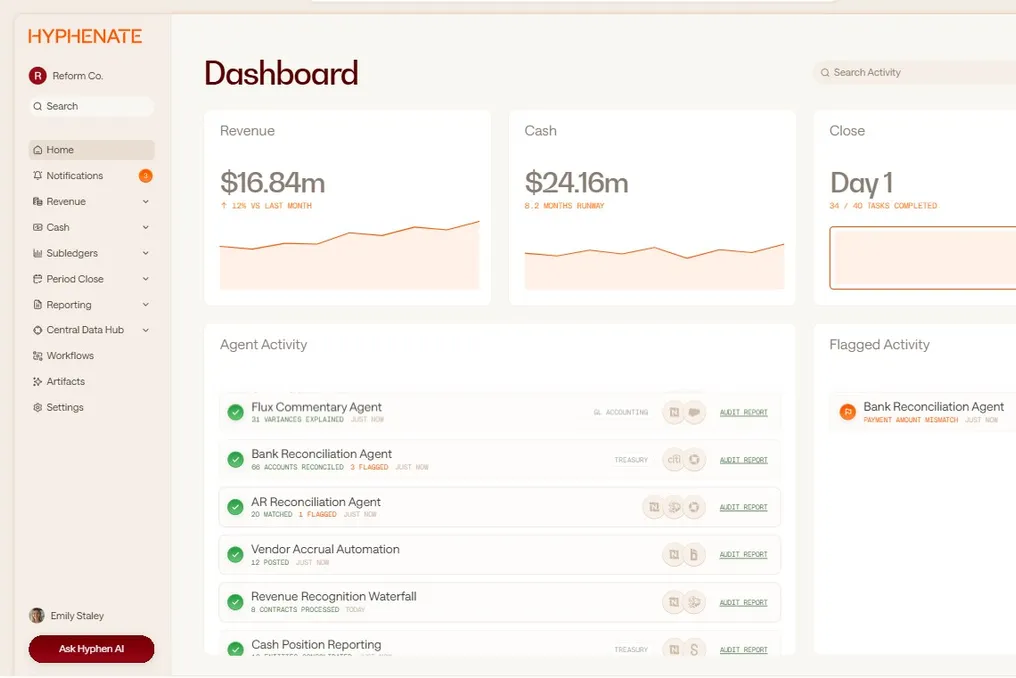
Hyphenate, formerly known as Maximor, has raised $45 million in a Series A round led by Nexus Venture Partners. The New York-based company was renamed at the beginning of October. This capital injection brings the total amount raised to $54 million.

The company's core idea is to use artificial intelligence to perform financial operations beyond simple communication. Hyphenate was founded by two Microsoft veterans: CEO Ramnandan Krishnamurthy and co-founder Ajay Krishna Amudan, who spent significant time in finance and corporate transformation at Microsoft, including restructuring the company's internal financial platform.

The company began operations in 2024. In September 2025, it secured a seed round of $9 million, supported by Foundation Capital alongside Gaia Ventures and Boldcap. Angel investors included Arvind Srinivasan, CEO of Perplexity, and Tien Tsuo, founder of Zuora.

The renaming to Hyphenate occurred in early October 2026, referencing financial processes such as Order-to-Cash and Procure-to-Pay, where each process is linked by a hyphen. Krishnamurthy explained that 'the multi-hyphenated approach is not limited to one track.'

Hyphenate does not require a complete replacement of existing ERP systems. Its agents operate on top of already used systems, such as banking and settlement systems. They are capable of making entries in accounting books, reconciling bank statements, and processing invoices.

The system also handles invoice sending and approval collection. This is comparable to a junior accountant who never misses deadlines. If a situation requires human judgment, the agent flags it in Slack. All actions are recorded, providing auditors with a clear trail.

The platform covers five key areas: order-to-cash, treasury, general ledger and period close, procure-to-pay, and reporting. The company claims that about 98 percent of transactions are processed entirely without human intervention. Furthermore, payment is based on actual work performed, not on the number of licenses.

Investors decided to allocate $45 million based on performance metrics. Hyphenate reports an 86-fold revenue growth since its seed round. Clients show high loyalty: on average, they use six modules, and 40 percent expand their cooperation within the first year.

Examples of successful implementations include one cybersecurity firm that launched in less than four weeks and reduced its cash staff from twenty to five people. Additionally, a private investment holding with over thirty subsidiaries managed to reduce audit findings from seven to zero in six months.

It should be noted that these figures are provided by the company itself and have not yet undergone independent verification. Previously, according to software leasing firm Rently, the platform allowed month-end closing to be reduced from eight to four days. Nevertheless, this explains Nexus's quick decision.

Many small and medium-sized enterprises still use Excel for closing financial reports, which is a slow, error-prone process that leads to end-of-month losses. Hyphenate bets that clients are looking for more than just another dashboard.

Hyphenate's offering presents low risk for CFOs because it allows testing AI agents without the need to invest in migrating the entire system. These investments signal capital movement into functional AI solutions. For founders, this proves that an audit trail can gain trust in a skeptical industry. Hyphenate is interested in further advancing pricing, margin, and capital decisions, allowing financial teams to save time on reconciliation and dedicate more time to business management.

Popular