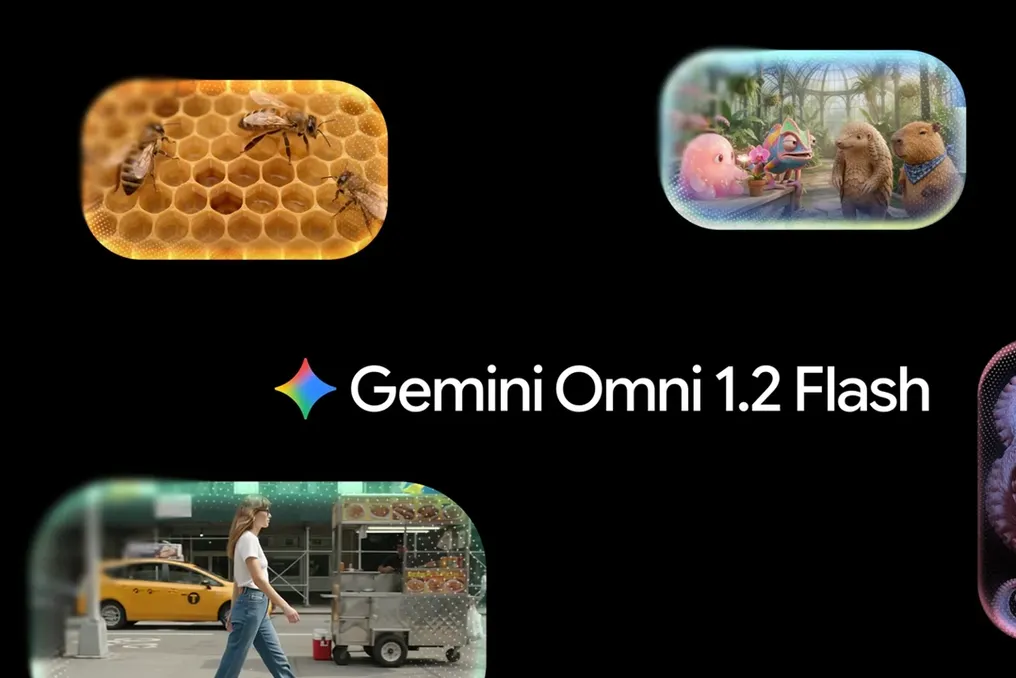
Google launches Gemini Omni 1.2 Flash for creating videos up to 15 seconds
Read more
Tecnoblog
tecnoblog.net

Google launches Gemini Omni 1.2 Flash for creating videos up to 15 seconds

Google has unveiled Gemini Omni 1.2 Flash, its latest artificial intelligence model dedicated to video generation and editing. This update is notable for its ability to produce clips with a maximum duration of 15 seconds, offering higher quality and uniformity.

Although 15 seconds may seem like a short period, Gemini Omni 1.2 Flash was specifically developed for the production of short audiovisual content. This launch represents a significant advancement over the previous version, 1.1, which limited video creation to up to 10 seconds.

Additionally, Google announced that the new model allows users to specify the video duration in one-second increments. This eliminates the need to be restricted to predetermined times, such as 5, 10, or 15 seconds, allowing choices like 4, 7, or 8 seconds, with a minimum established time of 3 seconds.

Another point emphasized by Google is that Gemini Omni 1.2 Flash produces more cohesive results, maintaining the characteristics of people, objects, or scenes, which reduces the probability of 'aberrations' appearing in the video.

The AI model has also been enhanced to generate more natural dialogues, offering better lip synchronization and clearer distinction between different voices. Camera movement features have been refined, including options to zoom in, zoom out, or move the camera around specific elements.

To optimize workflow and reduce costs, Gemini Omni 1.2 Flash accepts voice or text commands to modify various aspects of the video, such as the background, lighting effects, or screen format, without requiring the entire process to be redone with each change.

To aid in tracking results and saving costs, the model allows for the creation of drafts in 360p or 720p resolutions. If the result is satisfactory, the final video can be exported in 1080p or 4K, as needed.

Regarding costs, Google highlighted a 30% reduction in the price of a 720p video, equivalent to US$ 0.07 per second.

As a model, Gemini Omni 1.2 Flash is being implemented across various Google AI platforms, with availability distributed across its services.


Similar stories

Huawei's openJiuwen system provides event-based video memory for agents, reducing response time by up to 97%
Read more
pandaily.com

Huawei's openJiuwen system provides event-based video memory for agents, reducing response time by up to 97%

openJiuwen, an open-source framework supported by Huawei, has released OmniMem-Lens—a multimodal memory feature in version 0.2.0 of its AgentMemory module. This feature allows AI agents to remember long videos based on actual events rather than fixed time intervals, according to QbitAI on November 4.

The team claims that the standard approach of splitting long videos into one-minute segments and storing each separately compromises agent memory in two ways. When a continuous scene is split across windows, the agent only receives half the evidence, which contributes to hallucinations. Furthermore, a few seconds of key action mixed with minutes of irrelevant material can be lost in the noise, reducing search accuracy.

Most event segmentation methods also rely on only one type of data, causing them to miss topic changes if the image remains static, or scene changes if no one is speaking. OmniMem-Lens tracks both streams: the visual track notes scene changes, while the audio track uses speech recognition to determine topic shifts by speakers, even if the screen does not change. Cross-referencing these two sources allows for cuts precisely at the boundaries of real events.

In one example, showing a two-hour product review where the same architectural diagram was displayed for 40 minutes while the speaker covered three different topics, the audio track separated them into three memories, enabling an answer to a subsequent question about load testing metrics.

Memory is stored in three levels: L0 retains the original video, L1 contains event-level memories, and L2 holds more detailed segment-level memories. Levels L1 and L2 are fully converted into text and vectors, allowing them to be integrated into existing augmented retrieval generation stacks and vector databases with minimal changes. The main data organization work is performed offline. During a query, the system matches the query against L1 and L2, extracting precise frames from L0 only when visual detail verification is required.

When testing OmniMem-Lens alongside Qwen3-VL-8B against the direct response of Qwen3-VL-8B from the video, information extraction accuracy increased by 8% on Video-MME-L and by 6.4% on LVBench. The largest gain, 45.7%, was achieved on EgoLife-QA, a first-person dataset recording a full day of daily life where fixed slicing often fails. On LVBench, online response time decreased from 34.5 seconds to 1.72 seconds, approximately 20 times faster, and the team estimates a maximum latency reduction of 97%.

The project's source code is available on GitCode with a mirror on GitHub under the Apache-2.0 license. The team reports that openJiuwen WorkSwarm will soon begin supporting AgentMemory, which will allow remembering and recalling videos exchanged in everyday conversations during subsequent discussions.

SenseTime releases SenseNova 6.8 Flash for office and design workflows
Read more
technode.com

SenseTime releases SenseNova 6.8 Flash for office and design workflows

SenseTime has introduced the official version of SenseNova 6.8 Flash on November 2nd, expanding the capabilities of its multimodal agent for collaboration in office applications and the design field.

This model is capable of creating animated presentations, posters, websites, SVG graphics, as well as performing 3D modeling using tools such as Blender.

Furthermore, the company places special emphasis on long-term memory functions and interaction between different dialogues. These features are designed to help agents remember project requirements, link information from previous tasks, and suggest adjustments when relevant data changes.

The model is available through SenseTime's Raccoon assistant and under the SenseNova Token Plan. The company QbitAI demonstrated the generation of websites, posters, and presentations in the Raccoon client; separate testing of long-term memory and proactive collaboration was conducted using an internal development version.

Dawa Technology's Scenes AI works with 34-billion parameter world models in real-time on a single RTX GPU
Read more
pandaily.com

Dawa Technology's Scenes AI works with 34-billion parameter world models in real-time on a single RTX GPU

Dawa Technology, a company based in Chongqing that originated from the field of virtual film production, has introduced Scenes AI—a real-time world model. This system is capable of transforming video shot with a regular camera into an editable and persistent world.

The product received an excellence award at NVIDIA's intermediate startup event in Suzhou on October 15. Thirty members of NVIDIA Inception participated in this stage among more than 580 attendees.

Most video models focus on predicting the next frame. However, Scenes AI supports a continuous world state. Elements such as the scene, people, camera, lighting, objects, and physics are stored as separate variables that can be read and modified independently. When a change occurs, only the corresponding part of the state is updated, not the entire image redrawn.

In demonstrations, Dawa showed how a room transforms into a hand-drawn meadow while the chair, teddy bear, and wardrobe maintain their positions. Wall inscriptions remain in place, and people appear and disappear, while the weather changes from snow to rain.

The system includes a complex control layer and a lightweight generative layer. The control layer, built around the Latent Stage module, separates the scene, character, camera, lighting, costume, and props in latent space, applying physical constraints for solids, fabrics, liquids, and particles. The rendering layer, LiveStage, uses causal sparse diffusion to sample only the changing areas.

The model has a total of 34 billion parameters but activates about 4 billion per step, which is approximately 11.8 percent. Dawa claims this reduces GPU usage by 40–60 percent and accelerates inference three to five times compared to traditional video diffusion.

On a single consumer NVIDIA GeForce RTX card, the system achieves real-time output at 720p resolution and 25 frames per second. In continuous editing tests, the company reports a 98.2 percent success rate for target editing and a 93.3 percent preservation of human identity. The system utilizes CUDA, TensorRT, and NVENC and operates on local hardware without cloud computing.

Dawa states that its data was gathered from an 84,000 square meter studio space, over 300 real productions, and 180 TB of world state data. The company's Chief Product Officer, Li Zongxin, summarized the approach as follows: 'Video can end, but the world must keep running.' All presented performance metrics are data provided by the company itself.

Popular