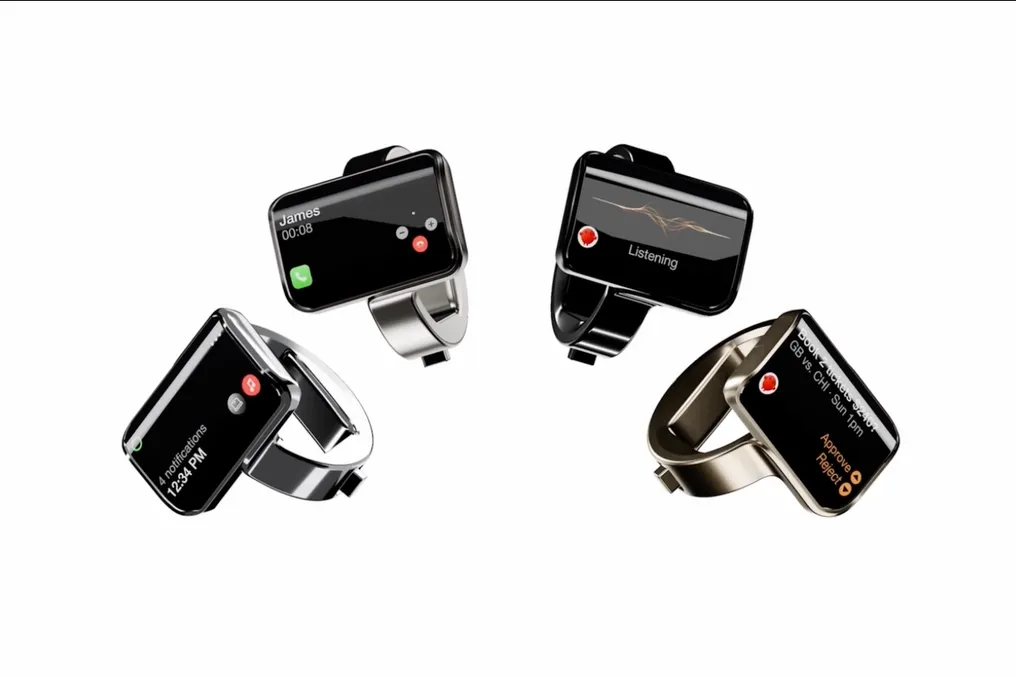
Startup Aina unveils smart ring with AI agents capable of anticipating user needs
Read more
YourStory [india, en]
yourstory.com

Startup Aina unveils smart ring with AI agents capable of anticipating user needs

Startup Aina, based in Bangalore and San Francisco, has introduced a new generation of artificial intelligence that, according to the company, will focus less on questions asked to machines and more on the ability of systems to foresee human needs. An intelligent ring model featuring a color display, voice commands, and gesture control was presented at a private event in Bangalore. The ring is priced at $499 (equivalent to 47,000 rupees) and is available for pre-order at a special early bird price starting from $399 (37,700 rupees). Shipments are planned to begin in January 2027.

Unlike traditional smart rings, which are primarily designed for health and fitness monitoring, Aina aims to make its device a daily interface between users and AI agents. The core idea is that while AI agents are becoming smarter, their use still requires unlocking phones, navigating apps, and approving individual actions. Aina intends to eliminate this friction by proposing the concept: what if the AI doesn't wait for a request?

To simplify interaction, Aina has developed three key features: Cues, Voice, and Remote. The Cues feature uses contextual information, including connected applications and daily routines, to predict the user's next desired action. For instance, if a person regularly orders a taxi at the same time in the morning, the ring might suggest booking a ride without a direct prompt. At the presentation, Aina demonstrated ride-ordering interaction, showing how daily operations can be completed with minimal gestures.

The ring can be controlled using a five-position joystick, allowing users to approve or reject suggestions with their thumb without taking out their smartphone. The company claims that its context-aware intelligence can learn user habits and predict corresponding actions within the next fifteen minutes using data from iPhone, Mac, and associated services. Integrations with Uber, Apple Music, Spotify, calls, calendar meetings, smart home control, and email actions were demonstrated.

The second interaction method, Voice, allows users to dictate notes, set reminders, send messages, and issue commands. Aina also showcased use cases with WhatsApp and Telegram, as well as dictation on Mac via Wispr Flow. The third function, Remote, turns the ring into a controller for connected devices. According to the company, users can manage music, phone calls, smart home appliances, and meeting settings without touching another device.

According to the specifications presented at the Bangalore launch, the ring weighs less than 13 grams, features a titanium body, a full-color display, haptic feedback, and directional sound. The company states a potential battery life of up to 18 hours and plans to release the device in four colors: Eclipse Black, Amber Gold, Mercury Silver, and Slate Titanium, in seven sizes. Aina also highlighted the presence of a five-position control mechanism called Shifter, which works in conjunction with the gesture-based interface.

The startup announced that the ring will be accompanied by an open developer platform, enabling third-party developers to create new integrations and interactions. Support for AI agent platforms such as Muse, Grokbot, and Instinct was also demonstrated. Currently, the company supports iOS and Mac, with further integration announcements expected. Whether the open platform will lead to a significant developer ecosystem remains to be seen once the device reaches consumers.

Aina was founded by Apurva Shankar, who previously served as Vice President of Hardware at Ultrahuman, based in Bangalore. Shankar founded Aina in May 2025 as a human-computer interaction lab focused on how people can interact with intelligent software outside of traditional screens and keyboards. The startup secured $5.5 million in seed funding in July 2026, as previously reported by YourStory. The round was led by Redstart Labs and 360 ONE Asset, with participation from MIXI Global Investments, Antler, Blume Founders Fund, and angel investors, including CRED founder Kunal Shah and Razorpay co-founders Harshil Mathura and Shashank Kumar. These funds were allocated for the commercialization of its AI-oriented hardware interface and the expansion of engineering and product teams.

Aina spent about 15 months developing the technology and began testing the ring with a limited group of users in October 2026. Aina's launch comes amid technological companies' experiments with new ways to integrate AI into daily life. Although smartphones remain the dominant interface for digital services, the rise of AI agents is prompting startups to rethink how instructions are given, actions are approved, and information is received. Aina's approach is to make this interface more compact and contextual while maintaining user control over whether suggested actions are executed.

However, at a price of $499, the ring is a premium purchase, especially considering that smartphones and smartwatches already perform many of the stated functions. Its utility will depend on the accuracy of the AI predictions, the reliability of third-party service integration, and how intuitive finger control becomes for daily use. Battery life, voice recognition, and application support will also play a crucial role when the product moves beyond controlled demonstrations. For now, Aina's claims remain unproven at scale, with commercial shipments scheduled for January 2027.


Similar stories

Startup Aina from Bengaluru introduces AI ring to predict user actions
Read more
business-standard.com

Startup Aina from Bengaluru introduces AI ring to predict user actions

Aina, a startup based in Bengaluru, has unveiled an artificial intelligence-enabled ring capable of anticipating user needs, managing applications, and controlling devices. Pre-orders for the gadget are available starting from $399.

Aina, a consumer electronics company that has secured venture funding, was founded by Apurva Shankar, a former hardware vice president at Ultrahuman. The company presented a display ring designed to guess daily activities and control agents, phone apps, Mac computers, and other connected devices. This launch followed 15 months of closed beta testing.

The ring operates on a proprietary context-sensitive operating system. It independently learns user usage patterns, gathering context from their phones, computers, and agents, after which it predicts the three most likely next actions. Users can approve or reject the suggested option simply by swiping up or down with their finger.

Pre-orders open on November 5th, with a special price of $399 for the earliest buyers for a limited quantity. Shipping is planned to begin in January 2027.

The company describes Aina as a new AI interface in the form of a ring that understands user desires. Additionally, users can press and hold the central button to interact with their agents.

Vision for Future Interaction

Shankar stated that they began developing Aina with the conviction that artificial intelligence would evolve from following instructions to anticipating human needs. He noted that this transition has already begun with proactive agents, and agents like Muse, Instinct, and Dots will soon perform hundreds of daily tasks.

He added that today people give commands via text or voice, but in the future, agents will learn to recognize patterns, consider context, and become proactive in almost all interactions, awaiting only user approval. Since one has to choose between options daily, using a phone for every such binary moment is inefficient. Therefore, hardware interfaces different from the phone are being developed for this future, focusing on quick approvals and voice control, and Aina is created precisely for this purpose.

Shankar emphasized that every major shift in computing has occurred through the collaboration of software and hardware. He cited examples: the mouse and graphical user interface led to personal computing, while the touchscreen and App Store led to mobile. Now, with Aina and AI agents, a new era is dawning—personalized computing accessible right at your fingertips.

Ways to Use Aina

Aina Voice

Users can integrate their existing agents through the Aina app and then press and hold the central button to communicate with them. A quick note-taking function is also provided. When an agent requires the user's attention, a notification appears on the screen. A simple swipe up is enough for quick approval. Users can also hold the button to respond with voice. Aina is equipped with a built-in speaker for conversations with AI agents and making phone calls. The user can initiate a call with a voice command and bring their hand to their ear to talk and listen.

Aina Cues:

Aina gathers context from the user's phone, Mac, and agents. It analyzes application usage patterns, location, and calendar details to determine what the user might need next. For example, if the user is heading to work at nine o'clock, Aina saves a shortcut, or 'Cue', for booking an Uber ride, ready just before it is needed.

The Aina Remote feature allows the ring to adapt to the user's current actions and display a live shortcut to control that activity. If music is playing, the ring turns into a music remote control. During a meeting, it becomes a controller for the microphone, camera, and a note-taking tool.

From HCI Lab to Consumer Product

Aina was founded by Shankar in May 2025 as a Human-Computer Interaction lab, where physical interfaces were tested in various scenarios of everyday computing. At the CES exhibition in 2026, the team demonstrated three experimental AI interface concepts. In April, the company introduced Dune—a context-aware three-button keyboard for Mac that adapts its controls to the application being used. Dune was sent to hundreds of early users.

The company tested Aina with a controlled group of private pilot users starting in October, using the feedback received to refine the hardware and user experience before the public announcement.

Aina's availability will be global. At launch, the device supports iOS and Mac. Further information on supported integrations will be announced after sales begin.

Indian AI Startups Consider Relocation Costs to the US in Pursuit of American Capital
Read more
business-standard.com

Indian AI Startups Consider Relocation Costs to the US in Pursuit of American Capital

Despite venture capital funds creating opportunities for Indian artificial intelligence (AI) startups to enter the US market, securing initial clients in America remains a significant challenge. American companies typically require proven work experience before entering into agreements with new suppliers, which complicates startups' efforts to attract initial customers.

Venture firms such as Antler India and All In Capital have launched specialized programs to help local AI startups establish themselves in the United States. While some companies have already relocated their headquarters, found clients, and attracted subsequent funding, their expansion plans are complicated by high costs for local hiring and visa issues.

Details on Challenges

Ashish Bhatia, founder and CEO of India Accelerator, noted that winning the first few clients is one of the main difficulties for Indian startups aiming to enter the US market. He explained that firstly, buyers in the US require references, making the acquisition of the first two or three clients the most difficult. Secondly, requirements for security, regulatory compliance, and architecture are significantly higher. Thirdly, hiring sales and business development staff in the US is expensive, and visas for founders, who often move between countries, create additional obstacles.

Similarly, All In Capital identified key challenges as client access, achieving product-market fit in a new market, and building a local network. Antler India pointed out another barrier—the lack of a peer network. Founders entering a new market may not have reliable contacts for advice on hiring, pricing, legal structures, or pitching to investors.

To overcome these difficulties, venture funds provide support that goes beyond mere financing. They assist startups in finding potential clients, building local connections, and managing operational requirements.

Examples of Support Programs

Antler India launched the Embark program in May 2025. Over this period, more than 50 startups participated across four cohorts, including over 15 from India. Raghav Goyal, Investment Director at Antler India, reported that seventy-five percent of participants now have paying clients or active pilot projects in the US. More than half of them have secured subsequent rounds of funding. Nearly 50 percent have moved to the US, converting their holding company into an American structure and obtaining O-1 visas for founders. Most of them signed their first contract with an American client within three to four weeks of participating in Embark. Among the startups that relocated their headquarters to the US are Dodge, KuboCare, Nudge, and Aina.

Likewise, All In Capital launched the Golden Ticket program in January of this year to aid Indian startups in expanding into the American market. The program received over 750 applications in the first ten days and aimed to select 20–30 startups. The program's portfolio included Vasuki AI, which develops commodity hedging solutions; Tross, which creates a data layer and application programming interface (API) for AI agents in healthcare; and Mowito AI.

Among these companies, Mowito opened an office in Detroit, started pilot projects with American clients, and attracted additional funding from a Canadian investor. Kushal Bhagya, Co-founder and Partner at All In Capital, emphasized that early progress should be assessed based on the quality of client interactions and pilot projects, not just the number of users.

Recognizing the complexities of entering a new market, venture funds are increasingly offering operational support alongside capital. For instance, Antler India's Embark program facilitates introductions to American clients and provides practical assistance in early sales. It also collaborates with partners such as Deel, Rho, Alma, and Inkle, helping startups obtain visas and establish American entities.

Nevertheless, not all Indian startups aiming to expand into the US relocate their headquarters abroad. As Jasnoor Gill, Investment Director at Antler India, noted, 'Some startups keep their engineering and product teams in India while developing American teams, so relocation is more related to proximity to clients and capital than leaving India behind.'

However, the path of expansion was different for each company. Some firms participating in these programs decided to return. According to Gill, a couple of startups returned to India, usually because their core clients or teams were better served from that country. Nevertheless, the more common scenario is that founders develop higher ambitions regarding the US after spending time with American clients and investors.

Alipay AI Pay launches PAYATHON 2026 hackathon to assess commercial viability of AI products
Read more
pandaily.com

Alipay AI Pay launches PAYATHON 2026 hackathon to assess commercial viability of AI products

Alipay AI Pay has announced the launch of its annual PAYATHON 2026 hackathon. The goal of the event is to encourage developers to integrate payment solutions into their applications, skills, and AI-based agents, and subsequently test them with real customers.

The announcement of the competition was made on October 24th in collaboration with the AI product community, according to sources IT Home and Leiphone. Registration will run until December 1st, and the final offline stage is scheduled for December 26th. The total prize pool amounts to 200,000 RMB.

The competition is divided into five tracks. Two main tracks cover autonomous applications and agent skills built around Alipay's Vibe Pay and Skill Pay concepts. The remaining three tracks—Token Pay, Machine Pay, and Agent Pay—focus on usage-based billing, recurring subscriptions, and transactions between machines or agents.

A distinguishing feature of this event is the evaluation system for submissions. In addition to product completeness and technical execution, organizers emphasize commercial metrics and actual user payments as key criteria. Alipay presents this as part of its developer-focused AI Pay strategy: simplifying the process of collecting payments, delivering goods, and setting prices so that small teams can turn working prototypes into monetized products.

Alipay provided examples of early developers already using the service. One team, led by a content creator, developed a tool for selecting themes, scenarios, and cover designs that attracted over 1,000 registered users and more than 300 authors but had no paying customers. After 159 days of trying to set up payments, the team utilized the AI-friendly integration guide, used Codex for coding, and went live in just 73 minutes, securing its first ten orders shortly thereafter, according to Alipay. The image and text generator Redink received nine orders, while another developer creating tools based on CodexGuide and GPT-Image2 reported receiving over 500 real orders.

It should be noted that the figures presented by the organizers are case studies and have not undergone independent verification. The hackathon reflects a broader shift in China's agent ecosystem—a transition from building tools to conducting transactions. Payment platforms are competing to become the standard checkout level for skills and agents, and Alipay is betting that solving billing issues for one-person teams will attract developers to the company's AI Pay stack at an early stage.

Popular