The Poco X8 is an intermediate category smartphone that stands out for its enhanced resistance to dust, water, and drops, in addition to having a voluminous 8,340 mAh battery and a large AMOLED screen.
This model presents distinct characteristics compared to the Poco X8 Pro, which achieved excellent performance in analyses focused on the gaming audience. The initial verdict indicates that the device is ideal for users who prioritize long battery life and a robust device capable of withstanding rain or accidental drops.
After testing the Poco X8 for fifteen days, all its functionalities were detailed. The device came with the smartphone, SIM tray key, protective case, manuals, a USB-C to USB-A cable, and a 67W HyperCharge charger.
It is important to note that DL Eletrônicos, the official Xiaomi distributor in Brazil, will not officially market the Poco X8 in the national market; therefore, the purchase must be made through marketplaces or importers. It is recommended to confirm with the seller whether the version includes a charger compatible with the Brazilian standard wall sockets.
Handling the Poco X8 revealed a significant difference compared to the Poco X7, presenting a design more aligned with the Poco X8 Pro. While the previous model had curved screen and sides, the Poco X8 opted for a flat display, using straight frames made of fiberglass plastic and cast aluminum, complemented by wide radius corners that give a more refined finish.
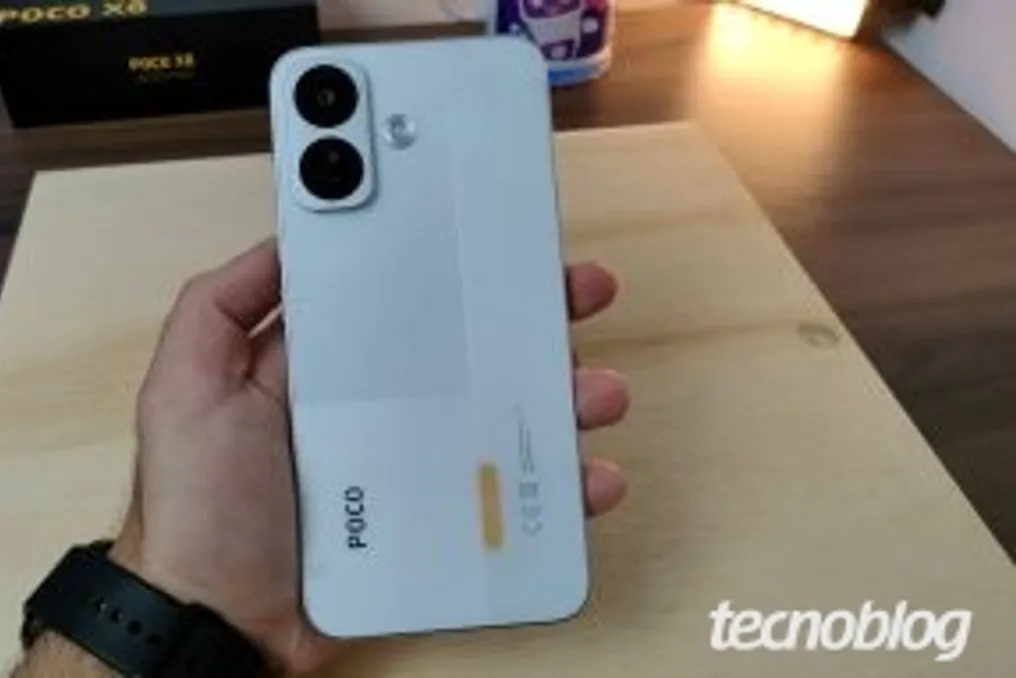
The back also received notable changes. The camera module was reduced, positioned vertically, and shifted to the left of the device, representing a drastic change from the square module of the Poco X7. The back, made of reinforced plastic, displays geometric details inspired by robots by Xiaomi, although the surface remains completely smooth.
It is undeniable that the Poco X8 is a considerable-sized phone, being larger and heavier than the Poco X8 Pro. Due to this robustness, it was difficult to use with one hand, especially when swiping the screen or toggling buttons on opposite ends. Despite this, the weight did not cause discomfort during prolonged sessions, but users accustomed to lighter devices may need a period of adaptation.
Durability is a prominent attribute of the Poco X8 and a point where it surpasses the Poco X8 Pro. According to Xiaomi, the phone has protection against internal and external impacts, supporting drops of up to three meters. During 1.5-meter drop simulations on vinyl flooring, the device remained intact, and the screen, protected by Corning Gorilla Glass Victus 2, sustained no scratches.
Furthermore, the Poco X8 guarantees robust protection against water and dust, boasting IP66, IP68, IP69, and IP69K certifications. The device supports immersion in fresh water up to 2 meters for up to 72 hours. In the tests conducted, the phone was submerged at 15 cm for approximately 10 minutes and continued operating normally.
In comparison, the Pro version does not specify drop structures or certifications, and its water resistance is lower, limited to 1.5 meters for 30 minutes.
The Poco X8 features a large 6.83-inch screen, providing greater immersion in streaming and gaming activities. With a 1.5K resolution (2772 × 1280 pixels), the panel achieves a density of 447 PPI, ensuring sharpness in text and images. The AMOLED construction is a differential in this category, offering more vibrant colors and deeper contrasts compared to LCD screens.
However, the panel is not compatible with HDR content, limiting the experience of contrast, color, and brightness. Conversely, the refresh rate of up to 120 Hz ensures fluidity in both daily browsing and gaming. With a peak brightness of up to 3,500 nits, reading text and watching videos is comfortable even under direct sunlight.
The biometric reader on the bottom of the screen functioned adequately, even with wet fingers, thanks to Wet Touch 2.0 technology, which enhances touch sensitivity in humid or oily conditions. The screen comes with a pre-applied film for protection against scratches and impacts, in addition to certifications against blue light emission and flickering to reduce eye strain.
The stereo audio system of the Poco X8 uses speakers located on the bottom and top edges, promoting greater musical balance and allowing the playback of tracks with sound distribution between channels. The Dolby Atmos seal adds sonic immersion. Nevertheless, the auditory experience was not ideal, as the bass is discreet and the treble is shrill, resulting in muffled and dry sound. Comparatively, the Poco F3 at 100% volume sounded 300% louder than the Poco X8.
Xiaomi equipped the Poco X8 with a modest camera set. On the rear, there is a 50-megapixel wide-angle lens (f/1.8) and a 2 MP depth sensor (f/2.4), which assists the main lens. The front camera has 16 MP (f/2.4). The absence of ultra-wide or telephoto lenses implies that proximity to the object is necessary to obtain good image quality.
In well-lit environments, photos maintain textures with good exposure control. However, HDR acts aggressively when photographing skies, making colors dull and 'washed out'. Night shots revealed noise and texture degradation, and the 10x digital zoom does not compensate for the lack of a telephoto lens.
Video recordings are reasonable and relatively stable due to Optical Image Stabilization (OIS). A negative point is the limitation to Full HD (1080p) at 30 fps, whereas the Poco X7 records in 4K at 30 fps. The device offers various modes, such as dual capture and slow motion, in addition to an underwater recording function, absent in the Poco X8 Pro.
The Poco X8 is powered by the Snapdragon 6s Gen 4 (4 nm) processor, which reaches frequencies of up to 2.4 GHz. It supports 6, 8, or 12 GB of LPDDR4X RAM, and internal memories of 128 GB (UFS 2.2) or 256 GB (UFS 3.1). The analysis was based on the global version with 12 GB of RAM and 256 GB of storage.
With this configuration, the phone performed well in multitasking and in games like Genshin Impact and Call of Duty: Mobile with maximum graphics, without freezing. However, the processor has limitations and is aimed at more basic tasks. Geekbench 7 tests show that the Poco X8 scores are equivalent to the results of the Poco X3 Pro (CPU) and Samsung M51 (GPU), launched about five years ago, falling significantly below the 1,429 (single-core) and 5,482 (multi-core) of the Poco X8 Pro.
The operating system is HyperOS 3, based on Android 16. This system is intuitive and fluid, although it contains ads in native tools and comes with several pre-installed applications. The system allows customization through various themes and lock screen options. The HyperIsland feature, similar to the iPhone's Dynamic Island, facilitates the management of active apps with expandable widgets.
HyperOS 3 also incorporates artificial intelligence tools for image editing, such as object removal and image expansion. Although broader features, such as automatic transcription and writing assistant, seen in the Poco X8 Pro, were missing, the results obtained were satisfactory. Xiaomi promises six years of security update support, guaranteeing protection until 2032.
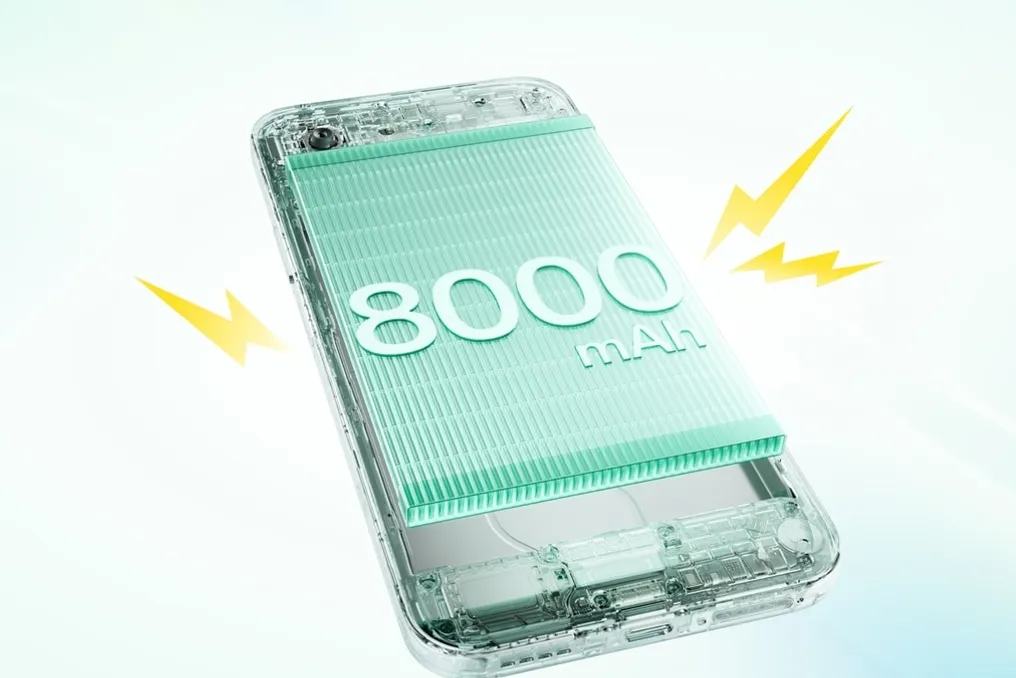
The battery is the biggest strength of the Poco X8. With a capacity of 8,340 mAh and silicon-carbon composition, it fulfills Xiaomi's promise of offering over two days of autonomy. In tests, the smartphone lasted a total of 59 hours, with nine hours of screen-on time dedicated to gaming, social media, and football streaming. It was considered one of the devices with the longest autonomy tested.
The time required to charge from 1% to 100% was 1 hour and 16 minutes, using the 67W HyperCharge source, which is considered satisfactory given the battery capacity. As an intermediate model, the Poco X8 does not support wireless charging, but it supports wired reverse charging up to 2.