
How to remove rust from a kitchen pull-out drawer using household remedies
Read more
Aaj Tak
www.aajtak.in

How to remove rust from a kitchen pull-out drawer using household remedies

Even with careful kitchen hygiene, there are areas where dirt accumulates gradually. Modern modular kitchens often feature steel pull-out drawers that become soiled over time. Water dripping from dishes, oil splatters, and humidity can leave stubborn stains and rust marks on the drawers. Initially, these marks seem small, but over time they spoil the overall appearance of the entire drawer. As a result, people either buy expensive cleaning products or consider replacing the drawer itself.

However, it is known that salt and lemon, which you have in your kitchen, can also be useful for cleaning. With this homemade method, stains on a steel drawer can be easily removed. That is, by applying a little effort and using the correct technique, you can restore the shine to an old drawer.

Before starting to clean the drawer, you must remove all dishes, spoons, bowls, and other items from it. This allows access to corners and parts that are usually difficult to reach for cleaning. After that, dust and surface dirt should be removed with a dry cloth.

Now, examine the areas of the drawer where water spots, rust, or dirt have accumulated. First, sprinkle salt on these spots. The light abrasive texture of the salt aids the cleaning process. It is important to avoid excessive scrubbing to prevent scratching the steel.

After applying the salt, squeeze lemon juice over it. The citric acid contained in the lemon can help remove certain types of stains and light rust traces. The mixture of salt and lemon should be left on these spots for several hours.

After the time has passed, gently wipe the affected area with a soft cloth or sponge. Then rinse thoroughly with clean water and dry completely. This will remove the residue of lemon and salt. Thanks to this, light stains and dirt on the drawer can be reduced. However, if the rust is very old or the steel itself is damaged, this method may prove ineffective.

Simply cleaning the drawer once is not enough. To keep the kitchen drawer clean for a long time, you need to pay attention to several small details.

Similar stories

How to organize a kitchen: 5 simple ways to store dishes in a small kitchen
Read more
www.aajtak.in

How to organize a kitchen: 5 simple ways to store dishes in a small kitchen

Before the Diwali celebration, cleaning begins in homes, and people strive to make every corner of their living space shine. It is said that Lakshmi visits on this day, so people thoroughly clean and beautifully decorate their homes. After cleaning, the most time is spent on cleaning and organizing the kitchen, and additional difficulties arise in small kitchens.

Especially in small kitchens, there is a lack of space to store pots, multicookers, frying pans, and other utensils. Often, dishes accumulate on kitchen countertops instead of being stored in cabinets, which makes the kitchen look cluttered.

If your kitchen looks like this, there is no need to worry. There are simple methods that allow you to effectively place more dishes even in limited space. This will not only free up space in the kitchen but also make it cleaner and more aesthetic.

How to organize a kitchen:

Installing wall-mounted shelves

If there is not enough space in the cabinets, you can use the walls. To do this, you should install sturdy wall shelves or hooks. On them, you can hang small frying pans, baking sheets, ladles, spoons, and other daily-use dishes. This will free up the countertop, and the necessary dishes will be easily accessible.

Nesting pots and multicookers

Sometimes storing pots and multicookers separately takes up too much space in the cabinet. In such cases, you can stack dishes of the same size inside each other. For example, a small pot can be placed inside a large one, and a small kettle inside a large one. This significantly saves space. It is important to ensure that all dishes are completely dry before starting to stack them.

Installing pull-out drawers in the kitchen

If there is free space at the bottom of your kitchen, you can order pull-out drawers. They are convenient for storing heavy dishes, such as pots, multicookers, and kettles. The advantage of these drawers is that you do not need to empty the entire cabinet to retrieve the contents; you just need to pull the drawer, and the desired item will be in front of you.

Separate storage for lids from dishes

One of the main reasons for taking up space in the kitchen is the lids from dishes. Often, when pot and multicooker lids are stored separately, the cabinet looks messy. To solve this problem, you can purchase a special lid rack. On it, you can neatly stack lids of different sizes one after another, which prevents inconvenience when retrieving dishes.

Using corner shelves

In empty corners of the kitchen, you can install a corner shelf. On it, you can place spice jars, small dishes, and cups used daily. This way, unused space can be utilized, and items in the kitchen will not look scattered.

Pay attention to these small details

5 home ways to clean greasy and smelly kitchen towels
Read more
www.aajtak.in

5 home ways to clean greasy and smelly kitchen towels

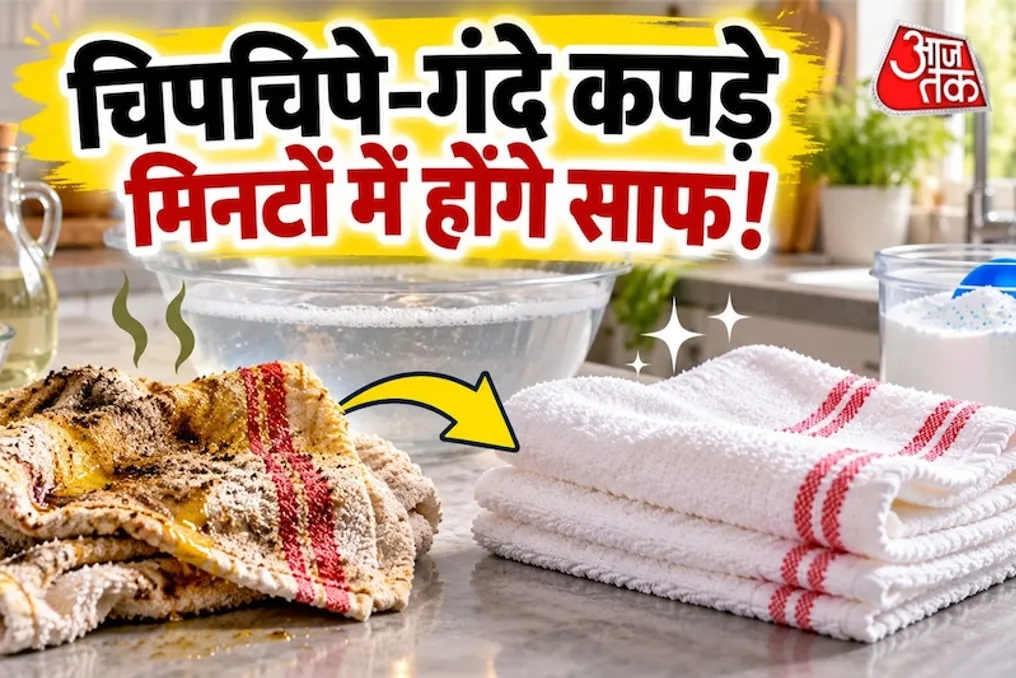
Kitchen towels are used very often when cooking—from wiping hands to cleaning stoves and countertops. Over time, they accumulate grease, oil, and spices, becoming sticky and dirty. Sometimes the contamination is so deep that even after multiple washes, the towels remain unclean, and an unpleasant odor begins to appear in them.

Instead of throwing away such towels or buying new ones, they can be cleaned using simple home methods. Five effective ways are presented that will help reduce greasiness and eliminate odors from kitchen rags.

1. Removing stubborn grease with hot water and detergent

If a layer of oil and fat has formed on the kitchen towels, hot water combined with dish soap will help. Dish soap is specifically designed to remove grease, and hot water helps loosen the grease residue. It should be remembered, however, that the water should not be too hot; the temperature must be adjusted according to the instructions on the towel's label.

2. Removing grease and odor with white vinegar

Sometimes, even after washing, the towels retain the smell of spices and oil. In such cases, white vinegar can be used, as it can help reduce dirt levels and get rid of unpleasant aromas.

3. Cleaning old stains and stickiness with baking soda

Baking soda is effective for removing old stains from spices and oil, and it also helps combat odors remaining in the fabric. If the grease on the towel is heavy, it is recommended to first treat the stain with a small amount of dish soap, and then soak it in a solution with baking soda.

4. Lightening oily and spicy stains with lemon

Yellow traces from turmeric, oil, and spices often appear on kitchen towels. Lemon can be used to remove them. However, it should be noted that lemon does not guarantee the complete disappearance of all types of stains. Before applying lemon juice to colored fabrics, always test its effect on an inconspicuous area, as the acid can cause discoloration. It is also not recommended to leave the towels with lemon in direct sunlight for a long time.

5. Proper washing and drying of towels

Relying only on folk remedies is not enough to keep kitchen towels clean; the correct washing and drying process is also crucial. If wet and greasy towels remain in one place for a long time, an unpleasant odor can intensify in them.

In this regard, the following recommendations must be observed:

Ways to clean a kitchen hood from grease and smoke without disassembly
Read more
www.aajtak.in

Ways to clean a kitchen hood from grease and smoke without disassembly

Daily cooking leads to smoke and grease released during preparation making the inside of the kitchen hood very dirty and sticky. A thick layer of grease accumulates on the hood filters, which makes it difficult or cumbersome to remove or disassemble.

If you want to clean the hood without removing or disassembling it, you can use several simple home methods. This will save effort, and the hood will look brand new.

To begin, you need to prepare the ingredients: two tablespoons of caustic or baking soda, one tablespoon of vinegar or lemon juice, one cup of boiling hot water (in a large pot or cauldron), dish soap, an old brush, as well as a bucket or spray bottle.

For a quick cleaning, place a large pot under the hood, pour water, vinegar, and baking soda (or caustic soda) into it, and bring it to a boil. Then turn on the gas stove and set the hood to high speed. The steam from the boiling water, entering the hood, will help melt the stubborn greasy dirt that has built up over months, which will start dripping down.

Next, prepare a solution by mixing hot water, a little dish soap, and vinegar in a spray bottle. This solution must be thoroughly sprayed onto the filters and external parts of the hood, leaving it for 10–15 minutes to soften the grease.

After this, the internal and external surfaces of the hood should be carefully wiped with a damp cotton cloth or microfiber. For cleaning hard-to-reach places, you can use an old toothbrush. Finish the process by wiping the hood with a dry clean cloth so that it dries completely. In this way, the hood will become shiny without requiring disassembly or removal of parts.

Popular