Expert notes structural problems in Chinese economy despite technological progress
Read more
Aaj Tak
www.aajtak.in

Expert notes structural problems in Chinese economy despite technological progress

After a two-week stay in China, British writer James Crabtree identified significant discrepancies in the state of the country's economy. While impressed by achievements in artificial intelligence, electric vehicles, and drones, he also found that the economy is facing issues related to weak demand, declining investment, rising unemployment, and a protracted crisis in the real estate sector.

In his publication titled 'China: Through the K-hole,' Crabtree characterized China as a 'K-shaped economy,' where rapid technological growth coexists with deep economic difficulties. He noted that upon leaving Shenzhen, he was struck by the power of the technological ecosystem, which surpassed his previous expectations, but the internal state of the economy turned out to be much worse than he had assumed.

Crabtree, an invited research fellow at the European Council on Foreign Relations, highlighted the growing gap between China's technology sector and its overall economic situation. He reported that while GDP grew by 4.5% in the last quarter, there is a decline in investment, weakening demand, a serious drop in property prices, and a cessation of spending by private businesses.

The geopolitical analyst also pointed to reduced tax revenues, pressure on China's stock market, and restricted access to advanced computing technologies. In Crabtree's view, China's remaining growth depends on exports, which are facing tariffs from trading partners.

During his trip to Beijing, Crabtree met with economist Michael Petis, who discussed the possibility of a prolonged period of weak growth in China, similar to what Japan experienced after its asset bubble burst. Analyst Petis assessed China's economic prospects as a period of slowdown, stagnation, and slow recovery that could last a decade or more, given that the country is grappling with one of the largest debt burdens in history. He called this a positive scenario.

Crabtree questioned whether official unemployment figures reflect the reality of the labor market. He cited an example where official unemployment is just over 5%, which, in his words, raises doubts. Chinese economist David Daokui Li recently reported the actual unemployment rate at 10.2%. Petis believes even this figure remains high. Quoting a Financial Times report, he mentioned that 53 million Chinese workers are employed in food delivery and ride-hailing, and about 200 million people work in the large gig economy.

The author suggested that China is using the informal economy as a kind of temporary buffer against unemployment amid the economic slowdown. His comments mentioned employment forecasts and alternative unemployment data that were not separately verified in the publication.

Crabtree noted that Chinese businesses are facing excessive domestic competition, especially in the electric vehicle sector. He recounted that during his visit, he often heard entrepreneurs say that the struggle in China resembles a civil war. Over a hundred EV brands are actively competing by lowering prices, leading to a significant reduction in margins for most companies. In Crabtree's opinion, such domestic competition forces Chinese firms to expand abroad in search of profit.

Furthermore, Crabtree drew attention to China preparing new export control regulations due to increased competition with the US. He stated that China is beginning to restrict the export of technologies, including powerful open-weight AI models, as well as drones and tunneling equipment. Beijing is creating systems similar to those in Washington to limit access to strategic technologies.

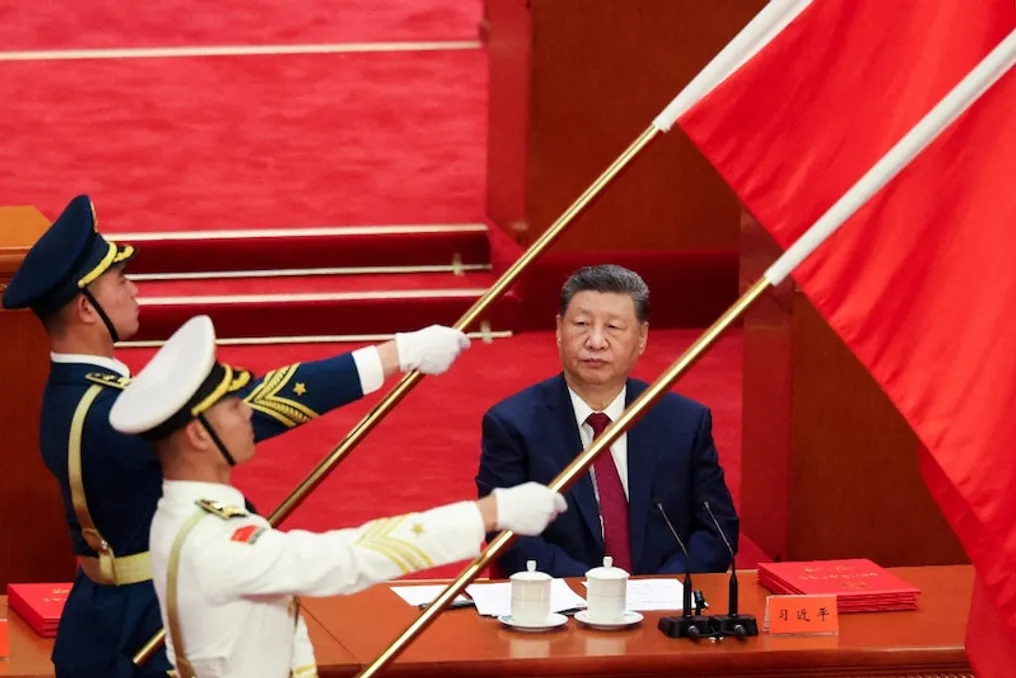
Ultimately, Crabtree concluded that China maintains technological competitiveness and strengthens its international standing despite structural problems in its domestic economy. He noted that Xi feels confident on the world stage, for instance, meeting with representatives from Washington in 2025. Although China's technological superiority is growing, the country feels economic weakness, which, in his opinion, explains Beijing's desire to maintain stable relations with the US.

Similar stories

Demographer states that China's population decline is irreversible in the short term, but reversible in the long term with incentives
Read more
noticiasaominuto.com

Demographer states that China's population decline is irreversible in the short term, but reversible in the long term with incentives

The independent Chinese demographer He Yafu told Agência Lusa that China's population decline is inevitable in the short term; however, this trend can be reversed in the long term if Beijing implements substantial birth incentives.

The expert, who has been monitoring the country's demographic evolution for several years, emphasized that the strong execution capacity of the Chinese government could be a crucial factor in this reversal. In 2025, China recorded the fourth consecutive year of population reduction, falling to 1.404.9 million inhabitants, amid an accelerated aging process and a constant drop in births.

Official data indicated that only 7.92 million children were born the previous year, marking a new historical low compared to the 9.54 million registered in 2024. He Yafu identified several structural factors responsible for this trend, such as persistently low fertility rates, a continuous decrease in births, a reduction in the number of women of childbearing age, the postponement of marriage and motherhood, in addition to the high costs of raising children.

Although Beijing has introduced measures to stimulate births—including subsidies, extension of parental leave, and improvement of family support services—He Yafu assesses that these incentives are still insufficient. He suggested that the monthly subsidy per child should increase from 300 yuan (equivalent to 40 euros) to 1,000 yuan (approximately 134 euros).

Demographic issues were discussed at a State Council meeting on Friday, where Chinese Prime Minister Li Qiang called for the stabilization of birth numbers. According to Xinhua agency, Li advocated for strengthening policies supporting education, housing, marriage, and childbirth, in addition to using tax benefits and social security measures to reduce the burden on families.

Despite the national trend, the China Statistical Yearbook 2026 shows regional disparities. Guangdong province, the country's main economic driver, concentrated about one in eight births in 2025, maintaining a positive natural growth rate of 2.26 per thousand inhabitants. In contrast, Heilongjiang, located in the northeast, recorded a natural decrease of seven per thousand, the most pronounced in the country.

He Yafu attributed Guangdong's ability to attract young people as a decisive factor in maintaining above-average birth rates. He explained that Guangdong's demographic advantage mainly stems from immigration, which ensures a vast base of young people of childbearing age. Due to its relatively developed economy, Guangdong continues to attract young people, sustaining a high number of people able to marry and have children, thus increasing the total number of births.

The expert concluded that regional variations result from the interaction between age structure, economic attraction capacity, family culture, and government policies. Internal migration is particularly relevant, benefiting areas such as Guangdong, Zhejiang, and Shanghai, while harming provinces like Henan, Hunan, Sichuan, and those in the northeast.

Aging represents another significant challenge for Chinese authorities. In 2025, there were 223.65 million citizens aged 65 or older, corresponding to 15.9% of the population, surpassing for the first time the contingent of under-15s, which totaled 212.76 million.

Citing a January 2025 study by the Southwest University of Finance and Economics and Tsinghua University, He Yafu mentioned a projection that China's population will fall to 1.190 million inhabitants by 2050, assuming an average fertility rate of 1.05 children per woman. In this future scenario, the proportion of people aged 65 or older will reach 29.5%, almost double the 15.9% seen in 2025, warning the demographer about the consequent increase in the elderly support burden.

Popular