In 1995, Professor Sekhar Raghavan noticed an unusual phenomenon: the tap water in Chennai had become brackish. This occurred against the backdrop of declining groundwater levels, causing seawater to seep into the city's underground freshwater reserves, making its use increasingly difficult.
The problem was not a lack of rainfall, as Chennai received a significant amount of rain. However, most of this water flowed into roads and drains into the sea instead of replenishing the groundwater beneath residents' homes.
This fact prompted Raghavan to ask himself: if rain falls over the city, why is so little of it conserved? His answer was to convey the idea of rainwater harvesting to the public. Armed with a bicycle and a simple message, he began visiting neighborhoods, going door-to-door to convince residents to collect rainwater and direct it back into the ground.
Nearly three decades later, his campaign offers a valuable lesson to another Indian city facing a water deficit—Hyderabad.
When it rains, but wells dry up
The city, home to about 1.5 million people, struggles with a severe shortage of drinking water. Causes include uneven regional distribution of water resources, competition between agricultural and industrial needs, and monsoon deficits.
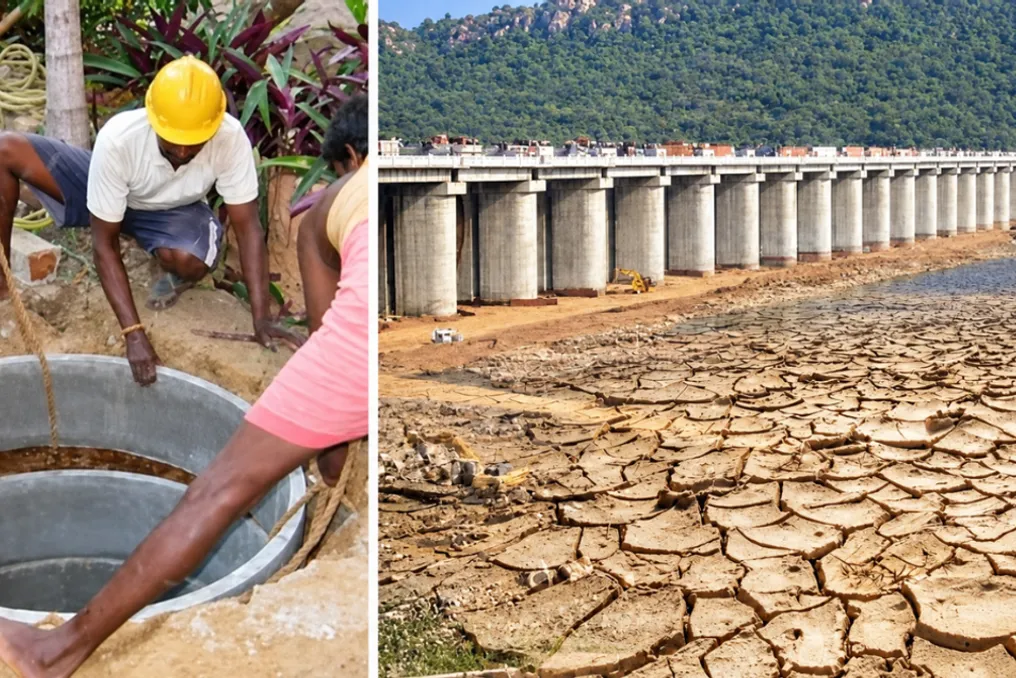
According to data provided by the State Irrigation Department, more than 330 out of over 600 mandals in Telangana were classified as drought-affected, and only about 500 of the state's more than 6000 lakes contain water.
Pressure on water resources is evident in the city's growing reliance on tankers. Daily orders have risen to 6,000–8,000, prompting Ashok Reddy, Managing Director of the Hyderabad Waterworks and Sewerage Board, to instruct staff to bring in additional tanker operators and begin their registration.
In some parts of Secunderabad Cantonment and on the outskirts of Hyderabad, residents report receiving drinking water only once every three or four days. It is also reported that one of the city's main reservoirs has dropped to about 13% of its capacity.
However, the shortage is not only related to the amount of incoming water but also to how much the city can retain it. This is where the Chennai experience becomes relevant.
One bicycle, one neighborhood at a time
When Raghavan started his campaign in 1995, rainwater harvesting was not a common practice for most urban households. He aimed to change this situation by explaining how rainwater collected from roofs, driveways, and other surfaces could be filtered and directed into replenishment systems, allowing it to seep into the soil and restore underground aquifers.
Instead of letting rainwater run off into drains, households could capture it and help replenish the groundwater they depended on.
Nevertheless, convincing people proved harder than explaining the scientific principles. Raghavan cycled through neighborhoods, talking to residents and encouraging them to install collection systems. Many initially rejected the idea, but he continued to work with communities, demonstrating how it could be implemented.
Through the Rain Centre, which he headed, he also collaborated with teams of plumbers and well diggers to survey systems across the city and demonstrate rainwater harvesting on model houses.
How Chennai turned an idea into law
In October 2002, the Tamil Nadu government passed legislation making rainwater harvesting mandatory. In June 2003, a decree extended this requirement to all existing buildings across the state, including Chennai.
Property owners were required to install systems by October 11, 2003. Non-compliance could result in fines or disconnection of the municipal water supply.
A government announcement in November 2003 stated that 99.5% of Chennai residents had implemented rainwater harvesting in their homes and complexes.
However, installing a system and ensuring its functionality are two different processes. An inspection conducted by the Rain Centre in a residential area between October and November 2003 showed that about half of the residents had implemented rainwater harvesting inadequately.
Even among those who installed systems correctly, many focused only on collecting rainwater from roofs, ignoring another important source: rain falling on the rest of their property.
In housing complexes, this surface runoff could account for twice the volume collected from roofs. Although this water may not be suitable for direct domestic use, it can still be directed into the soil to replenish groundwater. As it moves through the soil, natural filtration helps remove pollutants.
The missing piece: what happens outside the roof? Raghavan's work also highlighted a broader gap in Chennai's approach. While households were responsible for collecting rainwater on their premises, public spaces represented another opportunity. Roads, parks, and playgrounds receive significant amounts of precipitation. Nevertheless, most of the water running off Chennai's storm drains is directed to the city's waterways and ultimately discharged into the Bay of Bengal.
Instead of letting all this runoff disappear, the Rain Centre advocated for directing appropriate urban runoff into replenishment systems. However, this requires careful planning. Road runoff carries solid waste, fine silt, and other pollutants that can clog collection systems. Therefore, systems must incorporate filtration, waste removal, and regular maintenance.
The city also needs adequate open spaces and properly designed replenishment systems to prevent water stagnation and flooding. In other words, rainwater harvesting is only one part of water management.
What the Chennai experience teaches Hyderabad
The results of Chennai's efforts became clearer after the return of rains. Tamil Nadu received below-average rainfall in 2003 and 2004, which made it difficult for residents to immediately observe the benefits. The following year brought heavier rains, which allowed for a clear demonstration of what could be achieved with functioning collection systems.
After the 2005 rains, the Rain Centre recorded an increase in groundwater levels by approximately 20 feet in the areas under its control, prompting the team to continue its work. For nearly 15 years, rainwater harvesting helped Chennai strengthen its groundwater reserves. However, the 2019 water crisis revealed limitations related to infrastructure that was no longer being maintained properly. Clogged filters, abandoned recharge pits, and poorly functioning systems weakened the effect of the initial initiative.
Today, Chennai is exploring additional approaches, including 'sponge parks' and underground rainwater harvesting systems, to improve its ability to retain precipitation. For Hyderabad, the lesson is not simply to copy Chennai's legislation or install collection systems on buildings. It is about creating a system where households, communities, and civic authorities share responsibility for rainwater harvesting, maintaining recharge systems, and protecting groundwater.
Raghavan's journey began with a brackish tap and a bicycle. It was followed by a city-wide dialogue that helped turn a lost resource into a priority of urban water resource management.