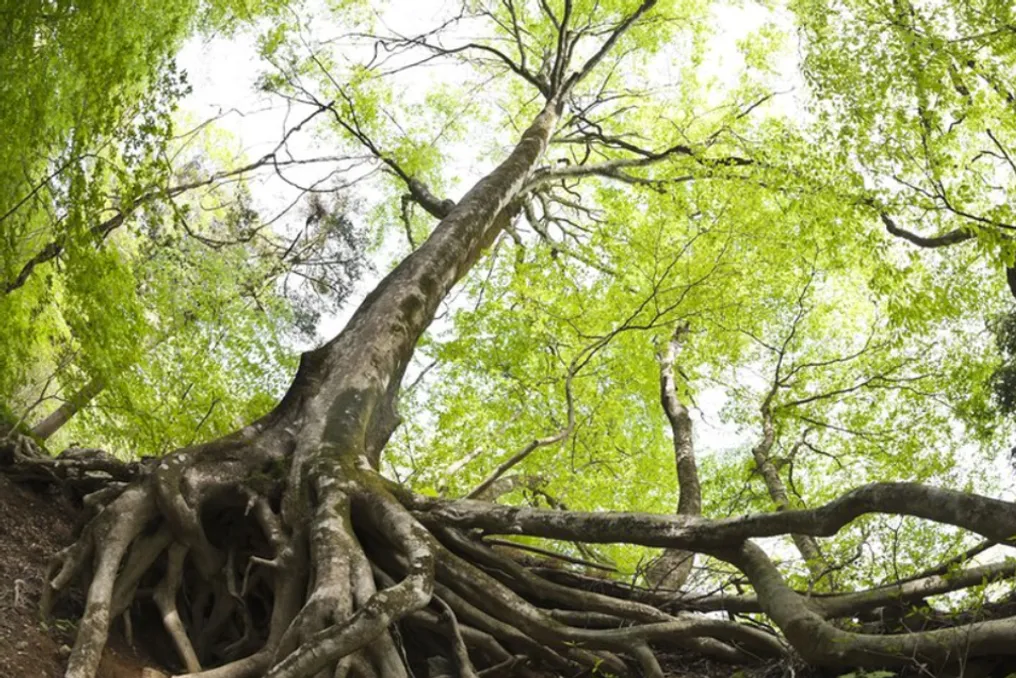
During a walk through the Western Ghats after the rainy season, one can observe moist soil and young saplings under the canopy of tall trees. Although each tree appears independent, striving for sunlight, a completely different process is occurring underground.
Fine fungal threads spread through the soil, establishing symbiotic relationships with tree roots. These fungi help trees locate water and nutrients, while the trees provide food for the fungi. Some of these fungal threads can connect neighboring plants, leading to the term 'Wood Wide Web.'
Unexpected Exchange Between Tree Roots
Trees use sunlight to produce sugars through photosynthesis, but obtaining necessary elements from the soil requires a different approach. This is where fungi come into play. Their microscopic threads penetrate the smallest soil pores inaccessible to tree roots. They help plants absorb elements such as nitrogen and phosphorus, and also improve access to water.
In return, trees supply the fungi with carbon-containing sugars. Scientists call these interactions mycorrhizal associations. The fungal threads, known as hyphae, can form an extensive network called mycelium. Some fungi are connected to multiple plants simultaneously, potentially linking their roots in so-called common mycorrhizal networks.
The fact of these connections is interesting, but it remains unclear whether one tree regularly supports another.
How Scientists Began Mapping the Wood Wide Web
In 2019, an international group of researchers, including scientists from Stanford University and ETH Zurich, began studying the locations of various partnerships between trees and fungi worldwide. They analyzed data from over 1.1 million forest plots in more than 70 countries, covering over 28,000 tree species.
Using computer models, they were able to map the distribution of major types of tree root partnerships, including those involving fungi and nitrogen-fixing bacteria. The study, published in the journal Nature, showed that these relationships depend on the climate. For example, in cooler regions, the decomposition rate of fallen leaves and other organic material affects the prosperity of fungal partners.
The results revealed global patterns beneath the forest floor and raised questions about how changes in temperature and precipitation can affect trees' dependence on these partnerships. It is important to note that scientists mapped general patterns of associations but did not track individual fungal threads connecting specific trees.
Do Older Trees Help Younger Ones?
Perhaps the most fascinating concept related to the Wood Wide Web is the idea of the 'mother tree'—a large, old tree that nourishes nearby saplings through shared fungal connections. Imagine a small sapling struggling for light under a dense forest canopy.
Studies have shown that materials sometimes move between plants connected by fungal networks. However, observing movement itself does not prove that a mature tree intentionally helps a sapling, or that this transfer makes the young plant healthier.
In 2023, researchers analyzed studies on common mycorrhizal networks in Nature Ecology & Evolution. They cautioned that some popular claims have spread further than the evidence allowed. Specifically, they found no published peer-reviewed evidence that adult trees selectively direct resources or alarm signals to their own offspring through these networks.
Thus, underground partnerships exist, but the popular image of forests caring for each other like a family remains unproven.
What Happens When Forest Soil is Disturbed?
Consider the tropical forests of the Western Ghats, the sal forests of central and eastern India, or the Himalayan mountain forests. The climate, soil, and trees in these areas differ, as do the organisms living around their roots. The 2019 global study provides insight into where various partnerships might occur, but it cannot specify which trees are connected under any particular Indian forest zone.
Therefore, studying local soils and fungi is crucial. The health of a forest depends on much more than what is visible above ground. Underground organisms help trees obtain nutrients, support the breakdown of organic matter, and influence plant responses to changing conditions. When forests are cleared or soil is disturbed, these connections can also be broken. Understanding these processes can help scientists approach the restoration of degraded lands and the protection of existing forests more carefully.
Next time you walk among trees, pay attention to the soil beneath them. Thousands of living connections are hidden there, performing vital work while scientists continue to figure out how they function. Forest protection begins with understanding the life we can see and the life we cannot.