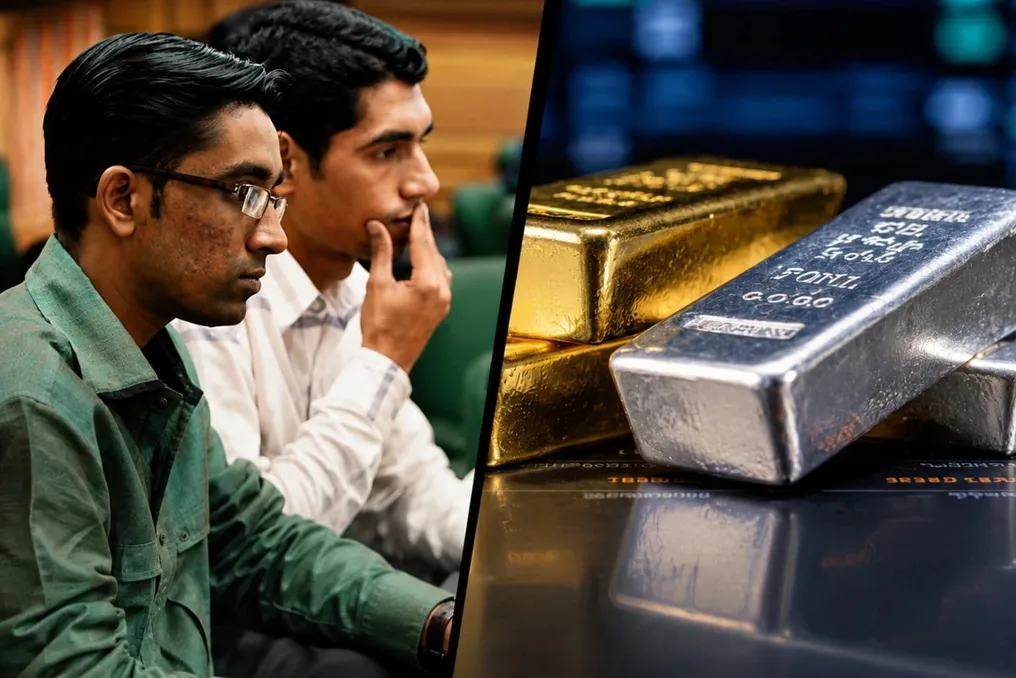
According to the new report from Motilal Oswal, the long-term forecast for gold and silver is assessed as positive, and the price decline may present a buying opportunity. The document also presents target levels for the global and domestic gold markets.
In 2026, gold and silver prices showed significant volatility. After a period of record growth, both precious metals experienced a substantial decrease, but signs of recovery are now emerging. In this situation, investors are questioning the potential return of gold's luster or further price drops.
The new Precious Metals report from Motilal Oswal Financial Services (MOFSL) indicates that while price fluctuations may continue in the near future, the long-term outlook for gold and silver remains favorable. The report's headline states: «Gold’s Rally: Deferred, Not Derailed».
According to the report, in January 2026, the international market price of gold reached a record high of about $5,600 per ounce. This was followed by a sharp drop, and the gold price fell below $4,000 per ounce. Nevertheless, a subsequent recovery was observed. Silver also experienced similar fluctuations; after exceeding the $100 per ounce mark, it faced a serious decline.
Changes in the dollar and rupee exchange rates also influenced gold and silver prices in the Indian market. MOFSL notes that in 2026, the dynamics of gold and silver were more volatile compared to the previous year, driven by factors such as US interest rates, inflation, bond yields, and geopolitical events.
The tradition of buying gold in India during Diwali and Dhanteras has existed for a long time. According to the report, over the last decade, gold prices in the domestic market have risen significantly during Diwali. In 2016, the gold price during Diwali was around 30,000 rupees, whereas in 2026, it reached approximately 1.50 lakh rupees.
Historical data from the report shows that 30 days before Diwali, gold traditionally showed better returns compared to the subsequent 30 days. For instance, in 2025, the gold price increased by about 20% in the month before Diwali, and the silver price by almost 38%. However, the report also emphasizes that buying gold during festivals depends not only on international prices but also on the domestic premium, imports, and actual purchase volume.
Despite high gold prices, investor interest remains strong. According to the MOFSL report, the volume of assets in the global gold ETF increased by approximately 187 tonnes in August and September 2026. The total asset volume of the global gold ETF reached a record 4,256 tonnes. In the third quarter, a record investment of $31 billion flowed into the global gold ETF.
In India, investments in the gold ETF grew by 71% in September 2026 compared to the previous month, reaching ₹4,450 crore. During the same period, ₹1,970 crore was invested in the silver ETF. Meanwhile, against the backdrop of high prices and import control measures for gold, gold imports into India also decreased: $2.3 billion worth of gold was imported in August, and this amount reduced to $1.8 billion in September.
According to Navneet Damani, Head of Commodity Research at MOFSL, gold remains a safe-haven asset amid global economic and geopolitical uncertainty. However, in the near term, prices will be influenced by the policy of the US Federal Reserve, inflation, the dollar exchange rate, and bond yields. The report mentions that the US Federal Reserve raised interest rates by 25 basis points in September, bringing US interest rates to the range of 3.75–4%. High interest rates and a strong dollar may put pressure on gold prices.
On the other hand, persistent inflation, concerns over national debt, geopolitical tensions, and central bank gold purchases could support prices in the long run.
MOFSL commodity analysts, Manav Modi and Navneet Damani, have identified potential levels for gold. It is considered favorable for buying when the international market price of gold is in the range of $3,800–$3,900 per ounce. The short-term target for gold is set at $4,200 per ounce, and the medium-term target is $4,500–$4,700 per ounce. The report states that investors can gradually increase purchases when gold prices fall. However, these broker forecasts may change depending on market conditions.
For the domestic market, MOFSL provided estimates assuming an exchange rate of ₹96 per dollar. According to the report, the level of ₹1,35,000 per 10 grams is a favorable zone for buying. The short-term target for gold is set at ₹1,48,000, and the medium-term target is ₹1,60,000–₹1,68,000 per 10 grams. It is noted that investors should focus on gradual buying during price declines rather than chasing gains.