
Moonshot AI introduces Kimi Hosted Agents as a managed cloud service for agents
Read more
Pandaily
pandaily.com

Moonshot AI introduces Kimi Hosted Agents as a managed cloud service for agents

Moonshot AI has launched Kimi Hosted Agents—a cloud service that packages the agent runtime environment, or 'harness,' as a managed product. This allows enterprises to avoid the need to build and maintain this infrastructure layer themselves, according to information from IT Home and the company's documentation on its open platform.

This offering is positioned as 'Harness as a Service.' Teams can configure agents on the Kimi infrastructure and receive a 24/7 environment for executing long-running tasks and collaborative work among multiple agents.

Enterprises can direct agents to internal systems for monitoring, research, and operational activities, or integrate them into customer-facing products as support or research assistants. Kimi Hosted Agents provides isolated sandboxes with network access controls, session boundaries that operators can stop at any time, and execution logs that can be exported for auditing. According to IT Home, the sandbox costs 0.072 yuan per hour plus model and plugin fees.

The platform currently includes over 140 skills and more than 30 plugins covering web search, professional data queries, office documents, and content generation. Developers can also connect their own tools, data sources, and MCP services. An additional security component, Kimi Inference Hook, allows the enterprise's proprietary or third-party security service to check task input data and tool output results before every model call, ensuring that only company-compliant content enters the inference process. This hook is currently available only to verified enterprise clients.

Official documentation also describes options for self-hosting environments, where sandbox tools run on customer-controlled machines while orchestration remains on the platform. In addition to the managed runtime, Moonshot is releasing the first series of official agent templates. IT Home notes eight financial templates covering modeling, deep research, morning briefings, IPO tracking, and portfolio monitoring; the documentation mentions a broader initial set of 12 templates, including game management and SRE incident response.

This launch expands Kimi's product line from models and desktop agents to a managed runtime, which Moonshot states the company will support and update. This occurred one day after Huawei Ascend announced support for zero-day inference for the open-weight Kimi K3.1 Pro model, highlighting a broader effort to simplify the deployment of Kimi agents in production environments.

Similar stories

Moonshot AI unveils K3.1 agent solution for game development in Unity, Unreal, and Blender
Read more
pandaily.com

Moonshot AI unveils K3.1 agent solution for game development in Unity, Unreal, and Blender

Moonshot AI has released a comprehensive solution for creating games and creative works, based on the Kimi K3.1 model series, Kimi Code and Kimi Work products, as well as plugins for professional tools including Unity, Unreal Engine, and Blender.

According to the company's statement, this package is designed to help studios accelerate game concept testing, advance engineering and artistic production, and integrate player feedback gathered during launch and operation back into the next development phase.

In the description, the Kimi model is capable of analyzing design documents, screenshots, source code, and 3D assets, after which it plans the necessary work. The Kimi Code product handles implementing changes within an existing codebase, while Kimi Work takes on multi-stage production tasks spanning multiple files.

Thanks to plugins and tool calls, Kimi can directly interact with existing projects, returning editable files to the user along with a report of completed actions. In Unity and Unreal Engine environments, upon receiving necessary access rights and project files, the system first maps the code structure, scene hierarchy, and module dependencies, then makes changes via editor plugins, and finally verifies the result through playback steps, logs, and execution data. For engineers, reports on code differences and verification records are maintained.

For operations in Unity, the Kimi models utilize the Tuanjie Codely Agent, a gaming agent from Unity China integrated into the Tuanjie Engine. Kimi interprets the developer's intentions, writes code, and analyzes testing results and screen recordings, while the Codely agent performs operations within the engine using editor scripts and runtime. During one demonstration, Kimi showed that it could operate for 20 hours without human intervention, recreating an existing game and generating a native project ready for further development.

The launch page features several demo builds created using Kimi K3.1 Pro. An internal jungle valley was constructed in Blender, and a 17.5-second flythrough was rendered at 1920x1080 resolution and 60 frames per second, alongside a cathedral interior in the browser containing approximately 3.3 million triangles and 8368 animated components. In Unreal Engine 5.8, a celestial palace scene was created featuring a colonnade of 36 arches with a 1750-meter radius and a procedurally modeled dragon totaling 36 million triangles, rendered using Nanite and Lumen. Kimi also claims that designers without programming experience can create playable prototypes in Godot within one or two days.

In addition to production tasks, this solution includes batch creation of advertising creatives, integration of in-game assistants via the Kimi API, sorting community feedback with source attribution, preparing localization drafts with back-translation checks, and initial selection of user-generated content. Kimi advises teams to start with one clearly defined task and evaluate pilot projects based on criteria such as time saved, quality of the result, and volume of required human refinement.

Google Cloud to Unveil Gemini Roadmap Focused on Building, Scaling, and Managing AI Agents
Read more
yourstory.com

Google Cloud to Unveil Gemini Roadmap Focused on Building, Scaling, and Managing AI Agents

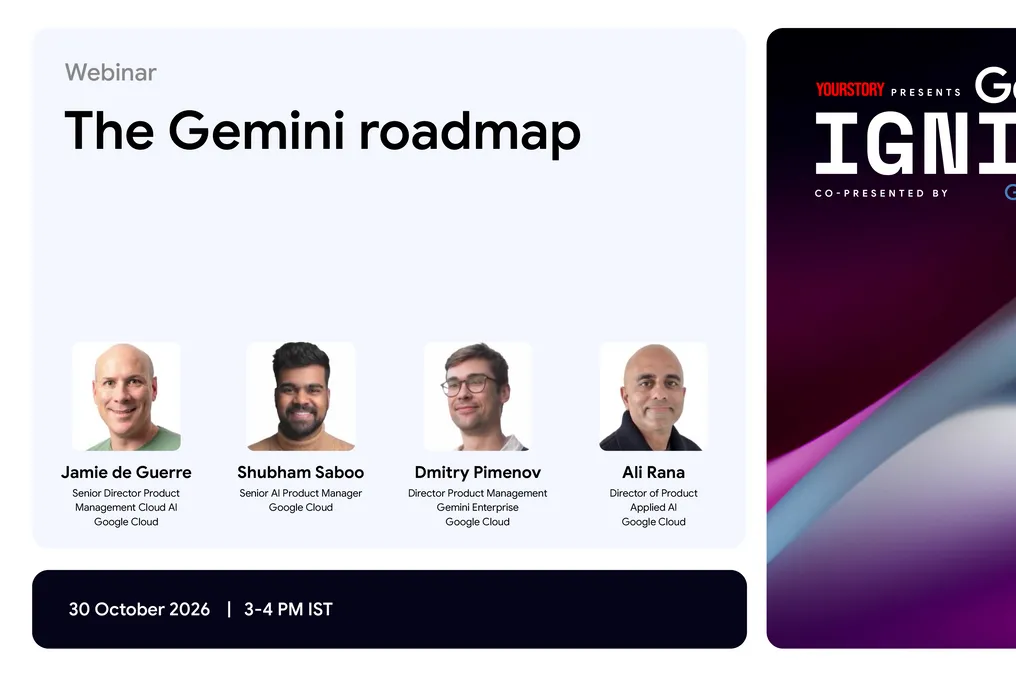
Small teams often possess great ambition, but they lack the personnel to transform those ambitions into production-ready artificial intelligence—from engineers developing agents to security staff monitoring their operations. This is precisely the problem the upcoming webinar from Google Cloud in partnership with YourStory aims to solve.

On October 30th, Google Cloud product leaders will present the 'Gemini Roadmap'—an overview of the latest Gemini AI updates, including the Gemini Enterprise Agent Platform and Gemini Enterprise for customer experience. The session is specifically designed for small organizations and examines how AI can serve as a powerful team amplifier, based on the Gemini roadmap through 2026. Attendees will receive proven ROI frameworks and the technical details necessary to maintain flexibility and competitiveness in a rapidly changing market.

The overview is divided into two segments, each targeting a different audience.

The first session is intended for developers and technical leads. It will explore the newest features of the Gemini Enterprise Agent Platform, which combines Google's cutting-edge AI research with a secure global infrastructure. This enables teams to build, scale, and manage agents that truly function in a working environment. The concept revolves around creating a secure, comprehensive platform for the entire agent lifecycle—a digital 'extra set of hands' that reliably handles complex workflows.

Participants will learn how to quickly build agents using the Agent Development Kit (ADK), deploy them to production via a fully managed integrated runtime, and utilize Agent Gateway and Agent Identity for managing permissions and security without needing a large security team. Furthermore, automated policy enforcement and compliance will be highlighted as deployments grow, alongside agent availability for all employees through the Gemini application.

Three Google Cloud product leaders will speak in this session: Jamie de Guerre, Senior Director of Cloud AI Product Management; Shubham Saboo, Senior AI Product Manager; and Dmitry Pimenov, Gemini Product Management Director.

The second session targets leaders focused on customer experience. It begins with a common challenge: fragmented applications and missed customer opportunities when every interaction matters—from the initial query to final checkout. Participants will see how to create AI agents capable of performing complex tasks and providing natural, helpful support throughout the entire customer journey.

This section is designed for leaders ready to move beyond basic chatbots. It will demonstrate how the same technology used by global brands to double their efficiency can be applied to a growing team. Gemini 3.1 Live Audio gives the brand a natural voice, resolving issues through fluid dialogue rather than rigid menus. The intelligent contextual engine remembers what the customer said three steps ago, eliminating the need to repeat information. Automated analytics instantly surface customer trends, helping teams improve service with every call, while enterprise-grade privacy keeps business and customer data under exclusive control.

Ali Rana, Product Director of Applied AI at Google Cloud, will lead the customer experience session.

For small organizations, the next step in AI adoption is less about experimentation and more about implementation: launching agents that operate stably in production, ensuring their security, and providing natural, not scripted, customer support. A massive engineering or security department is not something every small team possesses.

The webinar is designed to show that this is not a prerequisite. By combining a technical view of the Agent Platform with a business perspective on customer experience, it provides both developers and decision-makers with a clear picture of what is coming and how it can be applied.

Popular