
Massive disclosure of mathematical results by OpenAI generates debate and skepticism in the scientific community
Read more
Super Abril
super.abril.com.br

Massive disclosure of mathematical results by OpenAI generates debate and skepticism in the scientific community

OpenAI released a vast collection of hundreds of mathematical results in early October, claiming that this material could 'expand the frontiers of human knowledge.' These 722 articles, mostly generated by an as-yet-unrevealed artificial intelligence (AI) model, address 372 outstanding problems covering areas such as algebra, geometry, and theoretical computer science.

Although some of these articles were later removed or modified, the scale and manner of the disclosure—described as a 'launch,' 'dump,' 'mass bombardment,' or 'mathematicalypse'—caused significant upheaval in the mathematical community.

Among the topics covered are mentions of notable progress on old and highly relevant problems, such as the Riemann Hypothesis and the Birch and Swinnerton-Dyer Conjecture, both associated with $1 million rewards, part of the Millennium Prize Problems.

OpenAI justifies the release of this large body of results with the aim of 'promoting more progress in mathematics.' However, the way this disclosure occurred raises questions about the effectiveness of this goal. A senior colleague reported that one found article was so confusing that it would be discarded by a specialized journal editor.

OpenAI's own large language model, ChatGPT (specifically GPT-5.6 Sol), demonstrated skepticism when consulted, classifying at least one of the highlighted results as 'a serious hallucination... [that] should never be cited, submitted, or disclosed as proof without a complete audit by experts.' This indicates that, despite the innovative potential of some findings, the writing of at least some articles is unintelligible even to specialists.

There is a possibility that OpenAI is trying to divert attention from a previous controversial publication made in September, where it presented a solution to a case of the Navier-Stokes problem, another Millennium Prize Problem with a $1,000,000 prize. Mathematicians Tristan Buckmaster and Levent Alpöge accused OpenAI of using their data and ideas, investing about $15 million in computing power to reach the solution, although OpenAI denied such allegations.

Another potential reason for OpenAI is the growing interest in Artificial General Intelligence (AGI), a hypothetical type of AI capable of surpassing humans in almost all cognitive functions. Since pure and abstract mathematics depends on extremely complex arguments to validate its claims, the ability of OpenAI's models to perform research-level calculations may reinforce the belief that these models are approaching the 'Holy Grail' of AGI.

This perception could benefit OpenAI before its planned IPO, competing with Anthropic. Reports indicate that the company aims for a market valuation of up to $1.4 trillion, corresponding to approximately 4% of the United States GDP.

Unlike mathematics, where truth is established by expert consensus after rigorous review, mathematical statements are founded on objective truth, being unequivocally true or false. Traditionally, new work undergoes a lengthy peer-review process.

OpenAI has already removed three articles due to simple errors and corrected others due to inaccuracies that invalidated the results, suggesting flaws in pre-publication review. In parallel, there is a movement toward 'formalization' of results using software like Lean, which constructs mathematics from axioms, allowing for logical verification of every step.

AI systems are being applied to 'auto-formalization,' translating results into machine-auditable proofs. To foster confidence, OpenAI claims to have formalized 300 important results. However, there are precedents of failures in AI-generated formalizations, such as in the case of Navier-Stokes, leaving it uncertain whether the mathematical community will accept these formalizations.

Reactions to OpenAI's launch are polarized, ranging from considerations of the 'most significant moment in the history of mathematics' to severe criticism, comparing the material to 'a giant pile of feces thrown at our door.' While there is enthusiasm for advances in crucial problems, it coexists with apprehension about what the volume and speed of these discoveries mean for future research and who should bear the burden of interpreting AI-generated arguments.

These articles, along with other AI-assisted advancements, force the mathematical community to reevaluate its values, a crucial point for novice students and researchers, who face the possibility of their research being preempted by ambitious AI users.

Similar stories

Axiom Math formalized the proof of the 'Monster Theorem'—the longest theorem in the history of mathematics
Read more
nplus1.ru

Axiom Math formalized the proof of the 'Monster Theorem'—the longest theorem in the history of mathematics

Axiom Math announced the successful completion of the computer formalization of the classification theorem of finite simple groups, also known as the 'Monster Theorem'. This achievement is considered one of the most significant successes in the field of 20th-century mathematics.

This theorem deals with the classification of finite simple mathematical groups, which are fundamental building blocks for forming any finite group, analogous to how complex numbers are divided into prime factors.

Work on the proof of this theorem continued for more than half a century. The first steps were taken in 1963 when American mathematicians Walter Feit and John Thompson proved that the order of any non-abelian finite simple group is even.

The classification was finally completed in 1983 by Daniel Gorenstein. Furthermore, in 2004, Michael Ashbacher and Stephen Smith published a 1221-page exposition, marking the completion of the so-called first-generation proof. It was this work that Axiom Math undertook to formalize.

OpenAI and Anthropic refute the exponential time hypothesis in computational complexity theory
Read more
nplus1.ru

OpenAI and Anthropic refute the exponential time hypothesis in computational complexity theory

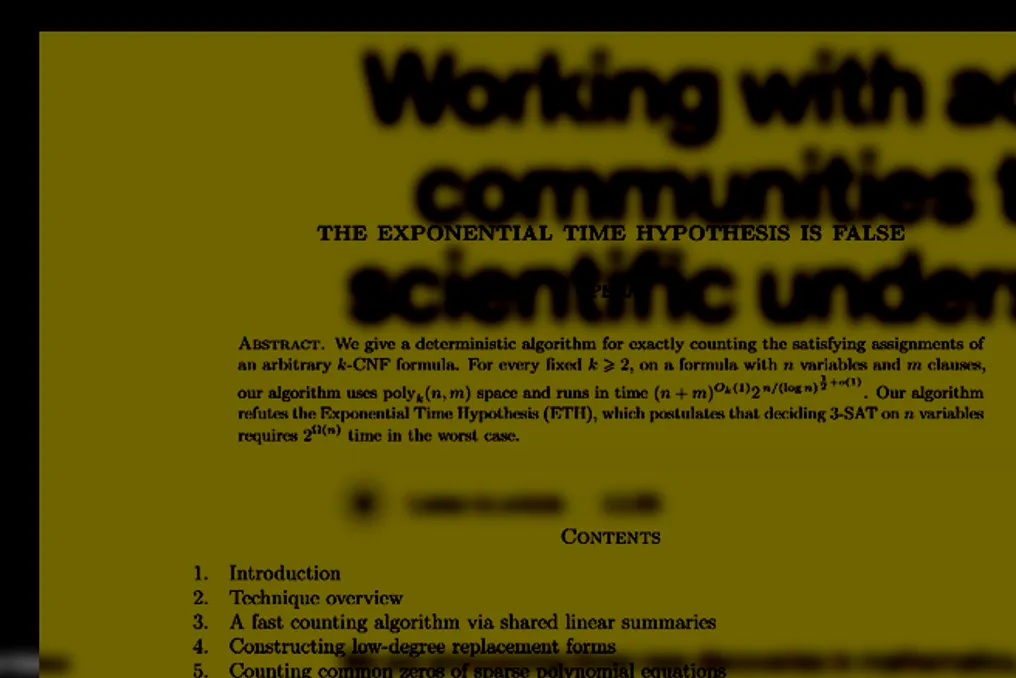
An internal model from OpenAI presented a proof that refutes the exponential time hypothesis—one of the fundamental assumptions of computational complexity theory. Concurrently with this result, a similar refutation was obtained by the Anthropic model.

The exponential time hypothesis asserts that as the volume of input data increases, the time required to solve certain types of problems will grow exponentially in the worst-case scenario. Specifically, according to this hypothesis, the 3-SAT problem for Boolean formulas cannot be solved faster than an exponential time dependent on the number of variables.

Both technology companies have published their refutations, formalizing them in the Lean language. The proof developed by OpenAI also allows for predicting the number of solutions for Boolean formulas in subexponential time. However, the results still require independent verification.

As part of the review, OpenAI employees sent the obtained result to a group of complexity theory experts. This group includes the authors of the original formulation of this hypothesis—Russell Impagliazzo and Ramamohan Paturi.

OpenAI announces three AI-generated scientific discoveries whose results will be verified by experts
Read more
olhardigital.com.br

OpenAI announces three AI-generated scientific discoveries whose results will be verified by experts

OpenAI has disclosed three scientific advancements attributed to its artificial intelligence (AI) models, covering the fields of mathematics, computer science, and physics. These findings include potential proofs for ancient mathematical conjectures, the refutation of a crucial hypothesis about computational limits, and theoretical progress in particle physics.

At this time, the company has also introduced a new methodology to integrate independent researchers into the evaluation of these results. This change in approach was motivated by criticism regarding how OpenAI had made hundreds of AI-generated mathematical works public in early October.

The three cases present distinct presentation methods. In mathematics, the model-generated material was published directly. In computer science, the proof was made available along with the organization of an external group for its analysis. In physics, the assigned experts opted to elaborate on the work before releasing the materials created by the AI.

OpenAI emphasizes that these results still need to be converted into verifiable and understandable scientific knowledge. Consequently, the discoveries announced by the company should not be considered definitive conclusions accepted by the academic community.

The second discovery relates to the Exponential Time Hypothesis (ETH), a concept widely used in theoretical computer science. This conjecture posits that certain problems of Boolean formula satisfiability cannot be solved by exact algorithms in subexponential time.

OpenAI claimed that its system identified a deterministic algorithm capable of precisely counting assignments that satisfy fixed-width CNF formulas in subexponential time and polynomial space. Specifically, in the context of the 3-SAT problem, this result contradicts the ETH.

If this conclusion is validated, it will force researchers to reevaluate theoretical results that depend on this hypothesis, which is applied in hundreds of areas, such as computational geometry, computational biology, and graph theory.

To investigate this claim, a collective of experts was assembled, led by Russell Impagliazzo and Ramamohan Paturi, both from the University of California, San Diego (USA), and Ryan Williams, from the Massachusetts Institute of Technology (MIT). Impagliazzo and Paturi had already participated in the original conception of the hypothesis in 1999.

The formalization of the proof in natural language and in Lean was made publicly available on GitHub. The group also requested contributions from the scientific community to evaluate the finding and debate how AI-generated results should be examined. However, the participation of these experts does not constitute prior confirmation of the discovery, as the group itself emphasizes that a claim of this magnitude requires independent and meticulous analysis.

The third claim is related to theoretical physics. OpenAI states that it has developed a mathematically robust demonstration regarding the existence of certain interacting quantum field theories in four dimensions, including gauge fields and fermions.

This work would encompass Quantum Chromodynamics (QCD), a theory describing the interaction between quarks and gluons through the strong force, as well as a unified extension of the Standard Model of particle physics. Furthermore, the company claims that the result proves the existence of pure Yang-Mills theory, a topic linked to one of the Millennium Prize Problems from the Clay Mathematics Institute.

Unlike the other two cases, the materials produced by the AI have not yet been released. David Gross, a 2004 Nobel laureate in Physics, will lead a group that includes Michael Douglas, Arthur Jaffe, Igor Klebanov, and Nikita Nekrasov. The experts decided to prepare the explanation of the work before making the original data public.

The existence of a rigorous demonstration for such theories would represent a significant leap for mathematical physics. However, at this moment, the assertion remains in the analysis phase, with no independent validation presented in the announcement.

The change in disclosure strategy occurs amid a discussion about the role of AI in scientific research. A central point is how to enable the community to analyze the results without initial access being restricted to a group selected by the company itself.

On October 25, the Advisory Group on Mathematics and Artificial Intelligence (AGMAI) issued a recommendation against the practice of AI companies selecting mathematicians to receive results in advance. Among the issues raised were unequal access, the influence of experts' fame on the credibility of claims, and the risk of biases in selections.

The group advocates that results be made available responsibly, providing information that allows for autonomous verification and promotes the development of shared scientific understanding.

OpenAI acknowledges that its new tactic also presents risks. The selection of experts to coordinate the analysis may affect who participates first in the discussion and generate information asymmetries. The company assures that external collaborators can share the work and publish their conclusions without being subject to confidentiality agreements.

Additionally, the company declares that it is not seeking academic recognition for the findings generated by its models. According to the proposal, credit should be given to the researchers who elaborate the explanations, verify the proofs, and produce materials that help understand the results.

OpenAI invites the scientific community to debate criteria for early access, transparency of conflicts of interest, attribution of merit, and support for students and researchers facing transformations caused by AI.

Popular