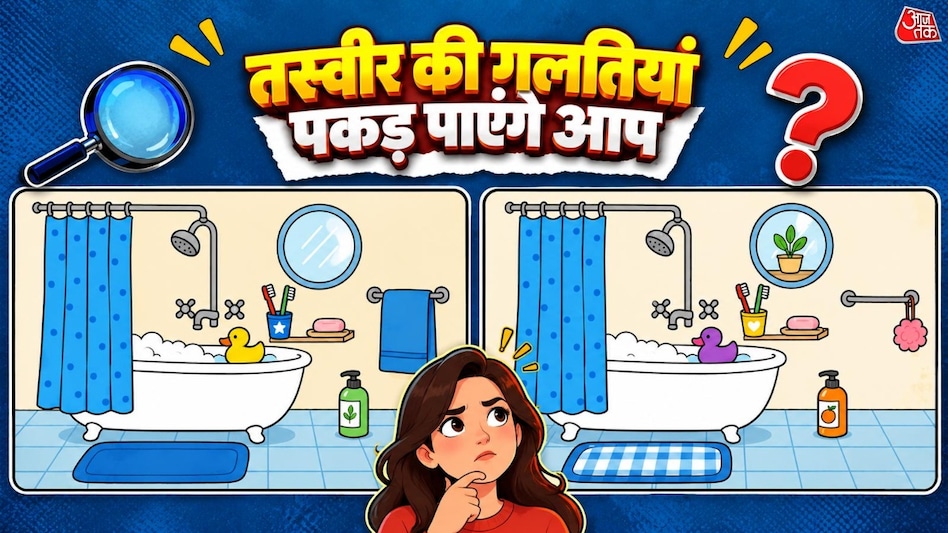
Games related to optical illusions and finding differences in photographs are very popular on social media. In such images, some elements may seem completely ordinary at first glance, but upon closer inspection, it is discovered that there are some inconsistencies. This is why such puzzles attract people's attention.
Today, an interesting intelligence test is presented. As part of this task, you need to carefully examine the provided image and find three errors within it. There is also a time limit—only 10 seconds to find all three flaws.
At first glance at the photo, it may seem like everything looks perfect. However, you should stop and pay attention to every part of the image. Perhaps the size of an object, its location, or some small detail differs from the others. The task is to identify exactly these three errors.
No special knowledge is required to solve this test; it is enough to focus your gaze on the picture and pay attention to the smallest details. Often, we look at images but do not notice everything present in them. Our gaze moves from one element to another, and at this moment, a small inaccuracy can slip by.
After carefully studying one part of the image, you should shift your gaze to another. Then, compare all the elements present in the shot. If any object seems different from the rest or is not in its place, you should pay attention to it. You can mentally start counting down from ten. As time decreases, you will have to use your vision and concentration. Nevertheless, you must not rush and count every trifle as an error. You need to find all three hidden inaccuracies. So, it's time to test your observation skills. Look closely at the image and see if you can find all three errors in 10 seconds?
Were you able to notice any error at first glance?
In such images, the first error is often found easily. But the real difficulty begins when you have to look for the other flaws. Perhaps after finding the first error, you start paying too much attention to that spot and forget to examine other parts of the image. Therefore, it is crucial to cover the entire picture with your gaze. Instead of constantly focusing on one corner or one object, you need to carefully examine all areas. Sometimes the error you are trying to find first is right in front of you, but your gaze misses it.
If you found all three errors, that is a good sign. You showed attention to small details and successfully completed the test. Even if you only found one or two errors, try again. Perhaps upon re-examining, you will notice the error that was missed the first time.
Optical illusions and difference-finding puzzles serve as a good form of entertainment. By solving them, we are forced to concentrate on different parts of the image. We try to recognize differences in shape, color, placement, and the relationship between objects. In such games, careful observation and the ability to notice small details are critically important. Moreover, solving one puzzle or finding a small number of errors does not determine a person's level of intelligence. It is an engaging challenge that can be undertaken alone or with friends and family.
You can show this image to your friends and ask them to find all three errors. Then you can compare who answered correctly in the shortest time. Thus, this small intelligence test will become even more interesting.
If you examined the image carefully for 10 seconds but still couldn't find all three errors, don't worry. It is not necessary for the answer to every puzzle to be found on the first try. You can look at the image again and focus on the areas that looked ordinary at first glance. To get the answers to this puzzle, carefully look at the circle drawn on the image. Inside these circles are shown three places where the errors are hidden. Now you can check your answers and see how many errors you found correctly.
So, how many points did you score in this test? Were you able to find all three errors in 10 seconds, or did some error escape your attention? Be sure to share your result in the comments and spread this challenge among your friends.