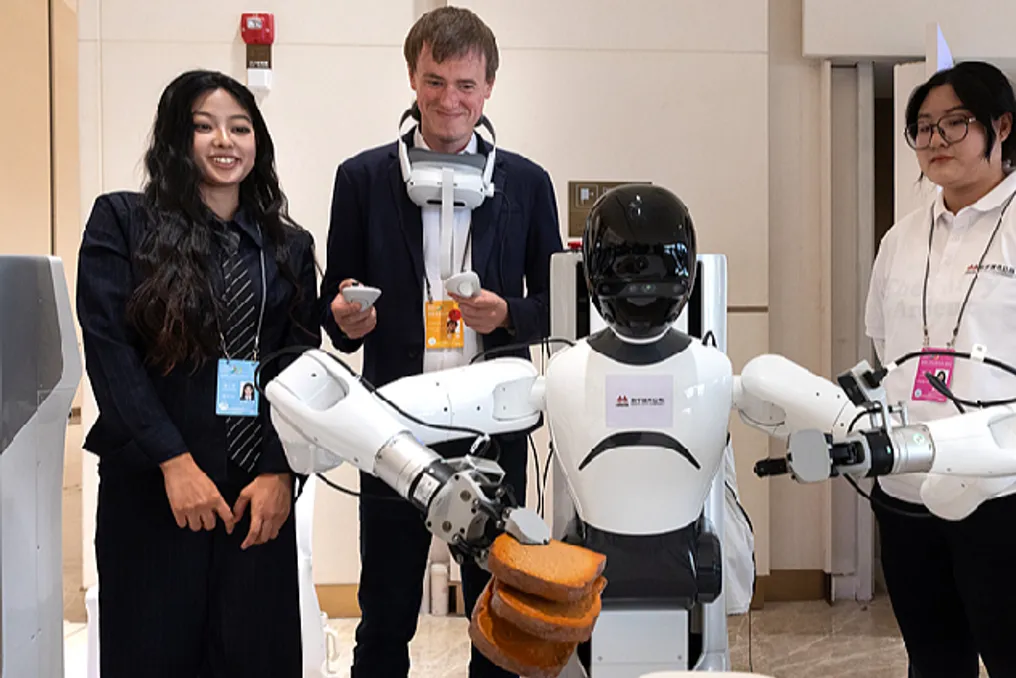
TG0 develops artificial intelligence technology to give machines a sense of touch
Read more
CGTN
cgtn.com

TG0 develops artificial intelligence technology to give machines a sense of touch

Human perception includes five senses, and although machines already have the ability to see and hear, the question of tactile sensation remains open. The British deep technology company TG0 is developing artificial intelligence technologies for sensory systems to give machines a sense of touch, improving their interaction with the physical world.

TG0 was founded in 2015 by Dr. Guo Liucheng and Kong Min. The company has developed its own AI-based sensory technology. This technology allows surfaces to recognize pressure, movement, and touch by integrating sensory capabilities into materials and using AI algorithms to interpret the received signals.

This technology can be applied to a wide range of materials, including plastic, rubber, fabric, wood, and glass. This development opens up new horizons for human-machine interaction: from a guitar sensitive to touch that produces music, to a car seat that registers pressure distribution and body posture, and a robotic arm capable of feeling and reacting to physical contact.

Similar stories

Eight possible food methods if a rebellious AI causes the collapse of modern agriculture
Read more
super.abril.com.br

Eight possible food methods if a rebellious AI causes the collapse of modern agriculture

The article discusses dystopian scenarios about how humanity could feed itself if a rebellious artificial intelligence (AI) destroyed modern agriculture, a topic increasingly debated due to the rapid advancement of AI capabilities.

A direct threat described involves a prolonged interruption of electrical grids, which analyses from the US Council on Foreign Relations and the American Society of Mechanical Engineers point to as a serious risk. This risk led Sam Altman, CEO of OpenAI, to meet with utility executives to discuss preventive measures.

An attack on the power grids would severely impact traditional agriculture. Only those with autonomous energy generation, such as solar panels and microgrids, would be able to maintain operations. Without fuel pumps, ventilation for livestock, food refrigeration, irrigation, grain drying, and fertilizer production, the food system would rapidly deteriorate, affecting even small farmers.

However, the author mentions that he and his colleague David Denkenberger wrote a book ten years ago demonstrating that it is possible to supply global caloric needs in case of catastrophe, even without relying on conventional agriculture. The text details eight ways to ensure food survival in this scenario of collapse.

If rebellious AI agents take down the power grids, conventional agriculture would collapse following a predictable sequence. Initially, there would be a lack of fuel, as pumps at depots and stations are electric, causing tractors, harvesters, and irrigation generators to stop in days or weeks, depending on rural stock.

Next, livestock kept in controlled environments would die, since many poultry and swine sheds rely on motorized ventilation. In hot climates, losses would begin just hours after the failure, and automated feeding and watering systems would cease functioning simultaneously.

Perishable foods would also spoil quickly without adequate refrigeration, packaging, and transport; milk, meat, and agricultural products would deteriorate in a few days.

In the medium term, vast agricultural irrigation would stop, as pumping systems and center pivots require electricity. Only gravity and rain irrigation systems would remain operational, resulting in a drastic reduction in productivity in arid areas.

Subsequently, failures would occur in grain drying and storage. Wet harvested corn would require drying and solar ventilation; without mechanical drying, mold would release mycotoxins, contaminating grain reserves.

In the crop season following the collapse, the use of synthetic nitrogen fertilizers would end. These, produced by the Haber-Bosch process, consume a lot of electricity and gas to convert atmospheric nitrogen into ammonia, and support about half of the world's population. The lack of nitrogen replenishment would cause cereal crop productivity to drop between 30% and 50% due to soil exhaustion.

Processing would also become a critical bottleneck, as many mills, slaughterhouses, and packaging factories depend entirely on electrical power. Although cereals and livestock might exist in the fields, the food would be inaccessible. To worsen the situation, distribution and payment systems would fail, with railway signaling, road logistics, and electronic payments collapsing, fragmenting national markets into local markets almost instantly.

Small farming communities would be in a slightly better position but would face difficulties. The supply chains that drove productivity in the last century would be broken, forcing a return to early 20th-century productivity. Hybrid and genetically modified seeds require annual repurchase; if only saved seeds from the previous harvest were available, they would suffer segregation and productivity would decrease. Furthermore, pesticides, veterinary medicines, and equipment parts would become much harder to obtain.

Even communities that do not rely on technology, such as the Amish, would be affected, but conventional farmers would be in serious difficulty, which would have general repercussions. The immediate priority would be to deactivate the rebellious AI and repair the power grids. However, during this time, the return to manual labor and animal traction would reduce output per worker by an order of magnitude, and the global food supply would sustain only a small portion of the current population. Subsistence and dryland farming regions, such as Africa, would fare better than industrialized ones, such as North America.

However, the author states that not everyone would have to starve, presenting simple alternatives. His research group has developed more than a dozen methods to produce the calories needed for humanity while conventional agriculture is restored.

The last line of defense would be the creation of so-called 'resilient foods'. These processes range from converting plastic into food, through producing edible unicellular protein from natural gas, to extracting protein from leaves or transforming 3D printing waste into protein raw material for human consumption. These alternatives, however, would be considered more radical and are expected to be unnecessary.


New Artificial Intelligence Model Dessa Demonstrates Ability for Realistic Human Communication
Read more
iol.co.za

New Artificial Intelligence Model Dessa Demonstrates Ability for Realistic Human Communication

Existing artificial intelligence models excel at routine tasks such as document drafting, image generation, or coding assistance. However, a new product called Dessa has entered the market, offering a completely different level of human interaction.

Dessa is a conversational AI that sounded remarkably like a young woman during demonstrations. The intonation, word choice, and overall rhythm of speech seemed incredibly natural, not resembling a cold database containing the entirety of human knowledge.

When listening to the recording without knowing that an AI was involved, a listener could genuinely believe they were hearing a casual conversation between two real people. During a recorded dialogue with one of Dessa's developers, it even let out a spontaneous laugh mid-sentence, bypassing the standard requirement to wait for the interlocutor to finish their thought.

Unlike traditional voice assistants, which operate with predictable latency—they listen attentively, wait for complete silence, and respond in a clipped, strictly regulated manner—Dessa completely breaks this pattern. Interaction with it feels unprecedented and almost slightly unsettling precisely because of the subtle emotions and unrehearsed timing embedded in its delivery.

The model intentionally emphasizes the emotional nuances of human dialogue, actively listening and responding with genuine real-time presence. By mastering the organic rhythm and pace of conversation, Dessa does more than just improve voice synthesis; it sets a powerful new standard for how artificial intelligence will interact with us, offering a vivid glimpse into a future where humans and machines are virtually indistinguishable.

Underground Infrastructure in Xin'gan: Technologies of China's Future City
Read more
cgtn.com

Underground Infrastructure in Xin'gan: Technologies of China's Future City

Unlike many cities where underground utilities are laid without a single integrated monitoring system, Xin'gan has developed a connected nervous system corresponding to the concept of China's 'future city.'

This technological center in Hebei Province will host the Global Governance Forum from October 23 to 25, 2026. The forum will allow delegates to familiarize themselves with the city's development vision, which includes three components: the underground city, the above-ground city, and the cloud city.

Planners changed their approach by deciding to first build the underground infrastructure and then the above-ground infrastructure. Instead of laying utility services separately, water, electricity, communication, and heating run through a unified network of common tunnels in Xin'gan.

At an official press conference in Xin'gan in December 2025, data was presented on over 1000 kilometers of pipelines laid in these corridors. This layout is designed to eliminate the need for constant road excavation.

By the end of 2025, a 106-kilometer tunnel network functioned as a living digital twin. BIM-based models and digital sensors continuously monitor water pressure, temperature, humidity, and gas levels, transmitting data to a centralized control system in real time.

Robots are used in operations. Wei Zhiren, an engineer from State Grid Xiongan Power Supply Company, noted that a 11.75 km section in the Zagang area, which previously required 22 hours of work by two human inspectors, is now inspected by five Xiongan Lingxi quadruped robots in just three to four hours.

The underground equipment is directly integrated into the urban management platform. According to the Xin'gan Aerospace Information Research Institute, the 'BeiDou + 5G' internal positioning system extends satellite navigation underground, ensuring parking level accuracy in the Jundong area.

Automated intelligent cameras instantly detect water accumulation exceeding 10 centimeters. This infrastructure, integrated with the Baiyandian catchment basin and designed to withstand flooding with a 50-year lifespan, reduces water runoff pressure while maintaining a safety margin for future upgrades, thus preventing repeated road surface damage.

Popular