At the upcoming APEC economic leaders meeting in Shenzhen this month, strategic expert Liang Linniu from China Southern Power Grid and Director of Computing-Power-Grid Engineering Company of CSG Digital Research Institute shares industry views on transitioning to an artificial intelligence-based energy grid. He discusses how to align computational loads with power supply and proposes practical cooperation options within APEC for integrating AI and green energy.
Amid global climate challenges and growing energy demand driven by the AI boom, accelerating the transition to green energy has become an urgent priority. The goal is to create an energy system that is safe, reliable, sufficiently supplied, sustainable, inclusive, environmentally friendly, and accessible.
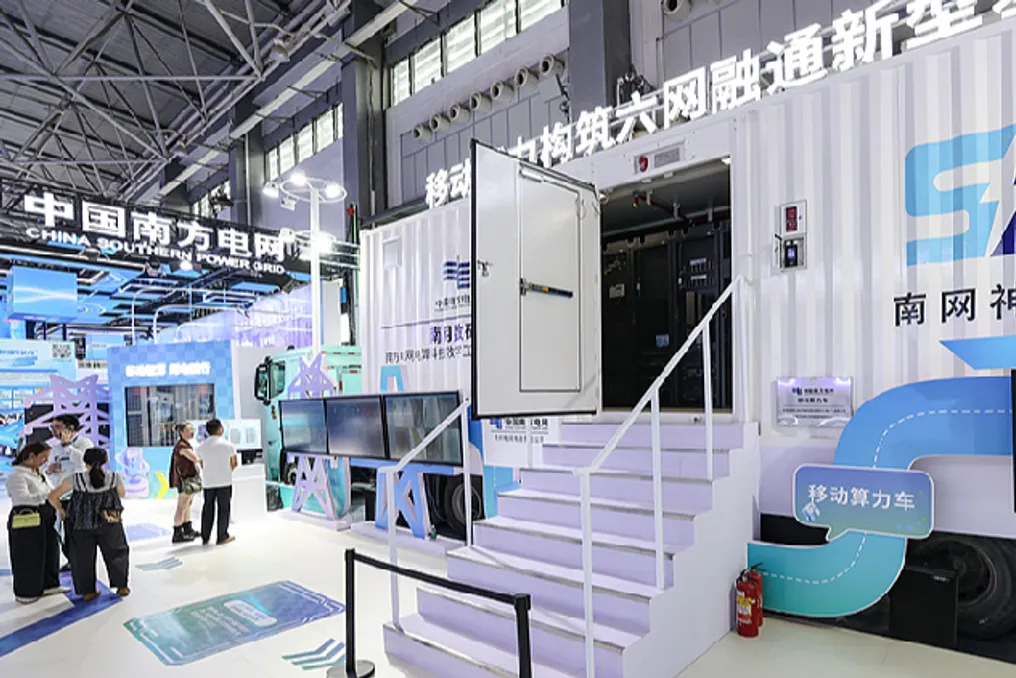
A key factor in achieving this goal is the development of new network infrastructure that coordinates six main networks: water supply, electricity, computing, communication, underground urban utilities, and logistics. More meticulous planning allows for the matching of energy consumption with clean energy supply across different regions.
Joint construction of facilities and resource sharing help avoid redundant investments, reduce energy consumption, and lower costs. Through unified coordination, energy-intensive processes, such as computational loads, can be flexibly planned and executed where there is a surplus of green energy and at the right times. This forms a solid foundation for green energy, improves the stability, resilience, and accessibility of energy systems, and promotes more efficient global AI development.
A critical path to realizing this vision is an AI-oriented paradigm that combines precision, operational responsiveness, and reliability in the energy sector to integrate general-purpose and specialized domain models. Deep integration of artificial intelligence into the production workflows and organizational models of the energy sector provides the necessary support for energy infrastructure to develop industrial AI. Furthermore, by meeting stringent requirements for intelligent perception, reliable decision-making, and safe operation in energy systems, this paradigm identifies common methodologies for the intelligent transformation of complex industrial systems and offers technological guidance for broader industrial AI upgrades.
The Significance of the AI-Based Paradigm
Against the backdrop of general pressures related to climate change and the AI revolution, energy is a key battleground, and energy systems are the primary driving force. Investigating the AI-based paradigm and implementing bidirectional reinforcement between energy infrastructure and energy-sector-specific AI represents a vital path toward modernizing energy systems, achieving the green transition, coordinating infrastructure development, and transforming industrial AI.
Energy systems possess unique advantages, such as a mandate for public services, strategic importance, and systemic complexity. Achieving technical breakthroughs in AI-based energy architecture in industrial scenarios can yield a dual benefit: robust support for energy infrastructure and innovative leadership, which in turn accelerates overall progress in industrial AI and digital intelligent upgrading in the real economy.
Firstly, since fundamental infrastructure connects energy production, industrial operations, urban management, and social needs, advancements in the AI-based paradigm modernize energy systems and provide more stable, reliable, and accessible power sources to support the large-scale deployment of industrial AI applications. Moreover, energy systems serve as a representative testbed for studying industry-specific AI.
Energy consumption requires balancing supply and demand in real-time; generation, transmission, and consumption are closely interconnected, and all operations must adhere to strict safety regulations. As the volume of renewable energy generated from wind and solar fed into the grid increases, closer coordination between energy generation assets, end consumption, and energy storage is required, increasing operational and coordination complexity. AI must interpret the physical laws governing energy system behavior, detect evolving conditions, and make reliable decisions under complex constraints to ensure operational safety. These challenges are widely present in other industrial sectors. Therefore, the technical achievements and practical experience gained within the AI-based paradigm can serve as a valuable foundation for other industries and stimulate broader industrial AI development.
China's Practice
Faced with global climate change and high strain on power grids caused by the expansion of artificial intelligence, China is promoting the development of a new network to enhance the coordination of six key infrastructure networks, facilitate the transition to green energy, and establish a stable, clean, sufficient, and accessible energy base for AI growth. The AI-based paradigm provides the core technical support for this task.
To meet the requirements for coordinated development of national critical infrastructure, including 'unified dispatching, multi-level management, and on-site decision-making,' China has proposed and implemented an integrated technical structure built on four pillars: AI-based interaction, AI-based architecture, AI-based processes, and AI-based tool integration.
AI-based interaction allows operators to submit requests and perform tasks using natural language, thereby lowering technical barriers for cross-network workflows. AI-based architecture reorganizes industry digital foundations around AI, ensuring compatibility between various agents, algorithms, and models and promoting connectivity among the intelligent systems of the six key infrastructure networks. AI-based processes enable intelligent agents serving the six key infrastructure networks to autonomously generate solutions and collaborate on tasks, supporting integrated planning and sequential construction of cross-network infrastructure. AI-based tool integration unifies access to various professional tools, maps equipment, workflows, and interconnections within the six key infrastructure networks, and allows AI to call relevant tools on demand for collaborative task execution.
This technical structure is applied in China Southern Power Grid, enabling the coordination of planning, construction, dispatching, and operation of connected infrastructure. Through its innovative E-Hong AI platform, China Southern Power Grid connects network equipment, operating systems, and artificial intelligence capabilities, unifying previously isolated data and toolsets for seamless workflows—an example of AI-based architecture. For network construction planning, operators can submit work requirements in conversational natural language in Da-Wate, eliminating cumbersome manual operations, demonstrating AI-based interaction. Its accompanying module, Da-Wate Yun-Rui, then analyzes where and to what extent network capacity should be built and automatically generates plans and reports. Tasks that previously took several days are now completed in 10 minutes thanks to AI managing end-to-end workflows—a demonstration of AI-based processes.
In power dispatching, Tian-Quan performs high-speed complex calculations based on generation and load conditions, as well as network safety constraints. It supports energy market participants in determining the volume and prices of traded energy by providing appropriate specialized computing resources for AI-driven professional tasks, representing AI-based tool integration. During equipment inspection, AI models process inspection images to identify hazards on lines and equipment defects, guiding maintenance prioritization. This shifts equipment maintenance from rigid calendar checks to condition-based maintenance, another real example of AI-based processes. These internal studies open up new opportunities for the economies of the Asia-Pacific region to develop clean energy and build smarter infrastructure.
Integrating Green Energy in the Asia-Pacific Region
China's experience in technical innovation within the AI-based paradigm and the coordinated deployment of six key infrastructure networks offers fresh approaches to cooperation for the transition to green energy and the integration of AI into energy in the Asia-Pacific region. Moving forward, APEC economies can deepen multi-level cross-border cooperation in several areas:
Joint Research and Development: Jointly developing AI-enhanced approaches to increase the utilization of variable renewable energy sources, such as wind and solar power. Studying ways to align computational loads with power supply to promote more stable, reliable, and green network operation.
Cross-Border Demonstration Projects: Launching joint pilot projects on AI solutions in the energy and clean energy sectors, tailored to local energy resources and the practical needs of individual economies. Testing coordinated planning, construction, and operation of auxiliary facilities to accelerate the translation of research findings into real-world application.
Standard Harmonization and Knowledge Exchange: Encouraging participation in the development of international standards. Exchanging technical specifications, data exchange protocols, and usage rules to improve equipment and system compatibility across borders and ensure coordinated dispatching of emergency response resources.
Infrastructure and Industrial Cooperation: Promoting the sharing of resources and coordinated operation of water supply, electricity, computing, communication, underground urban utilities, and logistics infrastructure. Examples include planning computational loads in response to power generation profiles and integrated laying of pipelines and cables during urban reconstruction programs. Expanding inter-regional and inter-corporate cooperation to reduce redundant construction and resource losses, increase the utilization of variable renewable energy sources, and decrease energy consumption and carbon emissions during construction and operation.
In the long term, through joint technological innovations, co-creation of use cases, standard harmonization, and the development of a mutually beneficial ecosystem, APEC economies can accelerate the achievement of a green, intelligent, reliable, and inclusive modern energy and infrastructure system. This will give a new impetus to sustainable development across the Asia-Pacific region.