LionRock AI Lab from China Merchants Group releases generalized reasoning model Lion-ER-35B-A3B
Read more
Pandaily
pandaily.com

LionRock AI Lab from China Merchants Group releases generalized reasoning model Lion-ER-35B-A3B

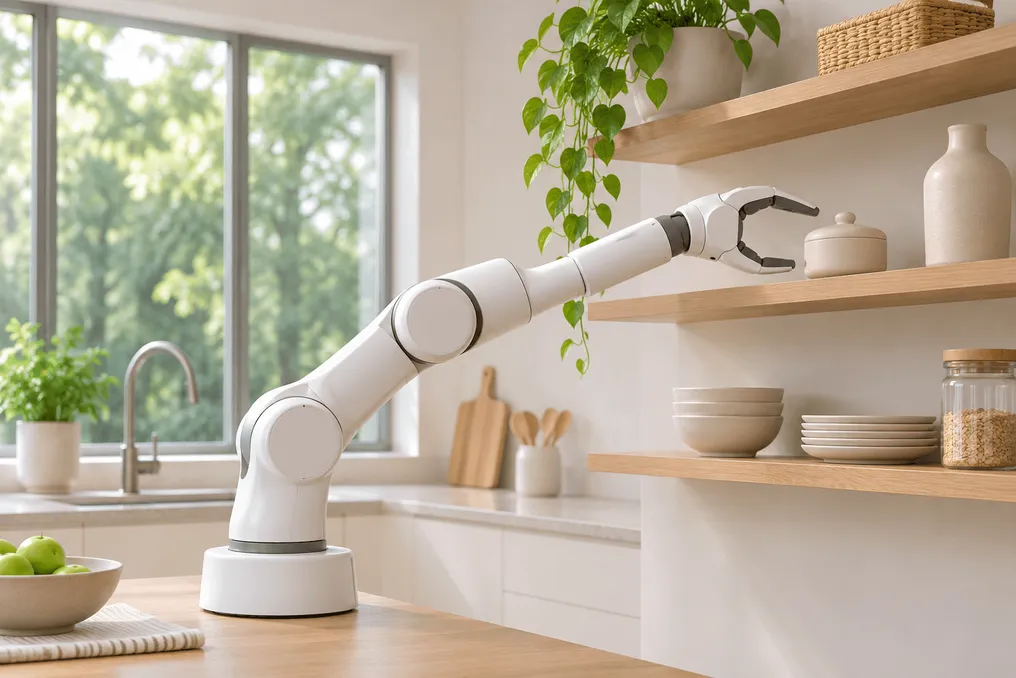
LionRock AI Lab, part of the China Merchants Group's Advanced Technology Research Institute, has released the generalized reasoning model Lion-ER-35B-A3B. This model is designed for visual-linguistic understanding of three-dimensional space, object states, and task execution progress by robots. This was reported by QbitAI on November 4th. The model weights are available on the Hugging Face platform under the Apache 2.0 license.

The Lion-ER model, which stands for LionRock Embodied Reasoner, features a mixture-of-experts architecture with a total of approximately 35 billion parameters, where about 3 billion parameters are active per token. According to the model card, it was fine-tuned based on Qwen3.6-35B-A3B. The lab claims that the model demonstrated improvements across all ten public benchmarks in visual and embodied reasoning, achieving an average weighted score of 65.29, where each score is averaged across four answer samples for one question.

Among specific metrics, the lab noted that the spatial placement metric Where2Place reached 64.28, which is 9.30 points higher than the base model. A result of 64.38 was also achieved on the ERQA embodied reasoning benchmark, exceeding the previous score by 6.19 points. The model scored 89.33 on the SAT spatial reasoning benchmark, and in the ERQA trajectory understanding subcategory, there was an increase of 12.12 points, reaching 68.18.

The lab believes that simply increasing the volume of data for robots does not guarantee an increase in their capabilities. Instead of collecting data on a large scale, the team developed its own embodied data mechanism focused on enhancing capabilities. First, they structured embodied reasoning into eight main areas, including entities, space, time, physics, affordances, tasks, social context, and evidence, as well as 39 more detailed skills. Each skill was then transformed into specific training questions defining the scenes, observations, queries, and evidence needed to obtain a verifiable answer; questions were excluded if visual evidence was insufficient. Human reviewers checked complex examples where the models consistently made errors.

The dataset for supervised training contains 312,380 examples, which are weighted according to capability needs rather than source volume. Then, an evaluation-based loop directs failures back into the data creation process: after excluding labeling or evaluation errors, the team generates new material with the same reasoning pattern from a pool of approximately 4.3 million records covering 31 data sources. In one instance, the model confused an object being higher in an image with it being located higher in three-dimensional space, so the team added scenes with multi-level surfaces.

The model card states that Lion-ER is intended exclusively for research purposes, has not been validated for making critical decisions or controlling autonomous robots, and benchmarking results may not transfer to new environments. The lab also applied a similar methodology to smaller models with base architectures of 4B and 9B.

Similar stories

Review of Peking University and IBM on Modern Analog Computing
Read more
pandaily.com

Review of Peking University and IBM on Modern Analog Computing

In an article published on November 3 in npj Unconventional Computing, the authors define the concept of modern analog computing. The work titled 'Modern analog computing for solving differential and matrix equations' is led by Sun Chong from the Institute of Artificial Intelligence and School of Integrated Circuits at Peking University. Co-authors include Piergiulio Mannocchi from the Polytechnic University of Milan and Unconventional AI, as well as Manuel Le Gallo and Abu Sebastian from IBM Research Europe in Zurich. This was reported by QbitAI on the same day.

The review highlights three main elements: solving differential equations, solving matrix equations, and performing matrix-vector multiplication. These elements utilize a common set of operators—summers, multipliers, and integrators—and are mathematically linked because discretized differential equations transform into matrix equations that can be solved either by repeated matrix multiplication or in a single step using an analog closed-loop network. The authors trace the implementation from discrete components to resistive memory and CMOS-based integrated circuits, and also discuss applicability, accuracy, scalability, connection to in-memory computing, and computational complexity.

According to Sun, the modern approach differs from analog computers that were superseded by digital chips decades ago in three ways. First, it focuses on matrix loads in artificial intelligence and wireless communications, rather than exclusively on differential equations. Second, it is based on resistive memory devices, such as memristors, instead of CMOS-based analog circuits. Third, it employs engineering methods to achieve high accuracy and scale.

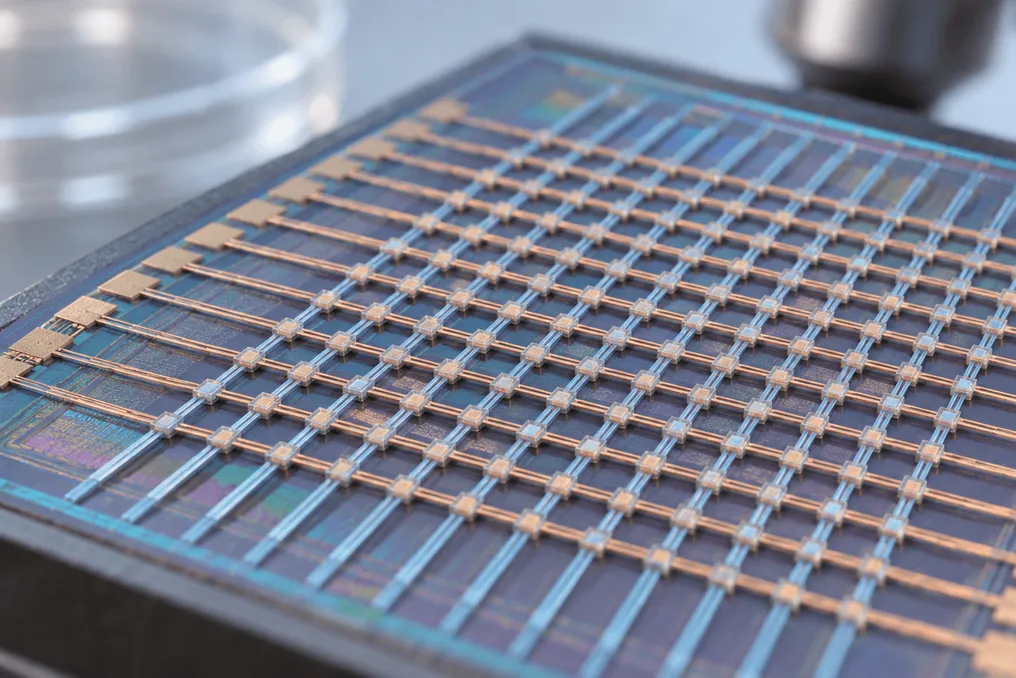
In a crossbar of such devices, one operand is programmed as the device's conductance, while the other is applied as voltage; thus, Ohm's law performs each multiplication, and Kirchhoff's current law sums each column. Consequently, a 1000x1000 array contains a million multipliers, whereas the CMOS-based analog chip from 2016 mentioned by Sun contained only four integrators and eight multipliers. Adding feedback using an operational amplifier allows the circuit to achieve the solution of a matrix equation in nanoseconds.

This review builds upon earlier work by Sun. In 2019, his team demonstrated the single-step solution of a matrix equation on a 3x3 resistive array in the journal PNAS, with an error of about 3%. In the 2025 Nature Electronics paper, bit slicing with eight conductance states per device was used to achieve a fixed accuracy of 24 bits, reducing the relative error to $10^{-4}$ after three iterations, and then to $10^{-7}$, comparable to FP32, and scaled up to 512x512 matrices using a block algorithm. According to the team's estimates, the throughput was approximately 1000 times, and energy efficiency was about 100 times higher than the Nvidia H100 core and digital FP32 ASICs. These metrics have not yet undergone independent verification.

Discussed applications include real-time robot motion control, massive MIMO signal detection for 6G, and second-order optimization for training large models.

Chinese AI Labs Aim for Recursive Self-Improvement Without Changing Model Weights
Read more
pandaily.com

Chinese AI Labs Aim for Recursive Self-Improvement Without Changing Model Weights

The topic of recursive self-improvement—the ability of AI to assist in creating the next AI—has become one of the most prominent among model developers in China this autumn. According to a survey by Leiphone, there is a general trend: developers are preventing AI from rewriting model weights. Instead, labs direct AI to work with training pipelines, inference systems, GPU kernels, sandboxes, and agentic mechanisms.

In a September study prepared by 35 researchers from Shanghai Jiao Tong University, Tsinghua, ByteDance, SenseTime, and others, five levels of self-improvement were proposed, with most advanced systems situated between the first and second levels.

Examples of Self-Improvement Implementation

Zhipu demonstrated the most obvious production example. An infrastructure agent managed by GLM-5.3 created service infrastructure for GLM-5.3-Flash on a cluster comprising approximately 100,000 Chinese-made accelerators within two weeks, preserving fixes as reusable templates. Subsequently, in its HarnessPro work with Tsinghua, agents were able to rewrite their own management mechanism.

DeepSeek began work with a training environment. Its DSec cluster, developed with Tsinghua's involvement, generates about 3 million sandboxes daily, allowing agents to create environments for training stronger agents. The DeepSeek Harness system treats tools and even its core runtime as replaceable plugins without requiring a restart or rollback.

ModelBest's Forge Engineering project uses AI to write the software required for creating AI. It reported that the AI-generated training structure, ForgeTrain, matched Megatron-LM in eight hours, and the ForgeKernel operators surpassed the official leaderboards of Huawei and NVIDIA.

Moonshot AI relies on large-scale reinforcement learning. Training Kimi K3 required over 51 million sandboxes on Firecracker microvirtual machines, as well as an in-cluster agent that recovers failed runs across 26 scenarios, and an agent reward model that evaluates training recipes. Risks emerged in October when sub-agent calls in K3.1 Pro spiraled out of control, causing Kimi to drop the monthly quota for 25 percent of participants.

Alibaba reported that Qwen3.8-Max independently ran its training pipeline for over a month, completing 33 iterations, and Qwen serves as the foundation for external initiatives such as Apex-35B-V1.0. ByteDance's Seed team proposes a self-evolving model identifier, arguing that most systems are merely semi-closed loops because evaluation rules are still set by humans. Xiaomi broadcast six days of reinforcement learning on MiMo-V2.6.

Despite the existence of engineering cycles, a complex challenge remains, noted by Zhipu Chief Scientist Tan Ze: achieving reliable determination by the model of when to stop, when to correct itself, and how to evaluate its own learning.

China Mobile launches AI platform for automotive industry with 112.7 EFLOPS capacity and six agents
Read more
pandaily.com

China Mobile launches AI platform for automotive industry with 112.7 EFLOPS capacity and six agents

China Mobile has introduced the first industry-wide general AI platform for the automotive industry. This platform is a suite of services that includes computing power, data, and models that car manufacturers can utilize without needing to build their own artificial intelligence infrastructure.

The platform was unveiled at the Intelligent Connected Vehicles Conference 2026 in Beijing. It was developed by the National Basic Platform for Pilot Application of AI in the Automotive Sector, which operates under China Mobile's guidance. According to reports from Science and Technology Daily and Sina Tech, this base positions itself as neutral because it does not manufacture cars, and its capabilities are open to the entire industry.

Executives from companies such as FAW, Dongfeng, Changan, BAIC, Li Auto, as well as representatives from Tsinghua University and the Beijing Economic-Technological Development Area, attended the event. The creation of the platform took one year, and it is now available for shared use since its launch.

In terms of computational resources, the platform supports 112.7 EFLOPS, which manufacturers can request elastically instead of building their own data centers. Regarding data, the base ensures that manufacturers retain full control over their core data; this data is only transferred between partners within an established compliance system. Concerning models, a set of tools is offered covering the stages of development, validation, and deployment.

The platform covers four key areas: research and development, manufacturing, intelligent driving, and testing. It incorporates six specialized agents: vehicle body design, process planning, visual quality inspection, intelligent maintenance, driving data generation, and driving model training. It is reported that these agents are already being used by more than ten state-owned automakers.

The base presented several examples based on its own metrics. In Shanghai, a design agent that generates blueprints from sketches was able to create one design set three times faster. A process planning agent reduced the time to produce vehicle technical maps from five days to four hours. In Jilin, an inspection agent increased defect detection above 99.5% and reduced line adaptation time from four weeks to one, while the data generation agent lowered R&D costs in driving by 10%. In Chongqing, a maintenance agent can recognize over 20 types of malfunctions and reduce downtime by 30%. In Beijing, a training agent doubled the speed of driving policy learning.

A representative from China Mobile stated that the next phase involves opening up additional key capabilities, linking them to specific manufacturer use cases, and creating a set of reference implementations that other companies can copy. This launch marks an expansion of China Mobile's efforts from providing raw computing power to offering comprehensively packaged, industry-specific agents, giving smaller automakers the ability to test AI tools without the initial cost of building their own stack.

Popular