Ozone layer shows unexpected deterioration in 2026, but recovery trend persists
Read more
Olhar Digital
olhardigital.com.br

Ozone layer shows unexpected deterioration in 2026, but recovery trend persists

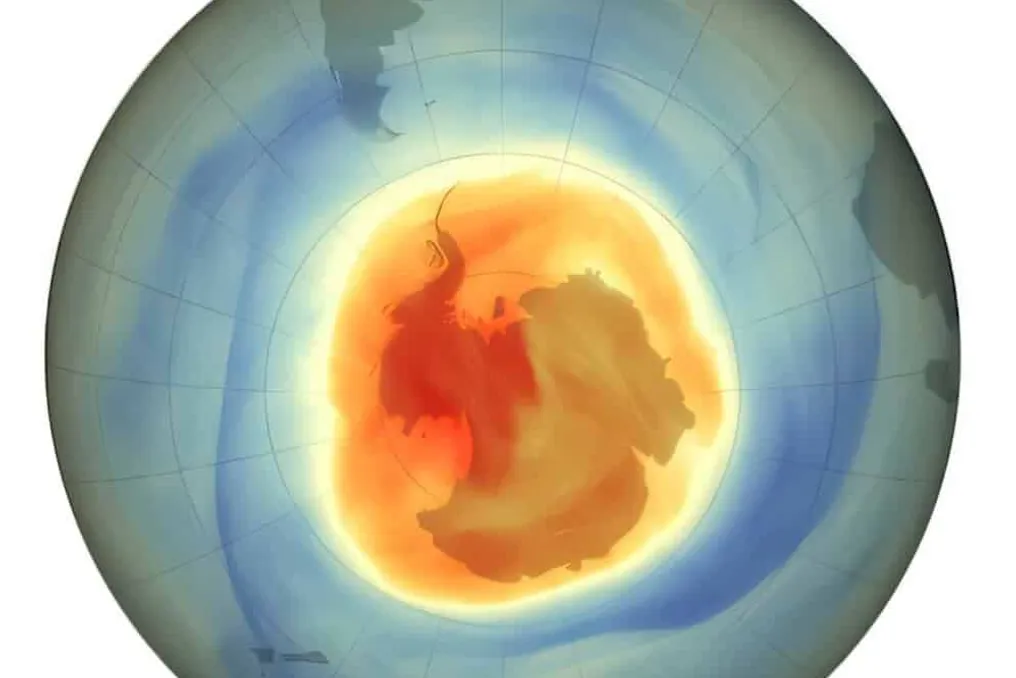
The ozone hole over Antarctica recorded one of the largest extensions in the last 48 years. Data released by the U.S. National Oceanic and Atmospheric Administration (NOAA) and NASA on Wednesday (4) indicates that this phenomenon reached its seventh largest average extent since monitoring began in 1979.

This increase was primarily driven by unusual weather conditions and a particularly intense polar vortex. During the period of greatest ozone degradation, which occurred between September 7 and October 13, the average area of the hole reached about 25 million square kilometers, more than double the territory of the United States.

Despite this significant size, experts state that the ozone layer is still on the path to recovery. The decrease in destructive chemical substances, resulting from international agreements, prevented the hole from reaching even larger dimensions.

The largest size recorded in 2026 was observed on September 18, when the hole reached approximately 27.1 million square kilometers. This dimension is equivalent to about 90% of the largest hole ever documented, which was seen on September 9, 2000.

Paul Newman, a scientist at the University of Maryland (USA) and former leader of the NASA ozone research team, commented to Phys.org that the late emergence of the phenomenon in recent years is a sign that the protective layer is recovering. However, in 2026, an exceptionally strong polar vortex prolonged the ozone destruction in Antarctica, allowing the hole to reach proportions unseen in a decade.

Even with the elevated extent, the 2026 hole did not show a level of destructive intensity comparable to previous record years. Paul Newman calculated that if the concentration of ozone-destroying substances in the atmosphere remained at the peak levels of 2000, the hole could have been between 3.5 and 5.6 million square kilometers larger.

This difference is attributed to global efforts to reduce the use of harmful ozone-depleting compounds. One pillar of this policy is the Montreal Protocol, an agreement signed in 1987 that committed to replacing substances like chlorofluorocarbons (CFCs) with less harmful alternatives.

According to Stephen Montzka, a NOAA researcher, the concentration of chlorine in the Antarctic stratosphere from these substances has dropped by about a third since the maximum levels recorded in the 1980s.

Monitoring the ozone layer involves direct atmospheric measurements and satellite observations. In Antarctica, NOAA researchers use instruments carried by meteorological balloons to measure gas concentration at various altitudes, in addition to employing a Dobson ozone spectrophotometer.

In 2026, measurements over the South Pole indicated that ozone concentration reached its lowest annual level on October 17, recording 105 Dobson units. This unit is used to quantify the amount of ozone in an atmospheric column; one hundred Dobson units correspond to a gas layer with approximately one millimeter of thickness, if all the ozone were compressed under standard temperature and pressure conditions.

The lowest value ever recorded over the South Pole was 92 Dobson units, in October 2006. Satellites are also crucial for tracking changes since 1979, including instruments aboard NASA's Aura, NOAA-20, and NOAA-21 satellites, as well as the Suomi NPP, operated jointly by the two agencies.

Despite the growth in 2026, NOAA and NASA assess that the long-term trend remains positive. The chemicals responsible for ozone destruction can remain in the atmosphere for several decades, and some of them continue to be slowly released by old equipment, landfills, and materials that still contain them. For this reason, complete recovery does not occur immediately after emission reductions, and the agencies estimate that the ozone layer should recover by the 2070s.

The 2026 result demonstrates that natural atmospheric conditions can still cause large annual variations, but it also underscores the relevance of international agreements: without the reduction of destructive substances, this year's hole would have been considerably larger.
Similar stories

Earth may suffer irreversible damage even if global warming decreases
Read more
olhardigital.com.br

Earth may suffer irreversible damage even if global warming decreases

The possibility of causing irreversible damage to the Earth remains even if global warming decreases. Exceeding the temporary threshold of 1.5 °C for global warming can lead to irreversible ice loss and accelerated sea-level rise, even if temperatures subsequently begin to fall.

This warning is contained in a new report prepared by the International Cryosphere Climate Initiative (ICCI) in coordination with the United Nations Environment Programme (UNEP), which was published on Tuesday (2).

The document, titled 'Overshoot and the Cryosphere: Averting Global Meltdown,' includes contributions from over 80 scientists specializing in polar and mountain regions.

The study analyzes the risks of so-called 'overshoot'—a scenario where the average global temperature exceeds the 1.5 °C limit set by the Paris Agreement and then returns to lower values.

According to researchers, the duration and intensity of this period determine the scale of the damage. Even if the planet can return to lower temperatures, some consequences for glaciers, ice sheets, permafrost, and polar oceans may persist for centuries or even millennia.

Another important point noted in the study is that the 1.5 °C threshold is not necessarily a safe condition for all frozen regions of the planet. Scientists believe that a warming level closer to 1 °C or even lower would be more suitable for preserving large ice masses over the coming centuries.

This distinction is significant because some melting processes show a very slow response to temperature changes. Even after a decrease in global warming, glaciers and ice sheets may continue to lose mass due to previously accumulated changes.

The problem is not limited to ice-covered areas. Warming and acidification of polar oceans can also cause long-term changes in marine ecosystems and in major ocean currents that help regulate global climate.

Furthermore, the thawing of permafrost—soil that remains frozen for long periods—can release greenhouse gases stored in the ground, thereby intensifying global warming itself.

Although the greatest ice loss is concentrated in polar regions, its consequences can affect distant countries, including Brazil. Sea-level rise increases the vulnerability of coastal cities to flooding, beach erosion, and infrastructure damage. It also contributes to the intrusion of saltwater into aquifers and agricultural lands near the coast.

Brazil's National Climate Change Adaptation Plan, submitted to the UN Framework Convention on Climate Change, already identifies sea-level rise as a risk factor for the Brazilian coast.

In such a scenario, communities living in low-lying areas may face growing difficulties in protecting housing, economic activities, and water sources.

Given these risks, the authors call for an accelerated reduction in greenhouse gas emissions to limit both the intensity and duration of any overshoot of the 1.5°C threshold.

The recommendation is to reduce emissions by at least 5% annually starting now and achieve net-zero emissions by mid-century.

The report also emphasizes the need for a gradual phase-out of fossil fuels and an expansion of renewable energy use.

Although some losses are already inevitable, scientists argue that it is still possible to avoid the worst-case scenarios. A faster reduction in warming can slow glacial melt, limit permafrost thaw, and, under certain conditions, allow for partial recovery of icy and snowy areas.

The central message of the document is that every additional fraction of a degree matters. Even if humanity manages to lower the temperature after exceeding the Paris Agreement limit, not all the damage caused during that period can be undone.

UN alerts: Greenhouse gases reach record levels, intensifying global warming in 2025
Read more
g1.globo.com

UN alerts: Greenhouse gases reach record levels, intensifying global warming in 2025

Atmospheric concentrations of greenhouse gases registered new peaks in 2025, increasing heat retention on the planet and accelerating global warming, according to a recent report from the World Meteorological Organization (WMO) released on Tuesday, the 27th.

The United Nations (UN) agency reported that the global average of carbon dioxide (CO2), the main gas associated with human-induced warming, reached 426.8 parts per million (ppm) in 2025. This value corresponds to 153% of the level existing in the pre-industrial era of 1750. In practical terms, this means that about 427 air molecules out of a million are composed of carbon dioxide.

This data also signals a 53% increase compared to the period before industrialization. Although the increase in CO2 compared to 2024 was only 2.8 ppm, the total volume remains higher than the average observed in recent decades. The WMO points out that the rate of CO2 growth in the atmosphere has tripled since the 1960s; during that period, the average increase was 0.8 ppm annually, rising to 2.4 ppm between 2011 and 2020.

Since the agency began publishing its annual greenhouse gas bulletin in 2004, the global average concentration of CO2 was 377.5 ppm.

Ko Barrett, WMO Deputy Secretary-General, commented that 'another year, another new record. Greenhouse gases are retaining an unprecedented amount of heat in the atmosphere, providing energy for more extreme weather phenomena and increasing risks to our economies and societies.' She added that 'the last 11 years have been the hottest ever recorded, and this trend is expected to continue. CO2 remains in the atmosphere for a long time, and therefore, it will affect the global climate not just for years, but for decades and even centuries.'

The report also highlighted that methane (CH4) and nitrous oxide (N2O), two other long-lived greenhouse gases, also reached unprecedented levels.

In 2025, methane registered a global average of 1,948 parts per billion (ppb), which is equivalent to 267% of the pre-industrial level, representing a 167% increase compared to 1750. About 65% of these emissions come from human activities, such as livestock farming, rice cultivation, fossil fuel extraction, landfills, and vegetation burning, while the remaining 35% are of natural origin, such as wetlands.

Regarding nitrous oxide, the third long-lived greenhouse gas, it reached an average of 339.1 ppb in 2025, corresponding to 126% of the 1750 level, or 26% above the record from that period. This gas is released by both natural processes and human interventions, mainly due to the use of agricultural fertilizers, vegetation burning, and certain industrial processes.

The WMO emphasizes that the constant increase in these concentrations implies that the atmosphere is accumulating more and more heat. Data from the U.S. National Oceanic and Atmospheric Administration (NOAA) indicates that between 1990 and 2025, the warming impact generated by these long-lived gases grew by 56%, with CO2 being responsible for approximately 81% of this increase.

The agency clarifies that the figures presented reflect the total amount of gases accumulated in the atmosphere, not just the volume emitted in the last year. The UN warns that events such as extreme heatwaves, droughts, and severe floods have impacted millions of people and generated billions of dollars in losses just this year.

This happens because approximately half of the CO2 released annually remains in the atmosphere, while the rest is absorbed by the oceans and terrestrial ecosystems, such as forests. However, the capacity of these environments to remove carbon from the air can vary depending on climatic conditions.

According to the WMO, the slower growth in CO2 concentration between 2024 and 2025 is due to the recovery of the carbon absorption capacity of terrestrial ecosystems and the decrease in emissions caused by forest fires. Oksana Tarasova, a WMO scientist, explained that 'the more moderate growth between 2024 and 2025 reflects the recovery of carbon absorption capacity by terrestrial ecosystems and the reduction in emissions caused by fires in 2025, after the strong El Niño of 2023 and 2024.'

Despite this slowdown in pace, the expert warns that the amount of carbon accumulated in the atmosphere continues to rise. She stated that 'an annual increase of 2.8 ppm still represents a significant amount of carbon added to the atmosphere through the burning of fossil fuels.'

The WMO also projects that CO2 concentrations will continue to rise in 2026, driven by the use of fossil fuels and the possibility of an intense El Niño, which could again compromise the vegetation's carbon absorption capacity. Furthermore, the agency warns that climate change may decrease the oceans' ability to absorb CO2, resulting in a larger proportion of emissions remaining in the atmosphere.

Greenhouse gas emissions hit new record in 2025, warns World Meteorological Organization
Read more
noticiasaominuto.com

Greenhouse gas emissions hit new record in 2025, warns World Meteorological Organization

The World Meteorological Organization (WMO) warned that greenhouse gas levels reached a new record last year, implying a hotter future for the planet. This scenario is reinforced by a new report released by the organization.

According to the report, concentrations of carbon dioxide (CO2) and other crucial gases reached unprecedented levels in 2025, consolidating a more significant long-term increase in global temperature.

Last year, the global average surface CO2 concentration was 426.8 parts per million, representing 153% of the reference level established before the industrial era in 1750. Furthermore, concentrations of methane and nitrous oxide, considered the second and third most relevant long-lived greenhouse gases linked to human activities, also registered new highs.

The world's average methane concentration stood at 1,948 parts per million (which corresponds to 267% of the 1750 level), while nitrous oxide exceeded the level recorded at that time by 126%.

Methane contributes approximately 16% of the climate warming caused by long-lived greenhouse gases, although it has a considerably shorter lifespan than CO2. The organization detailed that about 35% of methane is released from natural sources, such as wetlands, which are vulnerable to climate change, and almost 65% comes from anthropogenic sources, including livestock, rice cultivation, fossil fuel extraction, landfills, and biomass burning.

Nitrous oxide, being the third most important long-lived greenhouse gas, originates from both natural sources and human activities, such as fertilizer use, industrial processes, and biomass burning.

Ko Barrettt, Deputy Secretary-General of the WMO, warned in a statement that 'another year, another new record. Greenhouse gases are trapping an unprecedented amount of heat in the atmosphere, providing energy for more extreme weather phenomena and associated risks to our economies and societies.'

The same source indicated that the last eleven years have been the hottest ever documented and that this trend is expected to persist. The WMO official emphasized that, given the long residence time of CO2, it will continue to influence the global climate not only for years, but for decades and even centuries.

Popular