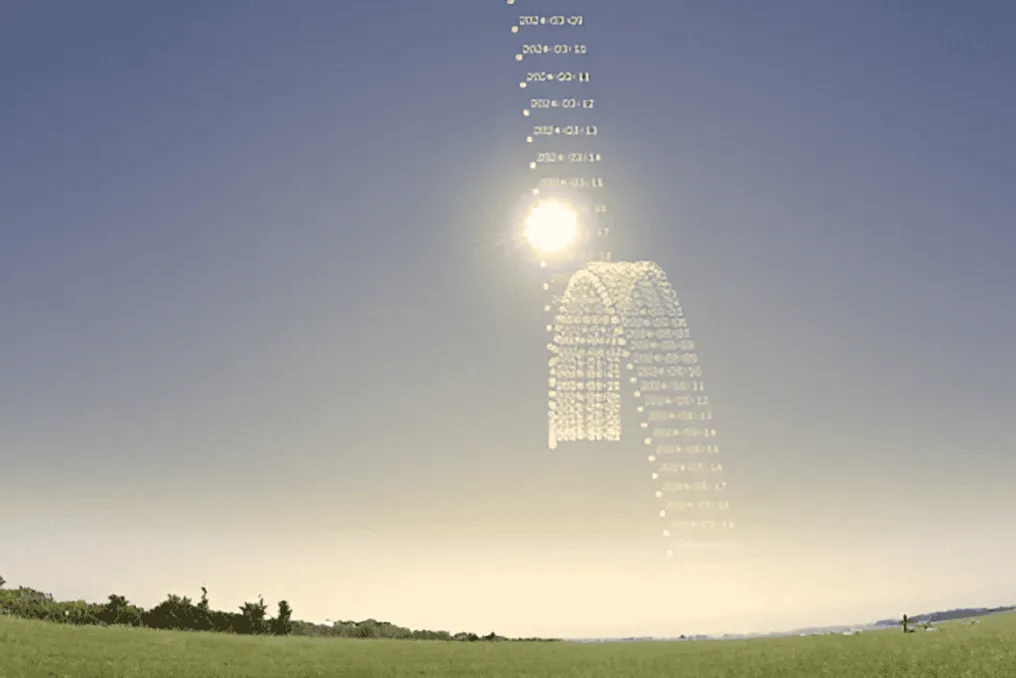
On Wednesday (4th), at 11:20 AM Brasília time, Mercury began a phase termed by astronomers as 'inferior solar conjunction.' During this event, the planet passed between the Earth and the Sun, approaching approximately 0.674 astronomical units (AU), which corresponds to about 100.8 million kilometers.
According to information from the astronomical observation guide In-The-Sky.org, this conjunction occurs once every synodic cycle of the planet, which is the time required for Mercury to return to the same position relative to the Sun when viewed from Earth; this cycle lasts 116 days.
At the moment of the inferior solar conjunction, Mercury was located only 0°22' (zero degrees and twenty-two arcminutes) from the Sun. This extreme proximity causes the bright light of the main star to obscure the planet, which had already made its observation challenging in previous days. This phase represents Mercury's 'disappearance' in the night sky and its subsequent movement to become a morning object in the coming weeks.
The unit 'arcminutes' is used in astronomy to measure very small angles in the firmament. Considering that a full arc has 360°, 60 arcminutes equal one degree, meaning the apparent distance between Mercury and the Sun will be slightly more than one-third of that value.
Simultaneously with reaching inferior conjunction with the Sun, Mercury also reaches perihelion, which is the point closest to Earth, reaching a distance of 0.67 AU from us. This implies that the smallest planet in the Solar System will be only 100.2 million kilometers from Earth.
Regarding when it can be seen again, Marcelo Zurita, president of the Paraíba Astronomy Association (APA), member of the Brazilian Astronomical Society (SAB), technical director of the Brazilian Meteor Observation Network (BRAMON), and columnist for Olhar Digital, informed that Mercury will become visible again on the eastern horizon, shortly before dawn, around November 20th, when it will be further away from the star in the sky.
Additionally, an article published in the scientific journal Icarus mentions the possibility that fragments of Mercury have been found on Earth. Meteorites analyzed by British scientists exhibit characteristics suggesting a probable origin on this planet closest to the Sun. If this hypothesis is confirmed, it would constitute the first record of Mercurian rocks on terrestrial soil, providing a valuable opportunity for study.